

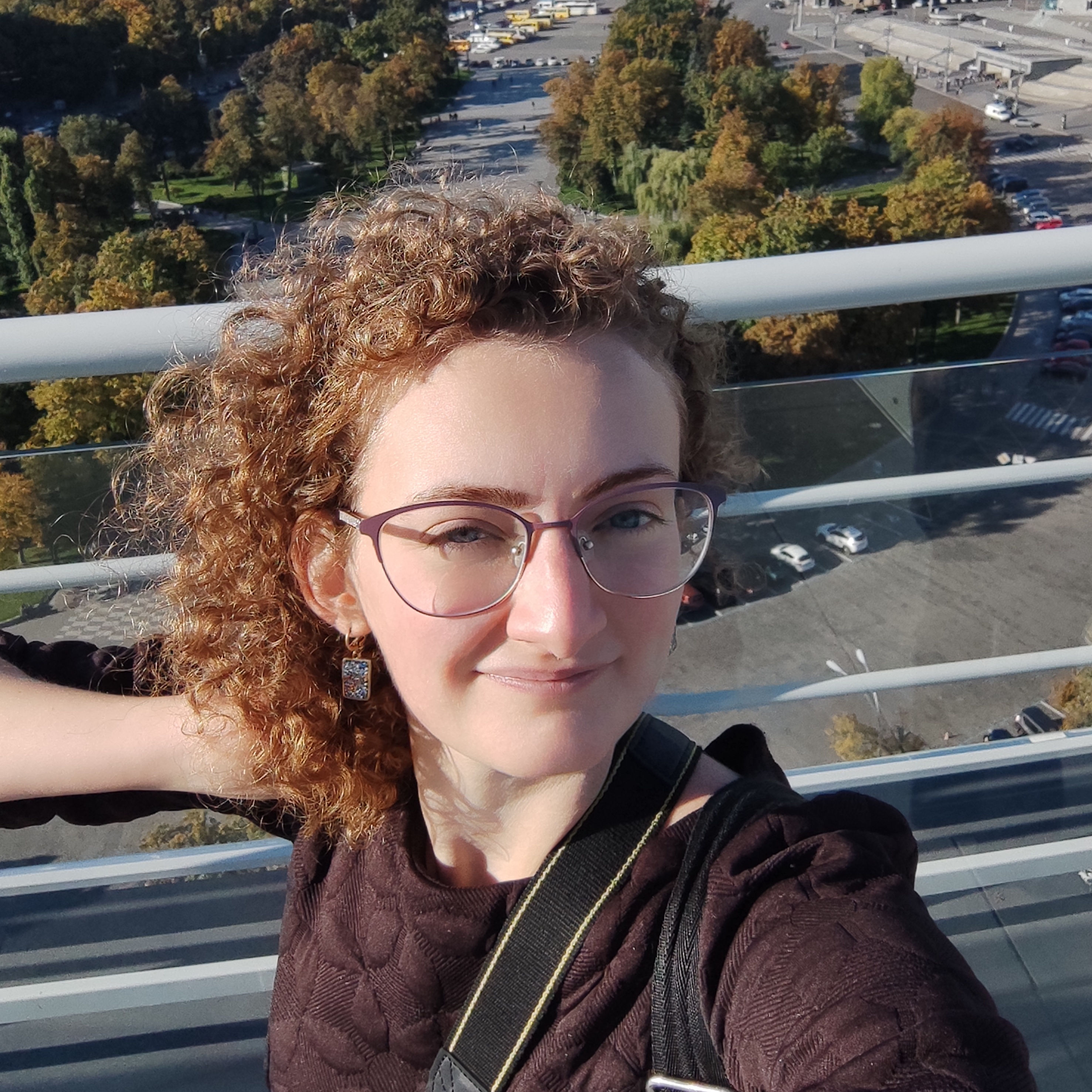
Veronika crossed the border into Poland, as a refugee, on March 4th, 2022—eight days after the Russian invasion. Today, she works three jobs as an educational administrator, a cleaner, and holds a grant-funded, part-time role as a playback theater trainer. She also organizes theater activities and is a member of a refugee writing circle in Krakow.
Veronika, 26, was born in Kharkiv, Ukraine, in northeast Ukraine. Kharkiv, founded in 1654 as a fortress, expanded its industrial base over the centuries and is now Ukraine’s second largest city. Vladimir Putin’s assault on Ukraine has deeply impacted this city where intense shelling forced many residents to flee.
Veronika earned a BA in Art History at Kharkiv State Academy of Design and Art. She is a professional practitioner of Playback Theater. She was a member of a Playback Theater troupe in Kharkiv. Playback Theater is a branch of improvisational theater where audience members tell stories from life experiences and watch them re-enacted, in the moment. Playback theater offers both entertainment and therapeutic value.
Russia began assembling forces at the Ukrainian border in March 2021. They enacted a partial withdrawal in June 2021 followed by a menacing surge to an estimated 100,000 soldiers by December 2021.
“When Russians soldiers first started gathering at the border, we thought, maybe, nothing would happen,” Veronika said. “As the build-up continued, particularly in December and January, we were warned that something was going to happen. Many Ukrainians with resources began renting homes in western Ukraine or left the country. I lived with my mother and grandmother in an apartment building. I wondered if there was something I should do.”
“I spoke with my cousin in Poland on February 23rd via Telegram and he asked if everything was OK,” Veronika said. “On February 24th, I was awakened by the sounds of artillery fire at 4:00 a.m. We had close family in Debica, Poland (near Krakow) who moved there five years ago. They told us, ‘If something happens, you can come to us; you can always return to Ukraine.’ I understood, from this moment, that I had to do something.”
“We decided to leave for Poland and began assembling our personal documents,” Veronika said. “My grandmother was hesitant to leave; she said, ‘Everything will be OK.’ My mother, like many Ukrainians, had already packed a “To Go” bag containing food, documents, flashlights, medicine, etc. We had little information on what to do. I called my father, a truck driver, who was in Dnipro. He said, ‘Everything will be OK; just wait.’ Still, we decided the safest course was to leave.”
Veronika’s family gathered in their apartment for departure—her mother, her grandmother, her godmother, and her godmother’s husband who owned a car. They ate their final meal in the apartment—potatoes, meat, and vegetables. Veronika, weighing the importance of the moment, took a photo of that last supper. They sensed danger closing in. They left the apartment, abandoning dishes in the sink.
“We left in haste, not knowing what we would experience on the roads,” Veronika said. “We didn’t know if we would encounter mines or tanks. I was afraid. I grabbed my cat and my belongings and we left in my godfather’s car. It was very cold; roads were covered in ice and snow. We drove to a village about 100 km away where my mother’s godparents live. It was still early in the war. What we saw en route appeared surprisingly ‘normal’—people were outside, walking, seemingly running errands in the bitter cold.”
Looking back, Veronika remembered a sense of relief that they chose to leave. She feared that, had they stayed, a rocket might fall on their home. A lot of her friends, including those from her theater group, chose to stay in those early days of the war. Some chose to leave a few weeks later. Meeting online, her friends spoke of the terror unleashed by Russian planes and rockets. When air road sirens went off, people only had seconds to react. This is why many chose to live in the Kharkiv Metro or in basements. People lived in the dark, dank and cold, without bathrooms, emerging to go to their apartments to get food. Homes were devastated by aerial bombing. Some of Veronika’s friends lived this way for two to three months. People who left later were often subjected to visual carnage on their journeys west.
Kharkiv Mayor, Ihor Oleksandrovych Terekhov (elected November 11, 2021), arranged evacuations for residents to a sanatorium in a safer region. Buses were organized. A major volunteer effort was launched to help move people, particularly the elderly. Some elderly, due to limited mobility or personal choice, had remained in upper floor apartments. Stranded, without water, volunteers had been carrying water to them.
“Our journey to Poland was very difficult,” Veronika said. “My godmother, with whom we traveled by car from Kharkiv, decided she would not escape to Poland; she did not want to leave family behind. I needed to arrange for my mother, grandmother and myself to leave Ukraine. Ours was a complicated path. We waited for hours in a shelter in Poltava, guarded by soldiers, for an evacuation train to Tarnopol. There were so many people—elderly and infirmed people, mothers with children and so many pets. Trains were packed very tightly. In our case, we were forced to leave personal belongings behind. Although some refugees managed to escape with suitcases, our particular train was so full that each passenger was only allowed to carry ONE backpack. It was stressful and scary as we waited and began boarding a train where all seats were taken. Adults, children and animals were sitting on floors and between doors. The train traveled slowly; we stood for thirteen hours. All the while, I feared an attack could happen.”
Arriving in Tarnopol, Veronika and her family were taken in by one of her mother’s colleagues. She describes them as very kind people who welcomed them at 3:00 a.m. in a city under curfew. They fed them and allowed them to bathe and rest before they undertook the remainder of their journey.
“Our final trek to the Polish border involved four different cars,” Veronika said, “three driven by volunteers and one very expensive taxi. We kept in touch via phone with my aunt in Debica so they could meet us at the border. It was very stressful on the Ukrainian side. The Ukrainian border guards were under pressure and could be gruff as exhausted people asked, ‘Why must we wait so long?’ That was the worst. I saw very old people, small children who were crying, and pregnant women with nowhere to sit. We stood for eight hours in line before entering Poland. It was very cold but, at least, it wasn’t snowing or raining.”
“We crossed into Poland on foot in the middle of the night on March 4th,” Veronika said. “I suddenly realized that I understood Polish! The mood was very different on the Polish side. There were so many volunteers offering warm drinks, food and clothing. There were tents set up to access services. We were too tired to eat. Oleksander, my uncle, was already there with his car. He had waited for us for seven hours. We were smelly, dirty and exhausted as we piled into his car for the three-hour drive to Debica. He had food in his car for us and used his iPhone to navigate as we drove in darkness. I remembered it was snowing and thinking it was pretty.”
Oleksander and his family lived in a small apartment building in Debica. He would make five trips, overall, to the border to pick up family and friends fleeing the invasion. Their small apartment became a haven with people arriving at different times of the day and night, with many stopping to rest and bathe before moving further west.
“I watched my aunt and realized she was so very tired,” Veronika said. “I felt I needed to decide quickly whether to leave or stay in Poland. We spent two weeks living with our family. We were nervous about living in a new place and having to learn a new language. My mother worked as a nurse for a large medical firm and they arranged housing for us for six months in Krakow. My mother’s workplace in Kharkiv was destroyed; she now works as a housekeeper. She submitted all of her nursing credentials for review to Warsaw and hopes to resume practicing as a nurse in Poland. It’s been taking time; we await the outcome.”
When asked about what she brought with her, Veronika paused. She explained she is not a person who places great value on material things. She sees herself as being a “practical” person. She didn’t have a lot of money and was not one drawn to expensive items.. She brought food, warm clothes (e.g., socks), documents, her laptop and a small light in case she got stuck in a poorly lit shelter. Friends in Ukraine would, later, mail photos, her camera and some handmade jewelry, pieces of immense sentimental—not monetary–-value.
“I have learned many things about myself from this experience,” Veronika said. “I thought the war would change me, but it did not. Even with the stress of being a refugee, I continue to do the things I loved doing at home. When not working, I take photos and enjoy walks. I visit libraries and museums. My mother and I share a very small studio apartment; my grandmother lives in Debica. I wish I could earn enough money to live independently. My playback theater troupe remains very important to me. We are doing things online and have performed in Poland and Lithuania since the war started.”
Veronika is grateful to be in Poland. She feels welcomed and very comfortable. The language and culture feel familiar. Krakow reminds her of Kharkiv. She misses certain people in Kharkiv, but not the city specifically. She does not plan to return to Ukraine.
“I lived in the same apartment my whole life.,” Veronika said. “My dream is to see the larger world. This is my opportunity. My city is devastated; my home was bombed. Many of my theater friends left Ukraine and are scattered across different countries. I don’t have concrete plans, but I have dreamed of doing theater in England, Ireland or Scotland. Being farther away, geographically, from Ukraine feels safer but it’s not really clear what place is truly safe. I met with a psychologist as I adapted to life in Poland. I was crying a lot. I’ve been away from Ukraine for eight months. This war has left its mark on me. Rebuilding Ukraine will take a lot of time. It’s not just the buildings and infrastructure. People lost the businesses and schools around which communities were built. People lost family members.”
Veronika wants readers to understand that Ukrainians are strong, hard-working, creative people. Many are volunteering—inside and outside of Ukraine—to help soldiers and vulnerable residents unable to leave their country amid Russian occupation. Most Ukrainians in Poland work two “jobs”, one to earn money to live and the other to support the war effort against Putin’s invasion.
“One of my goals is to further develop playback theater,” Veronika said. “Playback was a very vibrant art form in Ukraine with multiple troupes and theaters. Playback helps people connect and feel better together. So many of us who came to Poland (as refugees) lost our careers, our homes, our communities—which were part of our identities.”
Veronika explained that many of the Ukrainian women want to be able to work in their careers once their housing is stable and their children settle into school. Language and credentialing requirements present barriers.
“Everyone lives in a certain moment,” Veronika said. “A neighbor, a fellow refugee, from Lviv, arrived a few months after me with her four children. My story is, perhaps, ‘lighter’ than others. Most Ukrainian refugees recognize the generosity they’ve received. I hope to use my skills and talents to perform humanitarian work that is good for me and also good for my neighbors.”
I invite you to follow Present Time at https://presenttime.blog
 Present Time
The “Putin’s invasion” comment is interesting. It’s a hopeful sign that Putin and not Russia is blamed for the war.
LikeLike