

Praying for Peace

I snagged a table at the Boulangerie du Theatre in Sete, a small French town on the Mediterranean.  As I waited for my husband, two Muslim women dressed in silky, black chadors, sat next to me with three small children. 

Bon jour,” one of the women said, offering me a gentle smile.  I returned her greeting and smiled at the little ones.  I noticed five glasses of orange juice and three plain croissants, for sharing, on her tray.  Tony and I sat reading, sharing a pain aux raisin while sipping our coffee and tea.  I overheard the women speaking what sounded like perfectly accented French.  This has been my experience of many Muslim women I’ve observed here in France:  they are linguistically integrated, yet sartorially distinct.

It’s been two weeks since Hamas’ heinous attack on Israel.  Tension hangs in the air.  France’s President Emmanuel Macron called up 7,000 soldiers to provide added security across the country.  There’s a sense of Muslims and non-Muslims tiptoeing around each other.  I can’t quite describe the feeling.  How does one be supportive of the the innocents—on both sides—amid perennial hurt in a region I understand so little about? 

President Macron’s government, sadly, reported a dramatic uptick in antisemitic acts since Hamas’ attack and Israel’s retaliatory bombing of Gaza.  I’ve read about menacing graffiti and child-on-child verbal and, in a least one case, physical aggression in French schools.  Ten thousand French police are actively guarding Jewish sites across the country, including schools and synagogues. 

Six days after the Hamas attack, Dominique Bernard, a literature teacher, husband, and father of three daughters, was stabbed in the parking lot of his school in Arras, in northern France.  The alleged perpetrator, a former student of the school, was a Muslim immigrant from the Russian region of Inushetia.  Banners were hung on the Montpellier Opera House with Bernard’s image  and that of Samuel Paty, another teacher who was murdered in October of 2020 by a Chechen Muslim refugee. The banners read:  Hommage aux victims du fanatisme islamiste.  Montpellier soutient le professeurs de la Republique.  Translation:  Tribute to the victims of Islamist fanaticism.  Montpellier supports the teachers of the Republic.

President Macron forbade pro-Palestinian protests while allowing pro-Israel demonstrations.  Palestinian supporters defied the ban when several thousand protesters gathered in Paris on Sunday, October 15th ; they were dispersed by police with tear gas.  There have been smaller Palestinian protests here in Montpellier where we are staying.  A court challenge reversed the ban and a large pro-Palestinian protest occurred in Paris on October 19th, followed by smaller protests on October 21st in Montpellier, Nimes and other French cities.

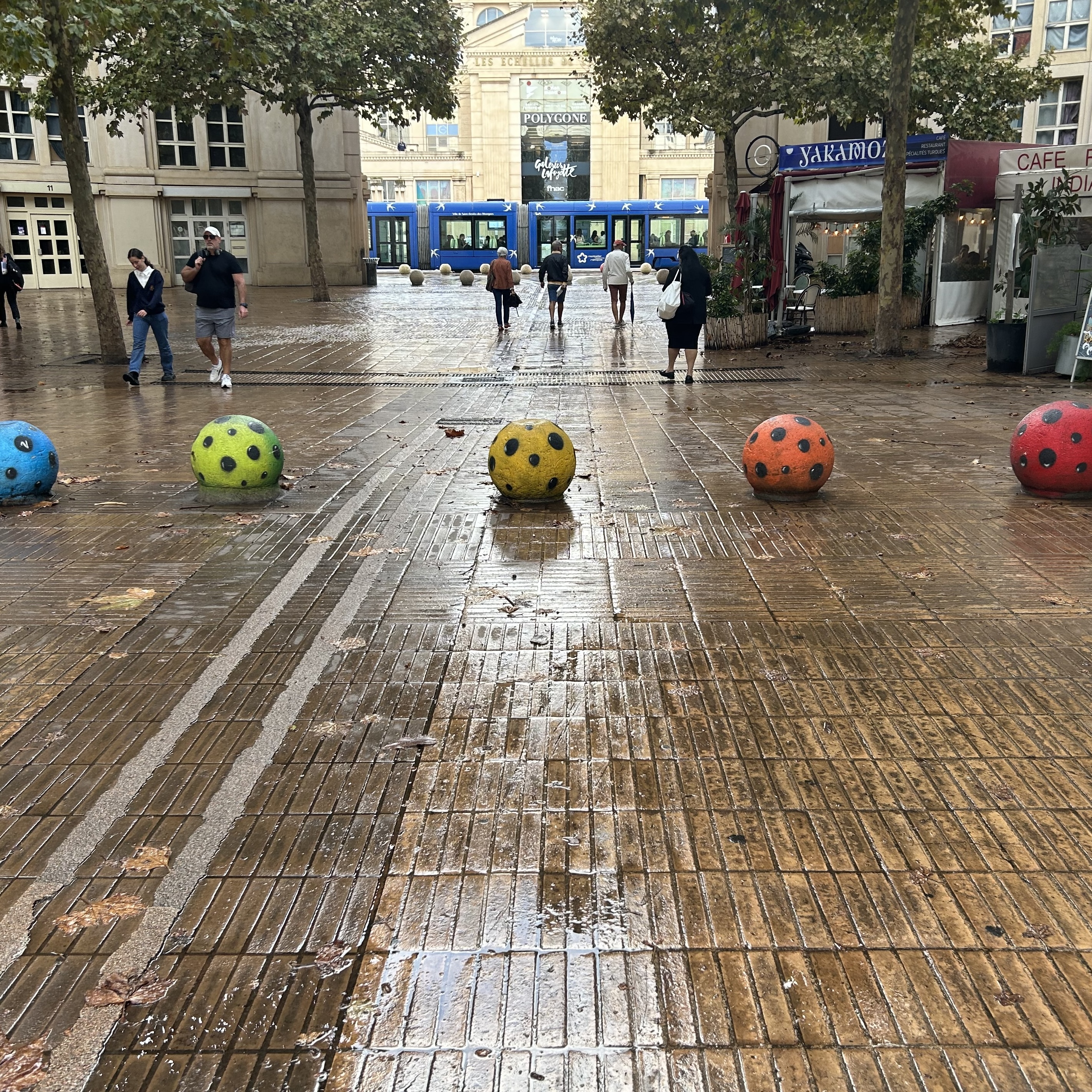
Reminders of France’s all-to-frequent terrorist attacks are built into the physical infrastructure of French cities.  Montpellier’s main pedestrian square, Place de la Comedie, is surrounded by painted K-rails to prevent vehicular assaults.  Sidewalks and entries to plazas are embedded with steel posts; granite stanchions; and, with an eye towards a bit of whimsy, painted concrete “balls.”  If you look closely, you see cut marks from when these protective measures were added to original design features.  Squads of heavily armed soldiers patrol parks, sidewalks, and shopping areas with their assault rifles at the ready.  France’s experiences of terrorism, including the 2015 Bataclan attack in Paris, 2016 truck ramming at a Bastille Day celebration in Nice, and 2018 mass shooting at the Strasbourg Christmas Fair are woven into the collective psyche of the French people.  And, lest you forget while sipping a café au lait at an outdoor café,  Vigipirate—an anti-terrorism security force vehicle may pass by, at a slow, watchful pace.

France is home to Europe’s largest Muslim population; Muslims represent approximately four percent of the population.  Women wearing hijabs and chadors are a common sight. France is also home to Europe’s largest Jewish population although their representation is much smaller, estimated at 0.67 percent of the population.  Preserving one’s culture while integrating into broader society, the latter being key to garnering social capital for oneself and one’s children, presents challenges.  Sadly, in France, all too often we learn of disaffected, disenfranchised Muslim youths who, feeling they have nothing to lose, are at risk of becoming radicalized.

Hamas’ brutal attack on Israeli citizens demands our attention and condemnation.  Hamas militants need to be brought to justice.  Innocent Palestinian civilians also deserve peace and security.  I remember travelling to New Zealand when President George W. Bush occupied the White House and engaged in military actions contrary to my political beliefs.  Some Kiwis were critical, assuming I supported the President when I did not.  I think of Jews who do NOT support Jewish settlements in the West Bank and Benjamin Netanyahu’s, right-wing, hawkish ways.  I think of Palestinians who do NOT support Hamas and who do NOT support the violence aimed at Israel. I think of Jews and Palestinians who simply want to live their lives in peace.  I worry about the death and destruction on all sides. 

I wonder how much of the Israeli-Palestinian conflict is about limited resources…limited water, limited land, limited agency.  It is so much easier to live peacefully when there is abundance.  Let us hope peaceful solutions can be found.

I invite you to follow my blog at https://presenttime.blog.

Sources:  https://www.jpr.org.uk/countries/how-many-jews-in-france, https://www.statista.com/statistics/868409/muslim-populations-in-european-countries/#:~:text=Approximately%205.72%20million%20Muslims%20were,million%20and%204.13%20million%20respectively.
https://www.lemonde.fr/en/france/article/2023/10/14/french-teacher-killed-in-arras-reignites-trauma-left-by-2020-murder_6174079_7.html

He did not choose war.  War caught up with him.  His photographs remain.

Note to Readers:  My heart is heavy as I think of current conflicts and suffering in our world.  If I had a magic wand, I would wave it and offer a healing incantation.  For now, I offer this story of war and remembering.

The family’s ancestral home near Barcelona was set to be demolished to make way for new construction.  Two red, cardboard boxes in the garage held a secret – five thousand, mostly unpublished, photos taken during the Spanish Civil War (1936-1939).  

Antoni Campana (1905-1989) documented scenes with his Leica Camera as his beloved Barcelona crumbled amid fighting between Republican (Loyalist) and Nationalist (Francoist) forces.  The Republicans, allied with the USSR, supported the democratically elected government of the Second Spanish Republic (1931-1939).  The Nationalists, allied with Germany and Italy, supported General Francisco Franco’s military junta that overthrew Spain’s democratically elected government.  

The Nationalists’ relentless bombing terrorized inhabitants and marked Barcelona as the first European city to experience indiscriminate attacks on civilian homes, hospitals, schools and shops.  This pattern of attacking civilians would continue into World War II.  An estimated 2,500 to 3,000 Barcelonans died amid 385 aerial attacks.

Campana’s images of children playing amid rubble, women waiting in line for bread, community feeding kitchens, and desperate and weary refugees from Malaga show the impact of war on everyday people.  He also documented the destruction of Roman Catholic churches alongside banners displaying handsome, “fatherly” images of Lenin and Stalin—reflecting the politics of anticlerical factions among the Republicans.  Campana’s photo of a young, pregnant, anarchist militia member named Anita Garbin (1915-1977) made her the “Madonna” of her movement, a revolutionary saint.  Franco’s forces prevailed and Anita became one among hundreds of thousands of Spaniards who escaped and lived in exile.  Campana was there to document Franco’s Victory Parade in Barcelona in February 1939.  German, Italian, and Moroccan soldiers—allies of the Nationalists—marched alongside Franco’s troops.

An estimated 500,000 Spanish soldiers and civilians, loyal to the Republican cause, fled to the border, to France, in the La Retirada (retreat).  Most were on foot.  This slow-moving mass of humanity—comprised of civilians and soldiers, some of whom were injured—were escaping Franco’s vengeance.  French authorities, unprepared for this massive influx, were hostile and suspicious of incoming refugees which included anarchists and communists.  

Families were separated at the border.  Women, children, the elderly, and the disabled were transferred to accommodation centers.  Men were sent to internment camps in Argeles-sur-Mer, St. Cyprien, and Le Barcares.  Surrounded by barbed wire and guarded by Senegalese troops, an estimated 60,000 Spanish men were held in humane conditions.  Robert Capa (1913-1954), the Hungarian photojournalist, documented detainees sleeping in holes they dug in the soil. Food was scarce.  Sanitation facilities were non-existent; 1,500 detainees died of dysentery.  

In a lesser-known aspect of history, French officials moved the male detainees to “concentration camps” in the South of France in Bram, Agde, Vernet, and Rivesaltes.  Germany invaded France in May 1940.  These Spanish prisoners would be joined by East European Jews and Romany. 

War continued in Europe.  Some detainees emigrated.  Some returned to Spain at risk of persecution, prison, or death.  The majority were conscripted into unpaid “Squads of Foreign Workers” or the French Foreign Legion.  Some were sent to the gas chambers at Mauthausen, caught up in the German deportations.  Others joined the French Resistance, contributing to France’s liberation on June 6, 1944.  They were finally granted status as “Political Refugees on March 15, 1945. 

Campana, a liberal, Roman Catholic and Catalan nationalist, captured images from varying sides during the Spanish Civil War.  He worked at the propaganda offices of the Catalan government and the Iberian Anarchist Federation.  He served in the air force of the Spanish Republic which opposed Franco.

Campana chose to remain in Spain when the war ended, despite personal risk. Franco’s government set out on a path of revenge, unleashing a massive purge campaign to weed out those who had been loyal to the Republic.  Franco’s extensive list of “enemies” included Republicans; liberals; socialists; Protestants; intellectuals; homosexuals; freemasons; Romany; Jews; and Basque, Catalan, Andalusian and Galician nationalists.  Thousands were expelled from the military and the civil service. Professorships at universities and teaching posts in schools were targeted.  One quarter of Spain’s school teachers lost their jobs.

Campana maintained a friendship with Jose Ortiz Echague, a photographer who had been a Francoist soldier.  Echague helped Campana find work amid the post-war, politically charged witch hunts.  Campana also took chances.  He bravely refused to comply with Franco’s order for photographers to surrender negatives and prints made during the war.  He kept them hidden, not wanting to put former Republicans at risk.

Campana pursued her career as a photographer and photo shop owner in the decades following the war.  He continued to keep the photos hidden, even after Franco’s death in 1975.  He expressed the wish that the photos not be exhibited.  His grandchildren discovered them when cleaning out the family home in 2018.  His family made the decision to share the photos publicly.

I wonder why Campana chose to keep the photos a secret—even after Franco’s death when it was safe to reveal them.  Was this about his own personal trauma and not wanting to revisit the pain of war?  Was it about protecting contemporary Spanish society from images of a deadly, divisive time in their history?

Campana could easily have destroyed the photos, but he chose to keep them.  I wonder if he intentionally “left” the photos in the garage, hoping his descendants would discover them with enough time and emotional distance to receive them as an honored and sacred message from the past.

To learn more and see some of Campana’s photos:  Antoni Campana exhibit at Pavillon Populaire, Montpellier, France:  https://www.montpellier.fr/506-les-expos-du-pavillon-populaire-a-montpellier.htm

I invite you to follow my blog at https://presenttime.blog.