I snagged a table at the Boulangerie du Theatre in Sete, a small French town on the Mediterranean. As I waited for my husband, two Muslim women dressed in silky, black chadors, sat next to me with three small children.
“Bon jour,” one of the women said, offering me a gentle smile. I returned her greeting and smiled at the little ones. I noticed five glasses of orange juice and three plain croissants, for sharing, on her tray. Tony and I sat reading, sharing a pain aux raisin while sipping our coffee and tea. I overheard the women speaking what sounded like perfectly accented French. This has been my experience of many Muslim women I’ve observed here in France: they are linguistically integrated, yet sartorially distinct.
It’s been two weeks since Hamas’ heinous attack on Israel. Tension hangs in the air. France’s President Emmanuel Macron called up 7,000 soldiers to provide added security across the country. There’s a sense of Muslims and non-Muslims tiptoeing around each other. I can’t quite describe the feeling. How does one be supportive of the the innocents—on both sides—amid perennial hurt in a region I understand so little about?
President Macron’s government, sadly, reported a dramatic uptick in antisemitic acts since Hamas’ attack and Israel’s retaliatory bombing of Gaza. I’ve read about menacing graffiti and child-on-child verbal and, in a least one case, physical aggression in French schools. Ten thousand French police are actively guarding Jewish sites across the country, including schools and synagogues.
Six days after the Hamas attack, Dominique Bernard, a literature teacher, husband, and father of three daughters, was stabbed in the parking lot of his school in Arras, in northern France. The alleged perpetrator, a former student of the school, was a Muslim immigrant from the Russian region of Inushetia. Banners were hung on the Montpellier Opera House with Bernard’s image and that of Samuel Paty, another teacher who was murdered in October of 2020 by a Chechen Muslim refugee. The banners read: Hommage aux victims du fanatisme islamiste. Montpellier soutient le professeurs de la Republique. Translation: Tribute to the victims of Islamist fanaticism. Montpellier supports the teachers of the Republic.
President Macron forbade pro-Palestinian protests while allowing pro-Israel demonstrations. Palestinian supporters defied the ban when several thousand protesters gathered in Paris on Sunday, October 15th ; they were dispersed by police with tear gas. There have been smaller Palestinian protests here in Montpellier where we are staying. A court challenge reversed the ban and a large pro-Palestinian protest occurred in Paris on October 19th, followed by smaller protests on October 21st in Montpellier, Nimes and other French cities.
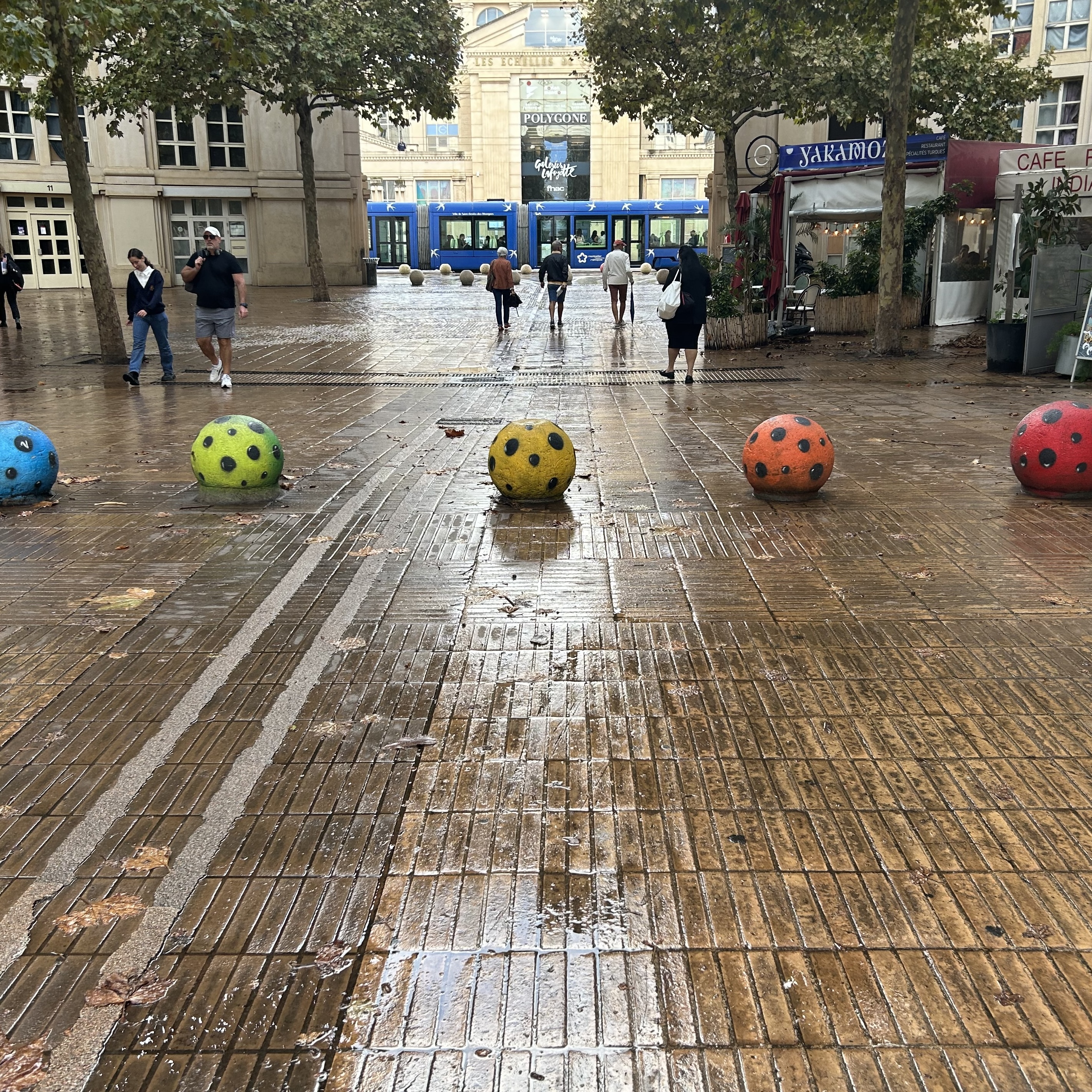
Reminders of France’s all-to-frequent terrorist attacks are built into the physical infrastructure of French cities. Montpellier’s main pedestrian square, Place de la Comedie, is surrounded by painted K-rails to prevent vehicular assaults. Sidewalks and entries to plazas are embedded with steel posts; granite stanchions; and, with an eye towards a bit of whimsy, painted concrete “balls.” If you look closely, you see cut marks from when these protective measures were added to original design features. Squads of heavily armed soldiers patrol parks, sidewalks, and shopping areas with their assault rifles at the ready. France’s experiences of terrorism, including the 2015 Bataclan attack in Paris, 2016 truck ramming at a Bastille Day celebration in Nice, and 2018 mass shooting at the Strasbourg Christmas Fair are woven into the collective psyche of the French people. And, lest you forget while sipping a café au lait at an outdoor café, Vigipirate—an anti-terrorism security force vehicle may pass by, at a slow, watchful pace.
France is home to Europe’s largest Muslim population; Muslims represent approximately four percent of the population. Women wearing hijabs and chadors are a common sight. France is also home to Europe’s largest Jewish population although their representation is much smaller, estimated at 0.67 percent of the population. Preserving one’s culture while integrating into broader society, the latter being key to garnering social capital for oneself and one’s children, presents challenges. Sadly, in France, all too often we learn of disaffected, disenfranchised Muslim youths who, feeling they have nothing to lose, are at risk of becoming radicalized.
Hamas’ brutal attack on Israeli citizens demands our attention and condemnation. Hamas militants need to be brought to justice. Innocent Palestinian civilians also deserve peace and security. I remember travelling to New Zealand when President George W. Bush occupied the White House and engaged in military actions contrary to my political beliefs. Some Kiwis were critical, assuming I supported the President when I did not. I think of Jews who do NOT support Jewish settlements in the West Bank and Benjamin Netanyahu’s, right-wing, hawkish ways. I think of Palestinians who do NOT support Hamas and who do NOT support the violence aimed at Israel. I think of Jews and Palestinians who simply want to live their lives in peace. I worry about the death and destruction on all sides.
I wonder how much of the Israeli-Palestinian conflict is about limited resources…limited water, limited land, limited agency. It is so much easier to live peacefully when there is abundance. Let us hope peaceful solutions can be found.
Note to Readers: My heart is heavy as I think of current conflicts and suffering in our world. If I had a magic wand, I would wave it and offer a healing incantation. For now, I offer this story of war and remembering.
The family’s ancestral home near Barcelona was set to be demolished to make way for new construction. Two red, cardboard boxes in the garage held a secret – five thousand, mostly unpublished, photos taken during the Spanish Civil War (1936-1939).
Antoni Campana (1905-1989) documented scenes with his Leica Camera as his beloved Barcelona crumbled amid fighting between Republican (Loyalist) and Nationalist (Francoist) forces. The Republicans, allied with the USSR, supported the democratically elected government of the Second Spanish Republic (1931-1939). The Nationalists, allied with Germany and Italy, supported General Francisco Franco’s military junta that overthrew Spain’s democratically elected government.
The Nationalists’ relentless bombing terrorized inhabitants and marked Barcelona as the first European city to experience indiscriminate attacks on civilian homes, hospitals, schools and shops. This pattern of attacking civilians would continue into World War II. An estimated 2,500 to 3,000 Barcelonans died amid 385 aerial attacks.
Campana’s images of children playing amid rubble, women waiting in line for bread, community feeding kitchens, and desperate and weary refugees from Malaga show the impact of war on everyday people. He also documented the destruction of Roman Catholic churches alongside banners displaying handsome, “fatherly” images of Lenin and Stalin—reflecting the politics of anticlerical factions among the Republicans. Campana’s photo of a young, pregnant, anarchist militia member named Anita Garbin (1915-1977) made her the “Madonna” of her movement, a revolutionary saint. Franco’s forces prevailed and Anita became one among hundreds of thousands of Spaniards who escaped and lived in exile. Campana was there to document Franco’s Victory Parade in Barcelona in February 1939. German, Italian, and Moroccan soldiers—allies of the Nationalists—marched alongside Franco’s troops.
An estimated 500,000 Spanish soldiers and civilians, loyal to the Republican cause, fled to the border, to France, in the La Retirada (retreat). Most were on foot. This slow-moving mass of humanity—comprised of civilians and soldiers, some of whom were injured—were escaping Franco’s vengeance. French authorities, unprepared for this massive influx, were hostile and suspicious of incoming refugees which included anarchists and communists.
Families were separated at the border. Women, children, the elderly, and the disabled were transferred to accommodation centers. Men were sent to internment camps in Argeles-sur-Mer, St. Cyprien, and Le Barcares. Surrounded by barbed wire and guarded by Senegalese troops, an estimated 60,000 Spanish men were held in humane conditions. Robert Capa (1913-1954), the Hungarian photojournalist, documented detainees sleeping in holes they dug in the soil. Food was scarce. Sanitation facilities were non-existent; 1,500 detainees died of dysentery.
In a lesser-known aspect of history, French officials moved the male detainees to “concentration camps” in the South of France in Bram, Agde, Vernet, and Rivesaltes. Germany invaded France in May 1940. These Spanish prisoners would be joined by East European Jews and Romany.
War continued in Europe. Some detainees emigrated. Some returned to Spain at risk of persecution, prison, or death. The majority were conscripted into unpaid “Squads of Foreign Workers” or the French Foreign Legion. Some were sent to the gas chambers at Mauthausen, caught up in the German deportations. Others joined the French Resistance, contributing to France’s liberation on June 6, 1944. They were finally granted status as “Political Refugees on March 15, 1945.
Campana, a liberal, Roman Catholic and Catalan nationalist, captured images from varying sides during the Spanish Civil War. He worked at the propaganda offices of the Catalan government and the Iberian Anarchist Federation. He served in the air force of the Spanish Republic which opposed Franco.
Campana chose to remain in Spain when the war ended, despite personal risk. Franco’s government set out on a path of revenge, unleashing a massive purge campaign to weed out those who had been loyal to the Republic. Franco’s extensive list of “enemies” included Republicans; liberals; socialists; Protestants; intellectuals; homosexuals; freemasons; Romany; Jews; and Basque, Catalan, Andalusian and Galician nationalists. Thousands were expelled from the military and the civil service. Professorships at universities and teaching posts in schools were targeted. One quarter of Spain’s school teachers lost their jobs.
Campana maintained a friendship with Jose Ortiz Echague, a photographer who had been a Francoist soldier. Echague helped Campana find work amid the post-war, politically charged witch hunts. Campana also took chances. He bravely refused to comply with Franco’s order for photographers to surrender negatives and prints made during the war. He kept them hidden, not wanting to put former Republicans at risk.
Campana pursued her career as a photographer and photo shop owner in the decades following the war. He continued to keep the photos hidden, even after Franco’s death in 1975. He expressed the wish that the photos not be exhibited. His grandchildren discovered them when cleaning out the family home in 2018. His family made the decision to share the photos publicly.
I wonder why Campana chose to keep the photos a secret—even after Franco’s death when it was safe to reveal them. Was this about his own personal trauma and not wanting to revisit the pain of war? Was it about protecting contemporary Spanish society from images of a deadly, divisive time in their history?
Campana could easily have destroyed the photos, but he chose to keep them. I wonder if he intentionally “left” the photos in the garage, hoping his descendants would discover them with enough time and emotional distance to receive them as an honored and sacred message from the past.
Pola wears whimsical eyeglass frames and loves spending time in the mountains, walking and skiing. She is a forty-year-old, mid-career Polish professional who earned degrees in journalism and cultural studies. Pola is a recipient of both ERASMUS and Leonardo da Vinci Scholarships from the European Union, supporting graduate studies and career internships. She works in guest services at home and abroad, often in mountainous areas where she can hike and ski. Her deepest aspiration is to become a writer. Pola agreed to share her perspective on recent events in and near her homeland.
Talk about the COVID-19 Pandemic: This is a very complex question to consider. Polish society is very divided, politically and in mentality. Responses to the virus and lockdowns were highly individualized. It depended on personality. Some people did not believe there was a threat. There is a sentiment among some Poles, given recent past history with an authoritarian communist regime, that “If the government tells us to do something, we still do it our way.” I lived in Germany and view Germans as more “rule followers.” People who could, worked from home, creating “home offices” that many continue to work from. My close friend is a physician and she was super careful about avoiding the risk of infecting others given her place of work. This meant we could not meet for a beer or a cup of coffee. Russia’s February 2022 invasion of Ukraine has proven more traumatic for Poles than the pandemic.
Talk about Poland’s Membership in the North Atlantic Treaty Organization (NATO): Poland’s membership in NATO is a good thing; it makes me feel a little safer. I’m not sure, if something happens, that NATO will come help us. Poland held mutual aid treaties with Great Britain and France on the eve of World War II. These two western allies declared war on Germany in response to their September 1939 invasion, but did not send troops to help Poland. One thing is certain, if Russia and NATO engage directly in combat, Poland will be a battlefield again—as in WWI and WWII–between powerful, external forces. Our geography is not helpful.
Talk about Poland’s Membership in the European Union (EU): I have benefited greatly from Poland’s membership in the EU as have many Poles. I no longer need a visa to travel, study or work with the EU’s twenty-eight member countries. I’m fortunate to have received EU scholarships. The concept of a fully integrated body of nations, working collaboratively, is a beautiful idea. We are learning that national interests are often stronger than communal interests. France and Germany were early proponents of the EU. Poland joined later. Poland received a lot of EU money—for economic, cultural, environmental, etc. improvements. Our government grew used to being on the “receiving end” of EU funds; they seem less willing to be on the “giving end” as needs arise. In my view, some Poles have a bit of a “victim syndrome.”
Talk about Women’s Rights in Poland: There are no rights for women in Poland at this time. Right now, we are in the middle of Europe and it feels like we are living in the Middle Ages. It is terrible. Our government, controlled by the conservative Law and Justice Party (PiS), is in the Middle Ages, closely aligned with a highly political Roman Catholic Church. If you become pregnant in Poland today, you essentially have to give birth. Doctors are required to register if women are pregnant. Protections for victims of rape and incest of women whose health is endangered by carrying a birth to term, though technically legal, are, in practice, eroded. Some women are afraid to go to the doctor if they suspect they are pregnant. Doctors who do not abide by the government’s anti-choice laws face prosecution as do private citizens who help women obtain abortions. Many Polish women travel abroad to obtain abortions as soon as they learn they are pregnant. I am so angry. Thousands of women, and their allies, took to the streets to protest—aka “Black Monday” or “Black Protest” on October 3, 2018 following a supreme court ruling severely limiting access to abortion.
Talk about Refugees in Poland: Different Constituencies, Different VoicesOur government uses fear to control its citizens. Our government actively searches for “enemies”, demonizing feminists, migrants, the EU, and members of the LGBTQ community. To me, Jaroslaw Kaczynski, leader of the PiS Party, is similar to Putin; he rules via manipulation and fear mongering. Kaczynski promotes a narrative that “Poles are white, Roman Catholic and hetero and that everything that is ‘different’ is bad. God, Honor and Fatherland are very important words for PiS. If a populace is steered to focus on imagined “enemies”, they are less likely to challenge and/or notice the failings of their government.
Crisis on Belarusian Border: Background: Poland forms part of the Eastern border of the EU and NATO. Belarusian President Alexander Lukaschenko manufactured a migrant crisis by inviting desperate migrants, largely from Afghanistan and Syria, to fly to Minsk and then bussing them to the Polish and Lithuanian borders where conflicts arose with border personnel. Some Poles helped migrants who managed to cross; they traveled to the border to provide humanitarian aid. Some placed Green Lights in the windows, indicating their willingness to help. Lukaszhenko’s weaponizing of refugees is similar to the governors of Texas and Florida in the U.S. bussing and flying migrants to New York and Massachusette. Pola’s thoughts: In the beginning, very little was written about this in the Polish press. The border crisis was not present in mainstream conversation. NGOs shined a light on the humanitarian crisis; unfortunately, these NGOs are not supported by government subsidies. The government rhetoric beat that fearmongering drum with echoes of “Terrorists are coming.”
Refugees entering Poland following Russia’s invaded Ukraine on February 24, 2022: Background: An estimated 7.4 million Ukrainian refugees have crossed Poland’s border since Russia launched an invasion on February 24, 2022. Ukrainians and Poles share cultural similarities, and shared histories of experiencing Russian “influence”, and shared fear of Russian aggression. Pola’s thoughts: When Ukrainians first began arriving, Poland showed its big heart. Many people opened their homes to Ukrainians. As inflation soars, the war drags on, and Putin speaks of expanding threats to its former satellite nations (e.g., Poland, Czech Republic, Slovakia, etc.), people are genuinely frightened of what the future holds as winter approaches. These conditions play into the hands of Kaczynski’s efforts to stoke the embers of ksenofobia—xenophobia.
Talk about LGBTQ Rights in Poland: It feels the same as women’s rights in Poland: members of the LGBTQ community do not have rights. This follows the government’s narrative of “Everything that is ‘different’ is bad and, somehow, a threat to society.”
Talk about Poland’s response to the Climate Crisis: There is a bit of dichotomy here. Many Poles see the value of and are embracing practices to reduce their environmental footprint. People are moving towards vegan and vegetarian diets; some avoid leather products. Municipalities are launching large-scale recycling efforts. On the other hand, Poland’s national government doesn’t seem to care. Russia has threatened to cut off natural gas supplies and Kaczynski said, “It’s going to be a difficult winter.” Efforts to reduce coal use and woodburning are being suspended at this time.
Talk about Poland’s 2023 Parliamentary Elections: I hope the current government will lose. I’m going to vote against PiS. I support the opposition—even if I feel they are not pushing for reforms as quickly as I feel they are needed. There will be a big mess to clean up. In my view, the Roman Catholic Church hierarchy meddles in politics, exerting too much influence on the government.
What do you feel Americans should know about Poland and the Polish people? We have wonderful mountains, a strong sense of hospitality, and our cuisine is very good. Our language is very difficult for foreigners to speak. We love foreigners as tourists; we are not, however, as welcoming to people who are ‘different.’ More seriously, we are a small nation in the middle of Europe, wedged between powerful nations and, therefore, subject to their whims. We have had a hard history with centuries of invasions and partitions. We love our country. We are also able to leave Poland and live abroad while still carrying Poland in our heart. Understanding the Polish mentality takes time, given our unique history. I think one needs to visit Poland and live here for a while to truly understand.
What makes you hopeful about Poland? Many Polish people now have the opportunity to travel and live abroad. They return to Poland with new ideas and fresh perspectives. I am not speaking of Poles who live abroad in insular communities as I saw in Reykjavik in what I call “Polish ghettos.” The young generation grew up with access to a world of ideas via the Internet. Broadened perspectives are less easily manipulated by authoritarian-leaning leaders. We are living in uncertain times—with the pandemic and war just over the border in Ukraine. Hope is still there.
Our history is burdened with ups and downs, but somehow, we still manage to pull ourselves together. I think also that these uncertain times will pass and the sun will shine again. There is a Polish proverb, nadzieja umiera ostatnia – hope dies last. Hope remains, even when times are difficult.
This Time, This Place interviews capture perspectives from Poles and non-Poles, living in Poland today. Views expressed are those of the interviewees and not necessarily those of the interviewer.
Note: Pola is a pseudonym selected by the interviewee.
Magda, 37, is a speech and neuro-sensory integration therapist living in southeastern Poland, near the Czech border. She is married and the parent of three children, ranging in age from eight months to ten years old. She identifies as Roman Catholic.
Reflect on your experience during COVID-19 Pandemic:
It was a very difficult time, especially with two small children at home. There was much uncertainty about the virus. We felt fear. We felt concern. One child was in preschool and one attended primary school.
A two-week lockdown was imposed on April 10th, 2020. We could not leave our homes–except for food or medical purposes. We couldn’t even take our children for walks in the forest. Regardless, my husband and I resolved to respect the rules and stay positive. We thought life would return to normal after two weeks, but then, the lockdown kept being extended. Our children’s classes were virtual until the end of the school year. This was particularly hard for my oldest child who is a special needs student. We were all emotionally exhausted due to the isolation and quarantining mandates. Still, we all caught COVID-19 early in the pandemic, despite precautions. Thankfully, we got through it with relatively mild symptoms.
I worked from home while also supporting our children’s learning. My husband’s job required his in-person (not virtual) presence. He engaged the children as soon as he returned from work each day, supporting me in finishing my work or taking time for myself. I tried to remain positive, reading lots of books and beginning to learn a new language, Spanish.
Summer’s arrival brought somewhat looser restrictions. We went outside as much as possible, taking the kids for walks in nature. We took a family vacation to Greece. My husband and I supported each other throughout which was very important.
How do you feel about Poland’s membership in the North Atlantic Treaty Organization (NATO)?
We feel safer as a country, particularly given the invasion of Ukraine—our neighbor—by Russia. I feel better knowing that the United States is stationing soldiers in Poland with plans to establish a formal military base here.
How do you feel about Poland’s Membership in the European Union (EU)?
As with so much in life, there are pluses and minuses to most every situation. Open borders and the freedom to travel with ease is a huge PLUS. We live close to the Czech border and visit frequently. Polish university students are eligible to participate in ERASMUS (an EU student exchange program) and there are entrepreneurial grants available to people opening new businesses. I was able to establish my neuro-sensory integration practice with EU funding assistance. Members of my extended family and friends tend to support Poland’s membership in the EU. We see the clear benefits for ourselves and our children. That said, I think it is a good thing that Poland did not change its currency from zloty to Euros.
Talk about women’s rights in Poland today:
Women’s rights is a very complicated topic. I think it’s fair to say that women—regardless of the country in which they are residing—experience difficulty finding balance between “career” and “family” demands. In Polish, we call this balance zloty srodek [the golden middle]. I am fortunate that my husband is a true partner who helps with the children and supports my career.
(Background: Poland’s Constitutional Tribunal issued a decision on October 22, 2020 eliminating Polish women’s constitutional right of access to abortion based on, “severe and irreversible fetal defects or incurable illness that threatens the fetus’ life.” Current Polish law, in theory, permits abortion up to 12 weeks in cases of rape or incest and if the pregnancy presents a serious threat to a woman’s life or health. In practice, this is often not the case. Source: https://www.nytimes.com/2020/10/22/world/europe/poland-tribunal-abortions.html)
As a woman and as a mother of a daughter, I do not support the ruling of October 2020. At the time, 100,000 women took the streets in Warsaw to protest the decision. Today, in Poland, every pregnancy, verified by a medical visit, must be registered and monitored by the physician. Doctors can be prosecuted if they do not follow these new rules. Poland has been identified as having the harshest anti-abortion laws in Europe. I believe women should have control over their bodies. I believe women should have a choice.
As a parent of a child with special needs, I speak from experience when I say that governmental financial assistance for such children is inadequate. Women of special needs children who stay home to care for them receive a small, monthly stipend of 2,458 zloty (about $554 USD) and are not allowed to work outside the home as a condition of receiving the stipend.
Our current government (led by the right-wing Law and Justice Party) established the “500 plus” program which, since 2016, pays families 500 zloty ($112 USD) per month for each child under eighteen. In my view, this is fostering a pathological state in which Polish women are expected to relinquish careers and live as women did in the 1950s. This, in my view, is a step backward for women as they are pressured to have more children.
Talk about the fall 2021 refugee Crisis on the Belarusian Border when Alexander Lukaschenko, President of Belarus, lured desperate Middle Eastern and African migrants to Minsk and he bussed them to the Polish/EU border.
This was a horrible situation. From the humanitarian side, innocent people, including those with children were simply dropped off by Belarusian officials and pushed, literally, towards the Polish border. From the political side, Lukaschenko was manipulating these people and placing them in life-threatening circumstances. Poles were very divided on this issue. Some wanted to and actually went to the border to help the migrants. Others called for Poland to build a wall—like some Americans say about the U.S.’ southern border with Mexico.
Talk about refugees entering Poland following Russia’s February, 24, 2022 invasion of Ukraine on February 24, 2022.
The Ukrainian refugee crisis feels different. Poles and Ukrainians share a common distrust of Russia, a distrust born of historical oppression. We share a similar culture and language, easing the integration of Ukrainians into our country. I remain astonished by the solidarity Poles are demonstrating by welcoming millions of Ukrainians fleeing the war. Many Poles host Ukrainians in their homes. Our small town opened a shelter for Ukrainian refugees and people continue to donate food, clothing, etc.
A more delicate aspect of hosting so many refugees is that our government immediately provided access to social supports such as education and healthcare and the right to work for all Ukrainian refugees. The sheer volume placed a burden on Poland’s social services where there were already waitlists for preschool slots and waiting times to see some doctors. As the war continues, some Poles are starting to wonder, privately—not in a public way—how long this will last. We also realize that some Ukrainians will choose to remain in Poland. Even in peacetime, the standard of living in Poland is higher than in Ukraine.
Talk about LGBTQ Rights in Poland:
I am not bothered by how others choose to live their lives and whom they choose to love. I also do not have friends who are openly gay. In my view, the PiS government is homophobic. I read that Poland is considered the “worst” in Europe in terms of rights for LGBTQ people. I feel really bad because I think that everyone of us has the right to live according to their own rules, provided they don’t hurt others.
Talk about Poland’s 2023 Parliamentary Elections:
I hope things will change, politically. As a woman and a mother of a daughter, I am counting on women’s rights being restored. I believe a woman deserves a right to the decisions made about her body. My friends who are mothers of daughters are all saying this.
What do you feel Americans should know about Poland and the Polish people?
I worry, sometimes, that Americans think Poland is somewhat backward. I want them to know that Poland is a country that has been devastated, for centuries, by wars and partitions, and this knowledge is embedded in the Polish psyche. I want Americans to know that our history makes us resourceful and entrepreneurial and we are able to unite in crisis. People in Poland are also well educated and intelligent.
This Time, This Place interviews capture perspectives from Poles and non-Poles, living in Poland today. Views expressed are those of the interviewees and not necessarily those of the interviewer.
Nata offers a message to politicians, the deciders in our world: “One minute spent thinking—about how and whether to help Ukraine—is one more Ukrainian life lost. I witnessed a fireball 100 meters from my kitchen window; my entire apartment building shook. This Russian rocket exploded mid-air, destroyed by our air defense system. We are fighting the Russian invaders. We are protecting our land. We appreciate the vast amount of support from the United States and Europe and, still, it is not enough. Russia is an imperialist country trying to make Ukraine a ‘colony.’ This should not be happening in the 21st century. So many Ukrainian treasures have been destroyed or looted by the Russians. So many innocent lives have been lost.”
Nata was born in 1985, six years before the dissolution of the Soviet Union. This was a time when school students were required to “pledge allegiance” to the Communist Party. Nata was in first grade when the Soviet Republic of Ukraine became an independent country. This followed decades of Soviet oppression and intentional Russification.
“Although the language of instruction during my school and university studies was Ukrainian,” Nata said, “we spoke Russian at home. We spoke Russian with our friends. We spoke Russian in our daily lives. Since the war began in 2014 (With Russia’s invasion and annexation of Crimea), I have been trying to bring more Ukrainian language into my life, but more recently, I have been intentionally speaking and performing in Ukrainian. It is a little hard, but I’m doing it.”
Nata is a Playback Theater conductor, actor and trainer living in Kyiv, Ukraine. Nata holds a Master’s Degree in Social Work from the Kyiv Polytechnic Institute and has worked professionally in art therapy. She studied the work of German-American social psychologist Kurt Levin (1890-1947), a pioneer of social, organizational and applied psychology. Nata’s academic credentials are complemented by extensive training, certifications, and performance in Playback Theater. She appreciates the inclusiveness of this form of theater and the varied audiences she’s been able to work with: Internally Displaced Persons (IDPs), children, people experiencing visual impairment, members of the deaf community, minority groups such as Romany, LGBTQ folks, etc. Nata has remained in Kyiv with her grandmother since Russia’s invasion on February 24, 2022 where she continues to produce theater for her community.
Nata created the “On Guard” (“Na Varti”) Playback Theater Company in Kyiv just after Russia’s February 24th invasion. This unified two pre-existing Playback Theaters already operating in Kyiv as many actors fled to safety as refugees or took up arms to defend their country.
Playback Theater is a form of improvisational theater in which actors act out stories told by audience members, on the spot. Audiences are intentionally small to create intimacy. Sometimes a formal “theme” is selected for a performance; other times, actors engage audience members to see what themes emerge from their current lives. Actors honor the audience members’ stories, evoking a sense of affirmation, acceptance and, sometimes, even resolution. Playback is an art form that creates space for people to communicate.
“I slept in the metro the second night of the invasion,” Nata remembered. “It made me ill to be there, all those people and pets, frightened and tired. I returned home. I slept in street clothes for the first couple of months, ready to run (for shelter) at any time. I met with relatives living in the metro. They made tea. We sat on their mattress and talked. It felt so unreal.”
“Our theater troupe resolved to perform Playback for people living in the metro,” Nata said. “Our first performance was in March, a few weeks after the invasion. Audience members shared powerful stories of the places they left behind in search of safety. They spoke of ‘sharp’ (sensitive) things, trusting us to be gentle with their painful experiences. Children said they missed their fathers who were away fighting. A little boy, seemingly adapted to subterranean life in the subway station, referred to us as ‘Humans from the Upper World.’ ”
“So many people left my city (Kyiv) after the invasion,” Nata said. “The streets were empty. Those of us who remained were afraid to go out. We stayed in our homes. Going out to find food was risky and a bit like ‘hunting’—for milk, bread and vegetables. So much of the food is sent to feed our soldiers who are fighting. IDPs began arriving from eastern territories seized by Russia—from Mariupol, Kharkiv, Donetsk, Dnipro, Kherson. I realized we needed to help them find community in this new place. So many of my friends left. A beloved colleague, Mykhailo, was killed. Once I started working with IDPs, I thought, ‘I live here. You live here now. I want to help you adapt as you bring your own stories to this place in which we both now live..’”
“Even though there is a war, people still need art,” Nata said. “People still need connection. We continue to develop our culture during the war: that is what keeps us going. If an audience member telling their story at a performance mentions they are from Mariupol, we ask, ‘Is anyone else here from Mariupol?’ and you see the hands raised. You sense the storyteller’s affirmation, that flicker in their eyes in that moment they realize they are not alone, that others share their experience of displacement. You listen to them sharing stories from their past and connecting them to their present, building a bridge to their future. You see these small groups of audience members gathering and sharing contact information with each other when performances end. They are connecting and supporting each other.”
“One woman from Mariupol told a story of a special Treasure Box in which she kept small personal mementos and souvenirs,” Nata said. “She carried that box when fleeing Russia’s deadly assault on Mariupol. Her apartment key was tucked inside; her apartment building was no more, destroyed by a rocket. Others spoke of hiding in basements, separated ‘by centimeters’ and escaping in cars amid flying bullets targeting civilian evacuees. ‘They’ made it through, but they passed cars that did not.”
Nata observed that stories told by IDPs evolved over time. Initial arrivals spoke of the horrors of the occupation, reliving their traumatic experiences. IDPs’ stories shift, over time following their resettlement to Kyiv—audience participants are calmer, more reflective, more forward-looking as they adjust to daily life in their new ‘home.” This does not mean that they overcame their trauma. They are, however, finding ways to live with loss while adjusting to a somewhat ‘normal life’ and planning for the future, whatever that future may be.
“If we are performing and the air raid warning sirens go off indicating a possible threat, we tell the audience they can choose to go to a shelter,” Nata said. “We continue to perform for those who remain. If we are performing and imminent threat sirens go off, we too, enter shelter with the audience until it is safe to emerge and continue our performance. Doing this work reminded me that people just want to live their lives. They want to work. They want to travel. They want to raise their families.”
“When delivering a Playback Theater training near Odessa (a region in southern Ukraine when the predominant language is Russian), I had the realization that I could not and should not do this in Russian,” Nata said. “ I was working with locals and IDPs—and I decided that, going forward, I would conduct trainings and performances in Ukrainian. Russian is my ‘Mother Tongue’; I still speak it with my family. Russian is also the language of an invasionary force. In my view, Russia does not “own” this language. I am privileged that I can understand when the enemy speaks. I am privilegedwhen some of my theater colleagues in Russia suggest that Ukraine ‘should come back to’ the former U.S.S.R. I understand their messages with clarity. This helps me understand the messages (e.g., propaganda) my colleagues in Russia are hearing from their government. As I switch my language, increasingly, from Russian to Ukrainian, I remind myself that Russia is an occupying terrorist nation.”
Nata and her troupe have performed in the metro, on sidewalks, in basements and, soon, they will return to a professional theater space. They remain committed to their art. These performances were funded, in part, by the NGO Inclusive Theatre Association “ART-Playback” (See instagram.co/art.playback)
“We live in risk. We do art in risk,” Nata said.
“I want Americans to know that Ukraine will fight for victory, until the last foot of the Russian occupiers leaves our land,” Nata said. “This invasion is our ‘common business’ in our 21st century global community. Ukrainians are fighting for their identity, borders, and independence. I want to have the right to my Ukrainian identity.”
Nata dedicates this story to all the brave defenders of Ukraine and, especially, to her dear colleague, Mykhailo, a talented scientist, psychologist and artist killed in the war.
To Support Nata’s work to bring live theater to the people of Kyiv:
Foundation of the Ukrainian School of Playback Theater which support Playback Theater across Ukraine: https://secure.wayforpay.com/payment/usptfoundation Contact Katherine if you wish to support Na Varti directly.
“I didn’t tell my mother where we were going at first,” Lilia said. “I didn’t want to upset her. I felt like I was watching a film about World War II. So many people and pets crammed the station. Once we boarded, a man with a gun walked through ordering Ukrainian men out of our train; they needed to stay behind to fight. Our darkened compartment held eight people, including three ‘grannies’ plus three cats. My Mushia spent much of the ten-hour journey to Lviv looking out the window as we crossed Ukraine.”
Lilia’s evacuation train left Kyiv on February 25, 2022, the day after Russia invaded Ukraine. She made the 540-kilometer journey to Lviv before boarding a second train to Poland. She was accompanied by Galina, her 83-year-old mother, and Mushia, her fluffy brown cat. Lilia hurriedly packed documents, sandwiches, and a few articles of clothing, including one unmatched sock. She left behind her country, her city, her job, her apartment, her plants, her friends, and family members who decided to remain in the besieged city.
The chaos, stress and sadness of the mass evacuations triggered traumatic memories of World War II for Lilia’s mother. Galina recounted a story Lilia heard many times since her childhood. Galina, as a five-year-old, witnessed a German aerial bomb make a direct hit on her family’s home in Semyduby, a village near Odessa Her father and grandmother, who were inside, were killed instantly. Galina helped her pregnant mother dig a grave together to bury the remains. Galina remembers seeing her sobbing mother lay atop her husband’s grave. Lilia tried to distract her mother, reminding her that they were going to Poland to see her granddaughter, Anastasia, who immigrated to Poland several years ago.
“When I looked at the sad, weary faces, it struck me that there were so many women and children with their dogs and cats,” Lilia said. “There were also elderly people and foreign students. Our men stayed behind. I worry about who will return to Ukraine. Our men are dying. Our cities are being bombed. Will all these Ukrainian women and children return? Putin is trying to destroy the future of our country.”
“Ten hours into our train ride, a baby began crying and would not stop,” Lilia said. “The mother was doing everything she could to calm her child. People began covering their ears. The crying continued, adding stress to an already stressful situation of people fleeing war in an over packed train. An African university student* offered to hold the baby for the distraught mother. The student cradled the baby, smiled, cooed and the crying ceased. People applauded. Smiles emerged on faces. That student held the child for one-and-a-half hours, as he stood with his luggage.”
Lilia, Galina and Mushia arrived in Lviv amid a rush of refugees. They boarded a second train to make the ninety-seven-kilometer trip to Przemyśl, Poland. This supposed shorter journey was lengthened by sixteen unexpected hours of the train idling on the tracks, likely encumbered by the mass of evacuation trains heading west to the Polish border.
“We were stuck in a field, with no water or toilets,” Lilia said.
This train had wooden seats. Compartments were packed with ten people each and a menagerie of children, babies and pets. Travelers were weary from long journeys and worry for loved ones—-husbands, fathers, and sons fighting the invaders. Many also left behind family members who chose to wait out the war at home, despite bombing, sniper fire and attacks on infrastructure, leaving thousands without electricity or easy access to water.
“We crossed the Polish border at 3 a.m. on February 27th,” Lilia said, “Volunteers were waiting with food, water and warm drinks at the train station in Przemysl. All pets had to be vaccinated. The line was very long. We waited for three or four hours for Mushia to get her shots. People asked us, ‘Where are you going? Krakow? Warsaw? Someplace else? Aleksander, a volunteer, drove us in his private car to my daughter’s home in Krakow. Mushia was so stressed; she did not eat or pee at all during our journey.”
Lilia misses her apartment in Ukraine. She misses attending theater in Kyiv. She misses her friends and extended family. Her sister, who chose to remain in Kyiv, stops by Lilia’s apartment to water her plants.
Nine months into her stay in Krakow, Lilia teaches in a program serving Ukrainian elementary students, ages six and seven, relocated due to the war. Her love of teaching is evident in her fun, spunky interactions with the little ones. She wrote a recent Halloween-themed play about Caspar the Ghost. Lilia donned a pointy witch’s hat and cape as she narrated the story designed to teach her charges about this new, unfamiliar holiday. Lilia stays up late into the night to work on a children’s book of fairy tales she is writing—with her beloved Mushia at her side, purring and nudging her for attention.
“This experience has taught me that I am brave and very strong,” Lilia said. “I am learning from this experience. I’ve met a lot of new people. It’s interesting to meet a new culture here in Poland. I have gratitude for these new lessons. I now know what I need to do. I need to teach my students about Ukrainian culture and our history and encourage love for their country.”
Time will tell when Putin’s war ends. Lilia and her students have found a way forward where learning intermingles with laughter despite the difficulty of this time.
About Lilia: Lilia was born November 13, 1968, in Kyiv when Ukraine was a republic within the (former) U.S.S.R. Her father, a builder, was a member of the Communist Party. He chose party membership to spare his family the significant burdens and risks of non-membership in a totalitarian state. Lilia’s mother secretly arranged for her baptism by a Ukrainian Orthodox priest—in their kitchen sink. Lilia was outwardly raised to be a “good communist”, as a red-scarved Pioneer and Komsomol graduate. She earned a Master’s Degree in English at Kyiv National Linguistic University. She has taught for over thirty years, including an appointment at a school for visually impaired students. She studied belly-dancing and is known to do a superb imitation of Marilyn Monroe in Karaoke. She currently lives in Krakow with her mother and cat Mushia.
*Lilia heard reports of Black university students being removed from trains. This was not her experience. She witnessed Ukrainian women, children, elderly and foreign nationals (including students of color) allowed to leave on evacuation trains.
Tonia*, a 41-year-old teacher and single mother, received this message from her school’s director on the morning of February 24, 2022, the day Russia invaded Ukraine. She was required to call the parents of her students to tell them school was canceled that day. Who knew—and who knows—how long this war will last?
“I started to cry,” Tonia remembers. “My colleagues and I were all crying. We were in shock and felt this immediate sadness. We feared for our children and loved ones. We realized that a lot of families’ sons would suddenly be mobilized to defend Ukraine from Russia’s unprovoked assault. I trembled with fear. It was hard to believe this was actually happening. I telephoned my friend and learned that her husband was already activated. As Ukrainians, we became united in that moment, in our fear and in our grief.”
A deep, emotional chasm formed, delineating Tonia’s life before and after the start of war. Tonia grew up in a Ukrainian Orthodox family in southwestern Ukraine, near Odessa, in a town along the Danube River. She graduated from university with a degree in elementary education and worked as a teacher. She is the primary caregiver for her bright, seven-year-old daughter, Liza* with auburn braids and a love of drawing. Liza’s artwork is the featured image in this story.
“Thanks to God, there were no bombings in our town that first day,” Tonia said. “There were rocket attacks on military installations several miles aways. We could hear the explosions and feel the tremors which increased our fear. We scrambled to find windowless areas to hide in our flats and homes—-interior rooms and corridors felt safer.”
Tonia’s decision to leave Ukraine after the Russian invasion was exacerbated by personal factors. She is fiercely protective of her daughter Liza, committed to ensuring her well-being. Tonia ended her marriage after her husband engaged in psychological abuse and child manipulation, common tactics of controlling partners. Tonia and Liza left home on June 27, 2022, four months after the war started.
“I packed documents, a backpack of everyday necessities including an umbrella, toys for Liza and her sketchbook,” Tonia said. “Liza brought her favorite stuffed animal, a kitten she calls ‘Koshenya’ (Ukrainian for “Kitten”). She still sleeps with ‘Koshenya.’”
They journeyed over 700 miles, over several days, in a bus overflowing with refugees, to arrive in Krakow. It was long. It was tiring.
“We waited for 12 hours at the Ukrainian-Polish border,” Tonia said. “I remember seeing all these evergreens through the window, planted in rows, lining the roadway. I lived for years in southern Ukraine, near the Black Sea, where there aren’t so many fir trees. This was different…and beautiful.”
Tonia and Liza disembarked at Krakow Glowny, the city’s central bus and railway station on July 2, 2022, after a five-day busride. They were totally worn out. They were dazed by the hum of activity as the area swarmed with refugees and volunteers offering assistance.
“I remember standing at the railway with Liza, with our few belongings,” Tonia said. “I was afraid to move. I didn’t speak the language and Liza needed to go to the bathroom. I was feeling vulnerable, tired and scared. I’d barely slept on the bus and was deeply exhausted. I wondered at that moment if it would have been better for us to have not left Ukraine. I RECOGNIZED I NEEDED TO BE STRONG FOR MY DAUGHTER. My daughter had no one else at that moment to help her. I gathered my thoughts. I realized I could be brave.”
“Volunteers gave Liza and me a real helping hand,” Tonia said. “They opened their hearts and genuinely cared about us. They connected me to people who could help us settle in. We received a level of assistance I never truly felt before.”
Tonia mentioned a surprising and highly valued technology providing key assistance: a free, online chat service for refugees, staffed by Poles and available via Telegram 24 hours a day, 7 days a week. Tonia established contact with “Martynka” on June 27th—the day she left Ukraine–and “Martynka” began acting as a virtual case manager helping with immediate and longer term needs. Tonia continues to reach out to “Martynka” as needed AND “Martynka” proactively initiates check-ins as they acclimate and plan next steps.
Once in Poland, “Martynka” connected Tonia and Liza with a lifeline of free support. Tonia was referred to Salam Lab (www.SalamLab.pl), an all-encompassing migrant assistance program in Krakow. Connecting with this organization allowed Tonia to secure free housing–for one year–plus free access to childcare, healthcare (e.g., physical and psychological), legal counsel, translation services and assistance with navigating the vagaries of a new culture and a new bureaucracy.
“Monika, the Director of the help center, was amazing,” Tonia said. “She was really kind and attentive to our needs. She helped in so many ways and connected us with a special program that offered a full year of support. I was finally able to calm down. I now realize all the possibilities for Liza and me to recover some sense of normalcy. I feel safe. I no longer worry that Liza and I might end up homeless, on the street.”
I asked Tonia, if she were able to speak to Vladimir Putin directly, what would she say to him. Her response reflects the unreality of a sovereign nation being invaded, unprovoked and unjustifiably.
“It is so hard to imagine what I would say in this unimaginable circumstance,” Tonia said. “I think I would tell him, ‘We never invited you to our home. We lived peacefully, with happiness and stability before your invasion. We never invited you to our home.’”
“I think it’s important for Americans to know how much we appreciate their support, in the war effort and in refugee relief (e.g., financial support from the help center),” Tonia said. “I want Americans to know only the TRUTH about this war. Ukrainians want and deserve to feel ‘at home’ in their country. Ukrainians want to feel safe. Ukrainians want to be with their families, celebrating holidays in their homeland. Ukrainians don’t want to have to bury their loved ones because of this senseless war. It is unfair that Russia chose to invade Ukraine, breaking 21st century rules of respecting established borders while unleashing deadly attacks and forcing so many people to suffer.”
“I hope the American people will see that Ukrainianas are strong, kind, generous, hospitable and open-minded people,” Tonia said. “We do things with big hearts. This war, after so many agonizing days and months into this tragedy, has united us in our grief, in our suffering and in our little victories. Ukrainian citizens at home are doing what they can to support our young boys who are soldiers—from baking bread to preparing food for them amid shortages, little money and mangled infrastructure. We want to be independent and able to support our people. This is very important for people to understand: Ukraine never asked for any ‘help’ from Russia.”
“I am really, really grateful to people who helped my daughter and me feel safe,” Tonia said. “I genuinely appreciate the non-Ukrainians who have taken time to understand our plight and chose to help us, with open hearts, without expecting anything in return. It is important for me to be USEFUL, to work and contribute. It is my way to express gratitude for the help Liza and I are receiving.
SPECIAL THANKS TO Maryna for her wonderful translation assistance!
Veronika crossed the border into Poland, as a refugee, on March 4th, 2022—eight days after the Russian invasion. Today, she works three jobs as an educational administrator, a cleaner, and holds a grant-funded, part-time role as a playback theater trainer. She also organizes theater activities and is a member of a refugee writing circle in Krakow.
Veronika, 26, was born in Kharkiv, Ukraine, in northeast Ukraine. Kharkiv, founded in 1654 as a fortress, expanded its industrial base over the centuries and is now Ukraine’s second largest city. Vladimir Putin’s assault on Ukraine has deeply impacted this city where intense shelling forced many residents to flee.
Veronika earned a BA in Art History at Kharkiv State Academy of Design and Art. She is a professional practitioner of Playback Theater. She was a member of a Playback Theater troupe in Kharkiv. Playback Theater is a branch of improvisational theater where audience members tell stories from life experiences and watch them re-enacted, in the moment. Playback theater offers both entertainment and therapeutic value.
Russia began assembling forces at the Ukrainian border in March 2021. They enacted a partial withdrawal in June 2021 followed by a menacing surge to an estimated 100,000 soldiers by December 2021.
“When Russians soldiers first started gathering at the border, we thought, maybe, nothing would happen,” Veronika said. “As the build-up continued, particularly in December and January, we were warned that something was going to happen. Many Ukrainians with resources began renting homes in western Ukraine or left the country. I lived with my mother and grandmother in an apartment building. I wondered if there was something I should do.”
“I spoke with my cousin in Poland on February 23rd via Telegram and he asked if everything was OK,” Veronika said. “On February 24th, I was awakened by the sounds of artillery fire at 4:00 a.m. We had close family in Debica, Poland (near Krakow) who moved there five years ago. They told us, ‘If something happens, you can come to us; you can always return to Ukraine.’ I understood, from this moment, that I had to do something.”
“We decided to leave for Poland and began assembling our personal documents,” Veronika said. “My grandmother was hesitant to leave; she said, ‘Everything will be OK.’ My mother, like many Ukrainians, had already packed a “To Go” bag containing food, documents, flashlights, medicine, etc. We had little information on what to do. I called my father, a truck driver, who was in Dnipro. He said, ‘Everything will be OK; just wait.’ Still, we decided the safest course was to leave.”
Veronika’s family gathered in their apartment for departure—her mother, her grandmother, her godmother, and her godmother’s husband who owned a car. They ate their final meal in the apartment—potatoes, meat, and vegetables. Veronika, weighing the importance of the moment, took a photo of that last supper. They sensed danger closing in. They left the apartment, abandoning dishes in the sink.
“We left in haste, not knowing what we would experience on the roads,” Veronika said. “We didn’t know if we would encounter mines or tanks. I was afraid. I grabbed my cat and my belongings and we left in my godfather’s car. It was very cold; roads were covered in ice and snow. We drove to a village about 100 km away where my mother’s godparents live. It was still early in the war. What we saw en route appeared surprisingly ‘normal’—people were outside, walking, seemingly running errands in the bitter cold.”
Looking back, Veronika remembered a sense of relief that they chose to leave. She feared that, had they stayed, a rocket might fall on their home. A lot of her friends, including those from her theater group, chose to stay in those early days of the war. Some chose to leave a few weeks later. Meeting online, her friends spoke of the terror unleashed by Russian planes and rockets. When air road sirens went off, people only had seconds to react. This is why many chose to live in the Kharkiv Metro or in basements. People lived in the dark, dank and cold, without bathrooms, emerging to go to their apartments to get food. Homes were devastated by aerial bombing. Some of Veronika’s friends lived this way for two to three months. People who left later were often subjected to visual carnage on their journeys west.
Kharkiv Mayor, Ihor Oleksandrovych Terekhov (elected November 11, 2021), arranged evacuations for residents to a sanatorium in a safer region. Buses were organized. A major volunteer effort was launched to help move people, particularly the elderly. Some elderly, due to limited mobility or personal choice, had remained in upper floor apartments. Stranded, without water, volunteers had been carrying water to them.
“Our journey to Poland was very difficult,” Veronika said. “My godmother, with whom we traveled by car from Kharkiv, decided she would not escape to Poland; she did not want to leave family behind. I needed to arrange for my mother, grandmother and myself to leave Ukraine. Ours was a complicated path. We waited for hours in a shelter in Poltava, guarded by soldiers, for an evacuation train to Tarnopol. There were so many people—elderly and infirmed people, mothers with children and so many pets. Trains were packed very tightly. In our case, we were forced to leave personal belongings behind. Although some refugees managed to escape with suitcases, our particular train was so full that each passenger was only allowed to carry ONE backpack. It was stressful and scary as we waited and began boarding a train where all seats were taken. Adults, children and animals were sitting on floors and between doors. The train traveled slowly; we stood for thirteen hours. All the while, I feared an attack could happen.”
Arriving in Tarnopol, Veronika and her family were taken in by one of her mother’s colleagues. She describes them as very kind people who welcomed them at 3:00 a.m. in a city under curfew. They fed them and allowed them to bathe and rest before they undertook the remainder of their journey.
“Our final trek to the Polish border involved four different cars,” Veronika said, “three driven by volunteers and one very expensive taxi. We kept in touch via phone with my aunt in Debica so they could meet us at the border. It was very stressful on the Ukrainian side. The Ukrainian border guards were under pressure and could be gruff as exhausted people asked, ‘Why must we wait so long?’ That was the worst. I saw very old people, small children who were crying, and pregnant women with nowhere to sit. We stood for eight hours in line before entering Poland. It was very cold but, at least, it wasn’t snowing or raining.”
“We crossed into Poland on foot in the middle of the night on March 4th,” Veronika said. “I suddenly realized that I understood Polish! The mood was very different on the Polish side. There were so many volunteers offering warm drinks, food and clothing. There were tents set up to access services. We were too tired to eat. Oleksander, my uncle, was already there with his car. He had waited for us for seven hours. We were smelly, dirty and exhausted as we piled into his car for the three-hour drive to Debica. He had food in his car for us and used his iPhone to navigate as we drove in darkness. I remembered it was snowing and thinking it was pretty.”
Oleksander and his family lived in a small apartment building in Debica. He would make five trips, overall, to the border to pick up family and friends fleeing the invasion. Their small apartment became a haven with people arriving at different times of the day and night, with many stopping to rest and bathe before moving further west.
“I watched my aunt and realized she was so very tired,” Veronika said. “I felt I needed to decide quickly whether to leave or stay in Poland. We spent two weeks living with our family. We were nervous about living in a new place and having to learn a new language. My mother worked as a nurse for a large medical firm and they arranged housing for us for six months in Krakow. My mother’s workplace in Kharkiv was destroyed; she now works as a housekeeper. She submitted all of her nursing credentials for review to Warsaw and hopes to resume practicing as a nurse in Poland. It’s been taking time; we await the outcome.”
When asked about what she brought with her, Veronika paused. She explained she is not a person who places great value on material things. She sees herself as being a “practical” person. She didn’t have a lot of money and was not one drawn to expensive items.. She brought food, warm clothes (e.g., socks), documents, her laptop and a small light in case she got stuck in a poorly lit shelter. Friends in Ukraine would, later, mail photos, her camera and some handmade jewelry, pieces of immense sentimental—not monetary–-value.
“I have learned many things about myself from this experience,” Veronika said. “I thought the war would change me, but it did not. Even with the stress of being a refugee, I continue to do the things I loved doing at home. When not working, I take photos and enjoy walks. I visit libraries and museums. My mother and I share a very small studio apartment; my grandmother lives in Debica. I wish I could earn enough money to live independently. My playback theater troupe remains very important to me. We are doing things online and have performed in Poland and Lithuania since the war started.”
Veronika is grateful to be in Poland. She feels welcomed and very comfortable. The language and culture feel familiar. Krakow reminds her of Kharkiv. She misses certain people in Kharkiv, but not the city specifically. She does not plan to return to Ukraine.
“I lived in the same apartment my whole life.,” Veronika said. “My dream is to see the larger world. This is my opportunity. My city is devastated; my home was bombed. Many of my theater friends left Ukraine and are scattered across different countries. I don’t have concrete plans, but I have dreamed of doing theater in England, Ireland or Scotland. Being farther away, geographically, from Ukraine feels safer but it’s not really clear what place is truly safe. I met with a psychologist as I adapted to life in Poland. I was crying a lot. I’ve been away from Ukraine for eight months. This war has left its mark on me. Rebuilding Ukraine will take a lot of time. It’s not just the buildings and infrastructure. People lost the businesses and schools around which communities were built. People lost family members.”
Veronika wants readers to understand that Ukrainians are strong, hard-working, creative people. Many are volunteering—inside and outside of Ukraine—to help soldiers and vulnerable residents unable to leave their country amid Russian occupation. Most Ukrainians in Poland work two “jobs”, one to earn money to live and the other to support the war effort against Putin’s invasion.
“One of my goals is to further develop playback theater,” Veronika said. “Playback was a very vibrant art form in Ukraine with multiple troupes and theaters. Playback helps people connect and feel better together. So many of us who came to Poland (as refugees) lost our careers, our homes, our communities—which were part of our identities.”
Veronika explained that many of the Ukrainian women want to be able to work in their careers once their housing is stable and their children settle into school. Language and credentialing requirements present barriers.
“Everyone lives in a certain moment,” Veronika said. “A neighbor, a fellow refugee, from Lviv, arrived a few months after me with her four children. My story is, perhaps, ‘lighter’ than others. Most Ukrainian refugees recognize the generosity they’ve received. I hope to use my skills and talents to perform humanitarian work that is good for me and also good for my neighbors.”
Andrei wore a t-shirt from a swing dance event in Israel that caught Anna’s eye. She invited him to dance. This is how their story began, in Saint Petersburg, Russia. Now newlyweds, they represent “new immigrants” choosing to build lives for themselves in Poland.
Andrei is a thirty-seven-year-old entrepreneur with a passion for swing dance and martial arts. Andrei was raised in a non-observant Jewish family in Saint Petersburg. He credits his paternal grandmother, with whom he maintains a close connection, with fostering his interest in the Jewish faith. Andrei completed a degree in Jewish Studies at Saint Petersburg University. He spent the last six years living in Israel and earned citizenship. His business, in outsourcing and financial technology, employs thirty employees and is poised for expansion. Andrei supports philanthropic efforts of the Jewish Community Center of Krakow’s (https://jcckrakow.org) aid to Ukrainian refugees. Andrei dreams of, eventually, using his talents and resources to proactively foster enhanced ethical thinking and behaviors in his adopted country. Moving to Poland represents a return to his family’s historic roots in this part of the Old World.
Anna is a thirty-two-year-old ceramicist who works at Krakow’s Meditau Ceramic and Meditation Studio (https://www.facebook.com/meditau/) with a business partner from Italy. Anna studied health sciences in Moscow. Her professional journey, as a physician’s assistant, involved working in hospital emergency rooms, serving as a school nurse and, later, training as a masseuse. Anna discovered her true passion was in the creative field of ceramics. She trained and now enjoys teaching this craft to others. Her personal evolution inspired her next goal: to create a podcast about becoming a better version of oneself. Anna also hopes to have a big family and a dog, with a preference for an Australian Shepherd or a Border Collie!
Anna and Andrei landed in Krakow following a two-month, summer 2022 odyssey driving around Europe with their cat, Wilhelm. Armed with passports, marketable skills and multiple languages, they set out to find THE COUNTRY in which to build their life together. They toured the Czech Republic, Greece, Croatia, France and Italy. Poland was not on their list.
“It was the three Euro teabag in Italy that helped us decide on Poland. I remembered from an earlier trip that Krakow was less expensive, and that the tea was good,” Andrei said with a smile. “Poland is much more affordable and offers a good quality of life. I feel people here are closer to my mentality with a strong emphasis on family and children—like in Israel. The cost of living is far lower than in Western Europe. I also appreciate Poland’s geographic diversity—there are mountains, there is the sea, there is even a desert.[1] We feel very comfortable here; we want to build a life here.”
Anna and Andrei were startled by the high costs in Western Europe and the level of homelessness they witnessed in France. Compared to France, Poland felt quite a bit safer.
“I found a good ceramics partner here in Poland,” Anna said. “This was my main reason for staying here. There are also swing dance and martial arts opportunities, plus you can get really good pickles in Poland—similar to Russia 😊!”
We talked about Russia’s invasion of Ukraine. Anna and Andrei’s families remain divided by the war, some supporting Putin, some not. Andrei and Anna emphasize that they support Ukraine and are doing what they can to support Ukrainians fleeing the war and those remaining to fight to protect their homeland from Russia’s invasion. Their experience with Poles—as folks who speak with Russian accents—has, generally, been positive. They recognize that Poles appreciate their efforts to learn and speak Polish. Although they miss family in Russia, they are unable to visit at this time. They are learning Polish and have each applied for permanent residence cards. If they were to travel to Russia today, Anna might not be allowed to leave. Andrei could leave because he carries an Israeli passport.
I asked Andrei about his experiences as a Jew in Poland and the perception of Poles by some Jews in the West.
“I feel safe and welcomed, here” Andrei said. “ I walk through Kazimierz (Krakow’s historic Jewish neighborhood) and I see signs in Hebrew. I’m involved in the Jewish Community Center. The concept of ‘Polish Hospitality’ is not exaggerated. When Poles hear me speaking Polish, they become more embracing. It’s important for Americans to remember that, beginning in the 1930s, would-be refugee Jews from Germany were rejected by England, Sweden and the United States. America is very far from this place. Americans are usually very judgmental of Poles based on newspaper articles and books that don’t show Poland from the best perspective. I think they should come here and live here and see for themselves.”
Andrei mentioned something that resonated with me. He said he wants to have the option of living in “two homes” (i.e., two different countries). Perhaps I read too many Erich Maria Remarque novels about WWII refugees. Maybe I’m indelibly marked by my parents’ refugee experiences. Maybe it was my student from the Democratic Republic Congo years ago who retold this story: “During the Civil War, I escaped with two sets of documents. One set reflected my tribe of origin. The other set reflected a warring tribe. When stopped by marauding militiamen, I had to know which dialect to speak and which documents to surface, lest I be shot on the spot.”
In an unsettled world, documents equal options. Andrei and Anna are aiming to play their cards well as they build a life for themselves in this little corner of Central Europe.
Agnieszka* is a 49-year-old university professor. She is married and the parent of two teenagers. She was born in southwestern Poland, near the Ukrainian border. She identifies as Roman Catholic.
Reflect on your experience during COVID-19 Pandemic:
I will start by saying that I’m grateful to have returned to my “normal” job of in-person teaching. Online teaching, during the lockdown, expanded my skill set, but I prefer teaching in-person. I don’t like it when students turn off their cameras during class. I’m glad we’re resuming some sense of normalcy, albeit with enhanced digital tools and skills. Online meetings during lockdown with colleagues in my field—at my university and across Poland—fostered new connections and collaborations. Today, we engage a hybrid model, with in-person and online teaching.
When we first went into lockdown, I questioned whether this was the reality or if I was experiencing some sort of odd dream. Who would have predicted that we’d all lock ourselves in our homes? There were times when the restrictions felt a bit absurd—we couldn’t even walk in parks or in the forest.
How do you feel about Poland’s membership in NATO?
Very simply, I feel better that Poland is a member of NATO; I feel safer. I never thought protection from NATO might be needed. We now have a war next door with Russia’s invasion of Ukraine. I’m counting on NATO if Poland requires military assistance.
How do you feel about Poland’s Membership in the EU?
It’s obvious to me that this is a good thing for Poland. We are more open as a nation. I like the ease of travel, being able to cross borders without having to get visas or show all of these documents. As a mother, I see the benefit for my children who can study, live and work anywhere in the EU; this gives them a more assured future, with options. My children have spent their whole lives in the EU. Some people in Poland express anti-EU sentiments; I hope Poland does not leave. I want Poland to remain open to the broader world.
Talk about women’s rights in Poland today:
Poland became a new country in 1918–after over a century of partitions. Polish women were granted the right to vote in 1918 (ahead of the United States). That said, Polish culture is traditional, conservative. Traditional social expectations for women imply we are supposed to be doting mothers, focused on family; career aspirations come secondary. Highly ambitious women are a bit of a “curiosity” among some traditionalists who question why a woman might leave her children with babysitters or prepare obiad–the main meal–without soup! Those of us who juggle our professional lives with family responsibilities still have this nagging feeling that we should, somehow, be doing more.
Talk about the 2021 refugee crisis on the Belarusian Border:
It was an uncomfortable and complicated situation. Alexander Lukashenko, the President of Belarus, manipulated desperate migrants, inviting them to fly to Minsk and then bussing them to the Polish border–the eastern border of the EU–without even telling them where they were. In my view, the Polish government should have provided basic humanitarian aid. People died in that forest. Polish volunteers, such as doctors providing assistance and people who took migrants into their homes were later questioned by police.
Comment from Katherine: This situation reminds me of migrants from the United States’ southern border being offered false promises of assistance and then being bussed or flown to northern cities and simply dropped off, leaving northern leaders like NYC Mayor Eric Adams’ administration unprepared for the influx and scrambling to meet immediate needs. Some Americans welcomed the migrants. An October 31, 2022 article in The Boston Globe, “White supremacists demonstrate outside Kingston (MA) hotel where migrants are staying” demonstrates that some Americans do not support migrants.
Talk about refugees entering Poland following Russia’s invasion of Ukraine on February 24, 2022:
To me, this is a very different situation. After the Russian invasion, many women arrived with children.[i] There is this perception that refugees are poor. Those who traveled by train were limited to one backpack; some carried only a shopping bag. That said, wealthier Ukrainians arrived by car. Many Poles have demonstrated considerable support via volunteering, hosting refugees in their homes and donating goods and services. That said, some Poles are growing weary as the war continues.
Talk about LGBTQ Rights in Poland:
LGBTQ slogans are manipulated by political forces who need an “enemy.” Conservatives see LGBTQ status as an “ideology” which, in Poland, has negative connotations. My university has students and staff who are openly gay. These is also an office on campus to counter discriminatory behaviors and/or practices.
How do you feel about Poland’s upcoming 2023 Parliamentary Elections?
I hope something will change. (The conservative PiS party is currently in power.) I only seem to see political parties I dislike (Agnieszka laughs). Politicians on the left are a bit removed from everyday lives of Poles living in more provincial areas.
What do you feel Americans should know about Poland and the Polish people?
American should know that we are all not like stereotypical Poles living somewhere in the United States. We are diverse. We are educated. We don’t all vote for PiS. We are not all Roman Catholic. We are not all antisemitic.
This Time, This Place interviews capture perspectives from Poles and non-Poles, living in Poland today. Views expressed are those of the interviewees and not necessarily those of the interviewer.
[i] Statista.com reported on November 21, 2022 that more than 7.87 million refugees from Ukraine crossed into Poland since the Russian invasion began on February 24, 2022.






 Present Time