
Is this place German?
Or Polish or Silesian?
Is is simply “Home”
KBS, 11/13/22, Wroclaw
Wroclaw (Breslau) was part of Germany during WWII

Is this place German?
Or Polish or Silesian?
Is is simply “Home”
KBS, 11/13/22, Wroclaw
Wroclaw (Breslau) was part of Germany during WWII
Ration cards and long lines were part of daily life when I studied in Poland in the mid-1980s. I was a meat eater then. I recall waiting in a long line–ration card in hand–as strips of unrefrigerated kielbasa, suspended from hooks on the wall, grew smaller and smaller. When it was my turn, there was no meat left.
Toilet paper—even the scratchy, communist, gray version–was a hot commodity. I tell my students at the Community College of Vermont about standing in line for ninety minutes for twelve rolls of toilet paper. I felt so lucky as I walked back to my residence hall, adorned in a “necklace” of twelve rolls tied up with string. People stopped me on the street to ask, “Gdzie?” (“Where?”) I readily shared the shop’s location. People understood that, even with quantity limits, there was no guarantee that this highly-valued bathroom commodity would be available.
I suspect the communist regime reasoned that people preoccupied with securing scarce items needed for daily living were less likely to plot a revolution. Poland was the first country to overthrow communism in August 1989. Their fellow communist neighbors watched and, when Moscow didn’t send in tanks, they, too, took the risk to win freedom. The Berlin Wall came down in October 1989. Czechoslovakia’s “Velvet Revolution” occurred in November 1989.
There were foods we could count on in communist Poland: bread, cheese, pastries and zapiekanki—a Polish street food. Join me on this trip down a culinary memory lane!
Bread: For the record, Polish rye bread is really, really delicious, a thick, chewy balance of mild and tangy flavor. I remember large, brown, oblong loaves on store shelves handed out by (often grumpy) clerks wearing polyester smocks with matching head coverings. “Self-service” was a very limited concept in communist Poland–you had to wait in line and ask for items you wanted which were behind the counter. As an aside, this sometimes meant getting icky apples—the only “fresh fruit” available in winter—as your request for a half or whole kilogram was subject to the clerk’s choosing from among a bin. Occasionally, WHITE ROLLS or CHALLAH appeared. I remember snatching up challah and eating the entire, warm loaf on the way back to my dorm. Today, Poland offers quality ryes but also delicious baguettes, multi-grain and even gluten-free breads—and a professional, capitalist sense of “customer service.”
Cheese: Communist Poland presented two kinds of cheese: “yellow” and “white.” “Yellow” cheese came in large wheels covered in bright red wax, with a flavor reminiscent of a mild emmental. “White” cheese, twarog, is a tangy cheese that paired well with tomato, onion and a bit of butter on a thick slice of rye bread. Oscypek, a smoked goat cheese that is pressed into decorative forms, was and continues to be available from local, small-scale producers. I did hear, however, that the Czechs copyrighted the name—as the French did with “Champagne.” For now, I will call my favorite Polish cheese “oscypek.” Today, cheeses of numerous varieties and countries of origin are available. When in Poland, I still choose twarog over brie!
Pastries: Even though sugar was rationed for individuals, bakeries were plentiful. Chocolate was rationed and only for children–this precluded chocolate-infused treats. My favorite Polish pastries were slightly sweet, yeasty and filled with apples, plums or farmer’s cheese. These are readily available today, however, in upscale versions. Raisins, a rarity in communist Poland, enhance flavor. Sweet cheese is accented with a bit of lemon, again, once a rarity. There is much more focus on how food is presented today, matching standards of western Europe.
Zapiekanki: Street food wasn’t really a concept in communist Poland. Zapiekanki were an exception. Before there was “Italian Pizza” in Poland, there were zapiekanki. The communist government severely limited “private” enterprise. There was—and still is—a zapiekanka shop, “Zapiekanki u Hanki” at 3 Sienna Street, just off of Krakow’s medieval square. The shop, founded in 1980, makes these delicious, toasted, open-faced sandwiches of sauteed mushrooms and perfectly melted cheese, drizzled with ketchup. Today, customers can top their zapiekanki with ham or other meats. Numerous zapiekanki shops have opened in Krakow. Hanka’s are the best as my husband and daughter can attest from our “every few years” visits to Poland.
I recently stopped by Hanka’s shop for a zapiekanka. I placed my order and chatted with Hanka, explaining that I was a frequent customer in the 1980s and on intermittent visits to Krakow since that time. Another customer in the shop, an Asian woman, who studied in Krakow in the 1990s, spoke up, in flawless Polish, that she too was revisiting her favorite eatery while vacationing in Poland!”
“This happens all the time,” Hanka said. “People come back.”
I asked about what it was like during the Pandemic.
“We closed,” Hanka said. “All the shops closed. The government provided some financial assistance to help businesses. We were, eventually, allowed to re-open na wynos (for takeaway), but there was no foot traffic. There wasn’t even a pigeon on the square. Now, we are dealing with high inflation. We will see what the future holds.”
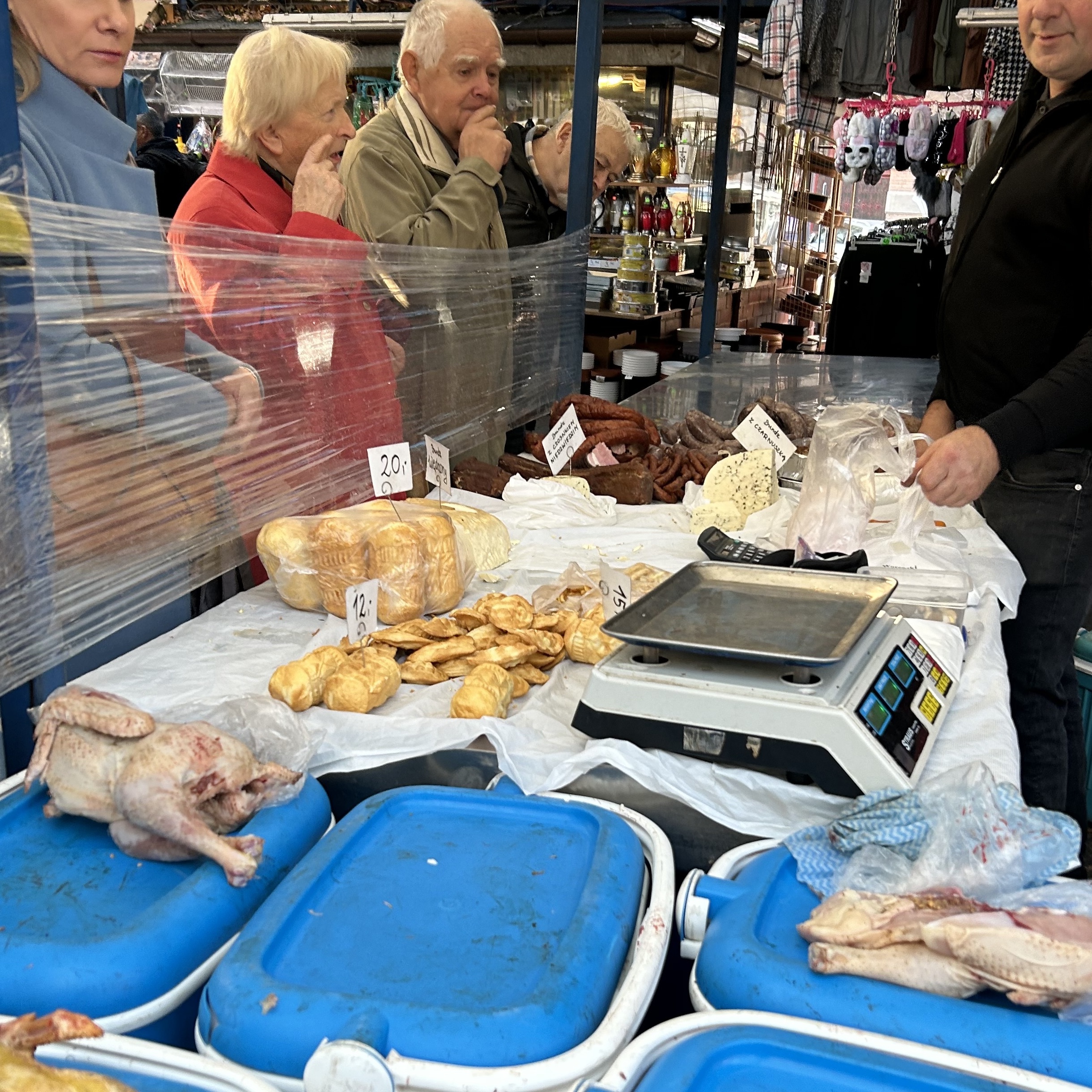
Photo: My favorite vendor at the Stary Kleparz Market, a local farmer who makes the best “Oscypek”—smoked goat cheese. People line up for his fresh chickens and kielbasa, too.
Thanks for reading. I invite you to follow my blog, Present Time, at https://presenttime.blog

It’s important for Americans to understand that we, too, have a right to self-determination ~ Lidka
Lidka, age 54, is a mid-career Polish professional who earned a Master’s Degree at the Jagiellonian University. She is a librarian and parent of an adult daughter. Lidka lives near Krakow and loves to garden and read, particularly science fiction and fantasy. She identifies as a non practicing Roman Catholic. Lidka agreed to share her perspective on recent events in and near her homeland.
Talk about the COVID-19 Pandemic: I remember speaking with a neighbor about feeling apprehensive when the pandemic started; it felt a little like a war. My employer was supportive. We continued to receive our salaries when sheltering in place from March to July (2020). We returned to work in a hybrid capacity; some colleagues continue working from home offices. As for me, I love my home and my garden and would be happy to work from home on a permanent basis!
What is positive about Poland today? We are surrounded by beautiful nature which is very accessible; there are lots of beautiful green spaces in Poland. Additionally, there are plenty of employment opportunities. I am able to work in my profession.
What could be better in Poland today? I wish our government (PiS political party) was more oriented to the European Union (EU); our current government is right wing. Our government’s actions have prevented Poland from receiving its full funding due from the EU, for general and pandemic relief purposes. You must understand that, during Poland’s transformation to a market economy after the fall of communism, “we were like preschoolers playing in a sandbox with teenagers.” We were less skilled in business. I also wish Poland’s social safety net was stronger. It is difficult to count on family when one needs assistance and there are fewer government resources to help. We do not have the infrastructure of wealthier countries (e.g., Germany). I wish Poland had better (i.e., higher) pensions and a more expanded system of care for the elderly.
What are your hopes for Poland? I hope Poland’s government will change in the 2023 parliamentary elections. I hope a more centrist and/or left leaning government wins, one that is more open to the rights of minorities (e.g., LGBTQ, etc.) and the rights of women. I am more introverted and do not participate in street protests; I do, however, support the protestors. I do not believe women should be required to just stay home, cook, clean, care for children and be unquestioningly obedient to their husbands.
What do you feel Americans should know about Poland and the Polish people? Americans should know that most of us do not support the current right wing government. During the last election, many young people did not vote. It was as if they did not understand the importance of voting. PiS gives a lot of money to older people and, therefore, can count on a high voter turnout from them. Some Americans wonder why there are so many “small, independent countries” in Europe. It’s important for Americans to understand that we, too, have a right to self-determination.
This is a very difficult time for us.
I invite you to follow my blog, Present Time, at https://presenttime.blog.
This Time, This Place interviews capture perspectives from Poles and non-Poles, living in Poland today. Views expressed are those of the interviewees and not necessarily those of the interviewer.

I’m sitting in my favorite Polish cafe on Bracka Street, a short walk from Krakow’s spectacular medieval square. Two weeks into my stay, I completed my first book interview and started volunteering with Ukrainian refugees. I’m reveling in Krakow’s rich cultural offerings and take daily walks to Wawel, the magnificent castle overlooking the Vistula River. I am immersing myself in this place, this time. When one speaks the language of a place—even imperfectly—the “aha moments” multiply.
Poland is my first stop on a project to gather stories Poles who experienced WWII German and Russian occupation told their children, here in Poland and, in the Diaspora. This is about interviewing folks of my generation to understand the impact on how we view our world. I am currently interviewing children of Poles who remained in Poland or returned after surviving forced labor camps in Germany. Virtual interviews with the Diaspora begin in January.
As WWII ended, Polish refugees—like my father—fled communism to far corners of the globe. Traumatized by war, they learned new languages and adapted to new cultures, rebuilding their lives in Europe, North America, South America and Australia. I once interviewed a member of Poland’s underground resistance who boarded a refugee ship to New Zealand. Tadeusz and I sat on a bench overlooking Wellington Harbor in 2006 as he recounted the British soldier who helped him sneak from the Russian-held sector to the British-held sector of a defeated Germany. Russian “liberators” would have forced him to repatriate to a Soviet-dominated, newly communist Poland. Tadeusz wanted to live in a free country.
I conducted my first interview with an acquaintance who is a university professor. We were classmates during the 1985-86 academic year. He expressed some hesitancy about tilling the soil of his parents’ wartime experiences. His parents’ stories, to him, seemed quite ordinary. This was where I gently explained that I was seeking stories of ordinary people experiencing extraordinary circumstances. My curiosity lies in how people were impacted amid the deprivations and horrors of a dual occupation, Germany from the west and Russia from the east.
My former classmate, like me, was raised on stories about the war. Viewed through our parents’ childhood lenses, these were not fully formed narratives. They appeared as anecdotes, whisps of stories. What they lacked in historical chronology and literary description was more than made up for with uczucia–feelings. As children, we understood, instinctively, that our parents’ childhoods were disrupted by war, infused with themes of hunger, loss, grief and displacement as bullets whizzed and bombs fell from the sky. As adults, we understand our parents did what they could to shield us from experiencing such horrors, and yet, the stories seeped out. My classmate’s parents’ stories and his reaction to them was familiar, resonant. The differences lie in the details of when, where, and who the protagonists were.
Krakow hums with Ukrainian voices and so many refugee mothers with their little children. I see them on the square and on the Planty—a circular park encircling the core of the Old City. They hold their children’s hands as they speak into iPhones with often serious faces, perhaps talking with their husbands defending their homeland against Putin’s war. I can only imagine these women and children sheltering in basement bomb shelters and enduring far-too-long bus and train rides to cross the border to the safety of a NATO-member country. I envision tearful goodbyes as their boyfriends, husbands and fathers remained behind to fight a Russian invasionary force.
Let me tell you about my “little ones.” I am supporting two Ukrainian teachers, refugees themselves, as they teach at a school housed in a basement suite. Classrooms and meeting spaces are named after Ukrainian cities. I am intentional—at this moment—to not reveal identifying information as the war rages. Working with these beautiful little boys and girls, ages six to eight, feels “right.” Folks helped my deeply traumatized parents learn English when they arrived in the U.S. decades ago.
I am careful to follow the lead of the Ukrainian teachers. They are the experts; I am a “helper” who brings the gift of being a native speaker. I pull out small stuffed animals and a squishy black plastic spider we named “Charlie.” We dance, we sing and we play games to instill familiarity with a new language and alphabet. One of the teachers is writing a series of fables designed to teach the children English’s non-cyrillic alphabet. I get to be her out-loud reader. The teachers work magic keeping the lessons fun. The children’s personalities emerge with the little girl in auburn braids whose pronunciation of “th” (very difficult) is flawless and the energetic boy with a buzz cut who likes to climb under the table. There’s a sweet girl, with dark hair and dark eyes, who was so very shy on her first day who now runs along with the pack during recess. These children enthusiastically give and receive hugs, an important part of our time together. It’s been liberating to “hop like a bunny” and “swim like a fish” amid a swirl of English, Ukrainian and Polish words in the air.
Thank you for reading. Please be in touch as I invite you to follow my blog (https://presenttime.blog/). I invite your questions, too!
P.S. Folks have been asking about Tony. My beloved husband and “best friend ever” is in France, engaged in a French immersion program. He’s been studying French for about five years and hopes an immersion experience will yield a fluency in speaking that he’s already achieved in reading. We miss each other very much AND support each other in this adventure! We look forward to celebrating Thanksgiving in Poland with Aleksandra, Alan (hopefully) and family!
I invite you to follow my blog, Present Time, at https://presenttime.blog.
Photo: Ukrainian children’s backpacks at school
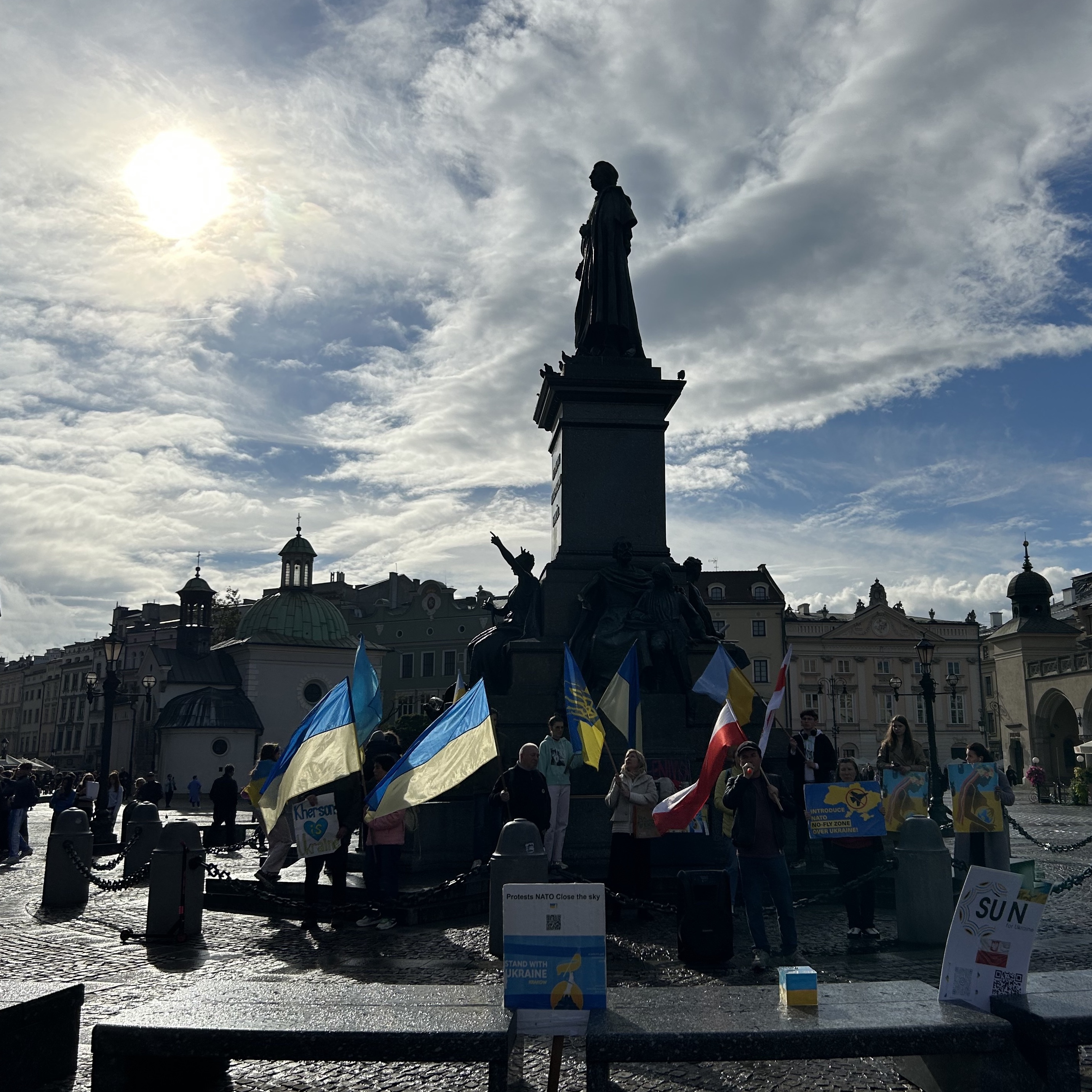
Under Mickiewicz*
They ask NATO to “close” the sky
Winter is coming
KBS, 10/25/22, Krakow
*Adam Mickiewicz (1798-1855) is considered the national poet of Poland

*Resource from U.S. Holocaust Museum:
NAZI POLICY FOR POLES (aka “Untermenschen” = “Subhumans”) AIDING JEWS: https://www.ushmm.org/learn/timeline-of-events/1942-1945/german-poster-announces-death-penalty-for-aiding-jews
PC: Elizabeth Mayer

Little ones read books
As Putin wages HIS war
Just beyond the San*
KBS, 10/18/22, Krakow
*This river straddles the Polish-Ukrainian Border

Wearing her slippers
She sweeps golden autumn leaves
Dluga Street is clean
KBS, 10/17/22, Krakow

My parents left Poland amid war and political oppression. I’ve always been drawn to this place—the history, the architecture, the landscape, the people—a place my Mother and Father were forced to abandon.
When I was sixteen, I emptied my bank account of all but ten dollars–so the bank would not close the account—to buy a plane ticket to Warsaw. I weighed the decision carefully as I was saving earnings from my restaurant job for future college tuition, something my parents could not afford. I took the risk and the lens through which I viewed our world changed. I met aunts, uncles and most of my nearly forty cousins. I saw people who resembled me and could pronounce my “ethnic” last name. I visited palaces, parks, and cathedrals. I undertook emotional journeys to the memorials to Poland’s WWII citizens slaughtered, imprisoned, displaced and dehumanized by Nazi and, later, Soviet occupiers. I learned Poland lost six million citizens during WWII; three million were Polish Jews and three million non-Jewish Polish citizens. My Uncle Tomek’s father died at Auschwitz. My Uncle Mietek was captured in a street snare in which Germans kidnapped citizens to ship them to Germany for forced labor. He managed to escape, walking nearly one hundred kilometers to his village. He disguised himself by carrying a crop on his shoulder, appearing as a “local” as opposed to an “escapee.” My father spent over three years in Nazi Forced Labor Camps. My mother’s earliest memories are of German bombs falling from the sky.
I returned to Poland at nineteen on a Kosciuszko Foundation Study Abroad Scholarship, spending 1984-86 at Krakow’s Jagiellonian University. Ration cards, Black Market money exchanges and the Chernobyl Nuclear Accident flavored the experience as I dug deeply into my Polish history studies. I made lifelong friends in that magical medieval city.
I began my career and married. My husband accompanied me on “every few year” trips to visit family, hike Poland’s Carpathian Mountains and, occasionally, swim in the Baltic. A three-month Family Sabbatical in 2001 allowed me to volunteer in Poland’s first domestic violence prevention shelter while my husband took a break from corporate life and our daughter attended a Krakow preschool.
And so we visited, every few years, to maintain a connection. This post-pandemic trip brings me back to Krakow to conduct research for a writing project and volunteer. I plan to support some of the many Ukrainian refugees fleeing Russia’s attack on their homeland.
I do not look at the U.S. through rose colored glasses, nor do I do the same with Poland. Each country possesses a unique and complicated history. I’ve been fortunate to witness Poland’s waning years of communism, nascent return to capitalism, and acceptance to NATO and the European Union.
I return again to check the pulse of my parents’ homeland. How are people living? What are they saying? How has the substantial influx of Ukrainian refugees impacted society? What does the specter of threatened Russian aggression mean on this former Soviet Satellite nation?
I hope you will follow the images and stories I share from “on the ground” in my beloved Krakow. I invite you to follow my humble attempt to make sense of what I see and experience. Please send questions and observations my way. Poland keeps calling me.
I invite you to follow my blog, Present Time, at https://presenttime.blog.
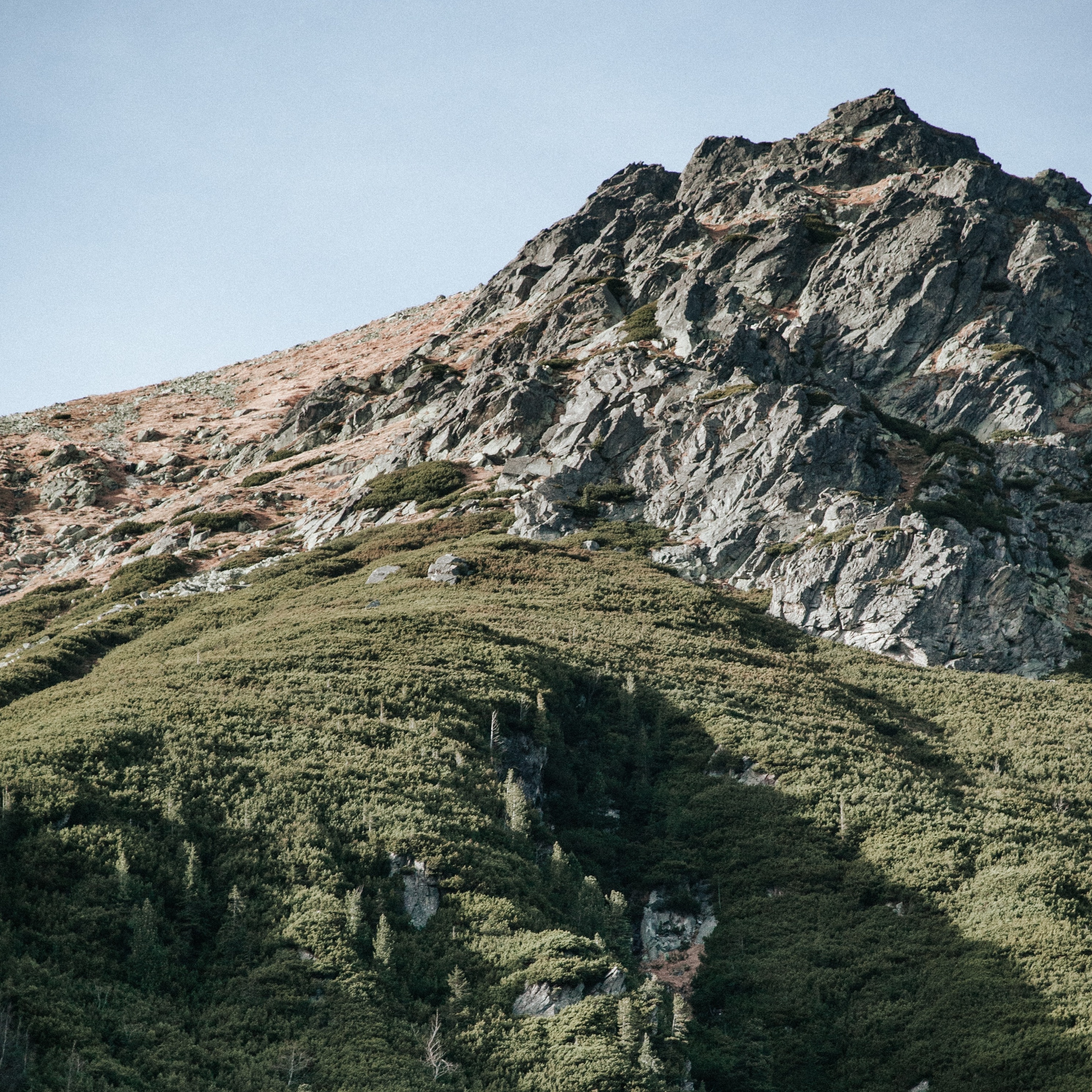
Photo Credit: Mariusz Słonski, Source: Unsplash
 Present Time