Note from Vienna


Aloisia commissioned the artwork in her husband Franz’s memory in 1906. The mosaic, depicting St. Jerome holding a cross and skull, is one of several adorning the exterior of the St. Anthony of Padua Church in the Favoriten DIstrict of Vienna. I wondered about Aloisia and Franz and their lives in Vienna as subjects of the Austro-Hungarian Empire. I loved how the mosaic serves as an enduring representation of their love.

Franz Joseph 1 (1830-1916), Emperor of Austria and King of Hungary, laid the corner stone of St. Anthony’s on November 10, 1896. The massive Romanesque and Byzantine church was created to meet the demand of a burgeoning Roman Catholic population. There were marriages to consecrate, babies to baptize, and funerals to commemorate lives lived. I stood outside taking in the soaring towers, arched windows and raised dome of the red brick edifice.

I chose to stay in the Favoriten District of Vienna for its proximity to the main train station and walkability to the city center. I booked a room at the newly renovated Boutique Hotel Kolbeck, noted for being friendly to solo travelers. I’ve learned—from my mistakes—to scrupulously study reviews of accommodations, inserting words like “clean” and “quiet” into search tools. My room was, indeed, clean and quiet with crisp sheets and a pristine private bathroom. My space was small, reminiscent of a single in a dorm. It suited me just fine as I was only there to sleep. My window overlooked an inner courtyard. 

The five-hour train from Katowice, Poland, chugged through the Czech Republic and skimmed near the Hungarian border before depositing me in Vienna. The largely agrarian landscape hosted occasional solar arrays and wind farms, reminders of the need to seek alternative energy as the region recovers from Storm Boris. 

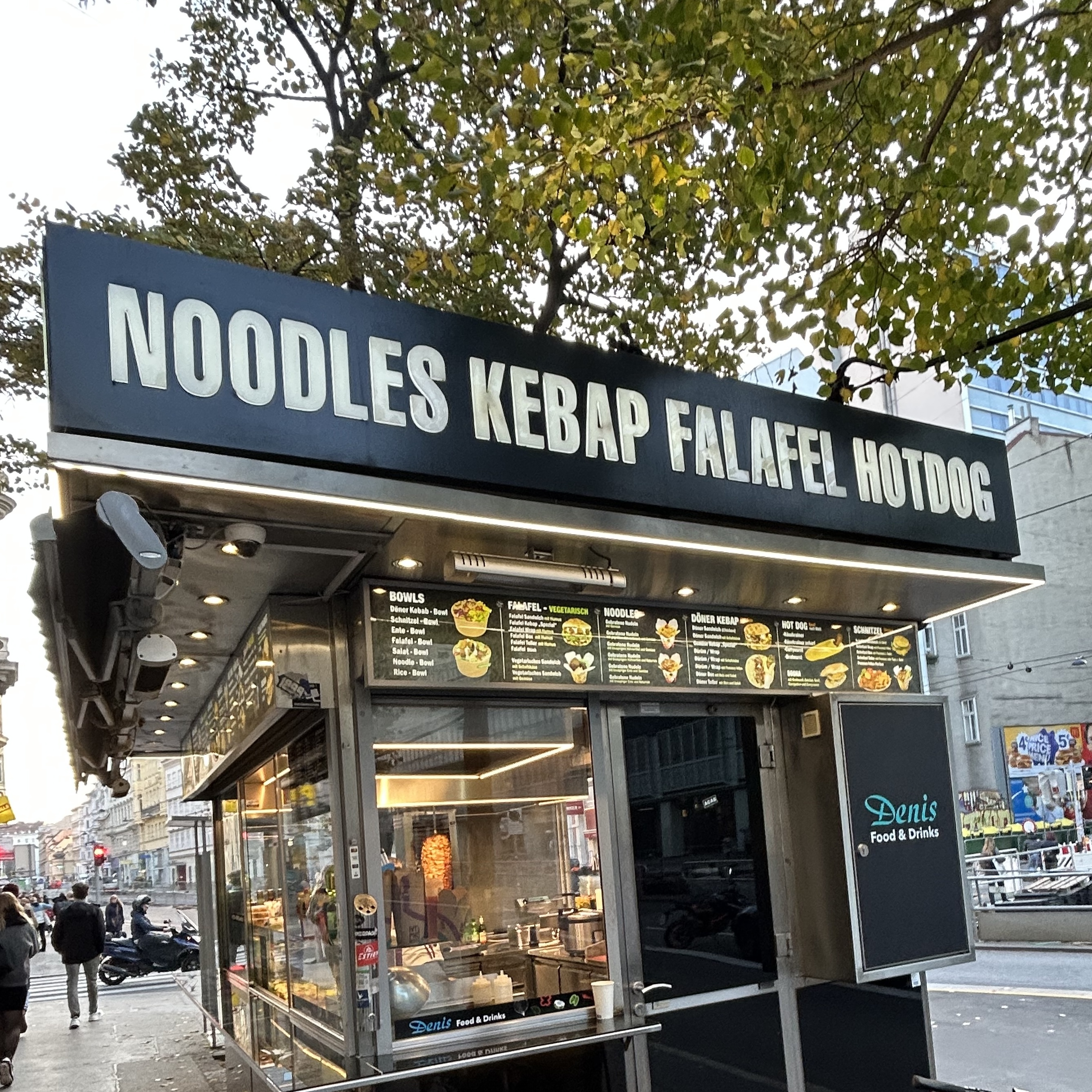
Arriving in Vienna in late afternoon, I ditched my luggage and set out in search of dinner and familiarity—on foot. The pedestrian way along Favoriten Street was bustling. Packs of high schoolers carried backpacks and ate kaiser pommes (french fries) doused with mayonnaise or ketchup. Toddlers played on the plaza under the watchful eyes of their mothers. The neighborhood evoked a familiar, working class vibe, with practical shops dispensing kitchen utensils, linens, and hosiery. I noticed many women wearing hijabs as I walked past Halal butchers and grocery stores. A food kiosk boldly advertised “Noodle – Kebap- Falafel – Hotdog” in a nod to diversity.  Men sat at outdoor cafes sipping tiny cups of coffee or glasses of hot tea. So many of them smoked. The smoke triggered a headache, thankfully cured by Advil in my backpack. I heard lots of German and Arabic with smatterings of English, Polish and Ukrainian. 

It was on this walk the I happened upon St. Anthony’s. Its spires caught my eye, peripherally, as I walked along Favoriten Street. I chose to detour.  A young boy was shooting baskets with his father on a court adjacent to the church. A group of teens sat outside on a bench, smoking. A woman left the church and I noted graffiti on the door as it closed. The massive entrance doors were locked due to the late hour. Signs advised visitors to not smoke, eat, or skateboard along the entryway.

I circled the building, snapping photos of its external mosaics peering down from above. This is how I found Aloisia and Franz. Graffiti, in German and Arabic encircled the exterior of the church. For the record, I am not a fan of graffiti. Encountering it on a place of worship is particularly troubling to me.

Later that evening, I conducted some research. I learned St. Anthony’s was vandalized with spray-painted statements including “Islam will win” and “religion over secular life.” Additionally, fifty youths broke into the sanctuary in October 2020, shouting “Allahu Akbar” (“God is the greatest”). This occurred shortly after the murder of teacher Samuel Paty in France. I further learned there has been an uptick in graffiti targeting Vienna’s Muslim, Jewish and Christian houses of worship since the October 7, 2023 Hamas attack on Israel.

So, what are peace-seeking people to do? The website for St. Anthony’s cites a kindergarten open to and respectful of all children of varying faiths, a weekly flea market and free community meal, a meet-up for seniors every Sunday at 3:00 p.m. and, of course, Masses—in German, Polish and English, the latter for African congregants.

Here’s to the peace-seekers, the bridge-builders, and the enduring legacy of love.

Sources:   https://at.usembassy.gov/wp-content/uploads/sites/70/2020/12/2023-Report-on-International-Religious-Freedom-in-Austria.pdf, https://www.intoleranceagainstchristians.eu/index.php?id=12&case=8021

I invite you to follow my blog: https://presenttime.blog

What would George think?


I slid open the wooden drawer of the university library’s card catalog to thumb through weathered index cards bearing authors’ names, titles of their works, and call numbers. I searched for a particular mid-alphabet author. Somewhere between Okolski, Szymon and Orzeszkowa, Eliza, I found what I was looking for:  Orwell, George (1903-1950), 1984. This listing contained a subtle warning: Access requires permission from faculty. 

It was 1984. I was studying on exchange in Communist Poland at Krakow’s Jagiellonian University. Soviet-style repression—limiting freedom of movement, freedom of expression, freedom to gather, and freedom to read books censored by the government—like Orwell’s—defined the confining parameters under which Poles lived. 

To seek permission from a professor to read a censored book could bring one under suspicion and, potentially, risk a highly-coveted place at the university. 

I arrived in Poland a few months before, a wet-behind-the-ears, novice traveler. At nineteen, I’d flown only twice before. I purchased a Boston to Brussels plane ticket and another ticket for a thirty-hour train to Warsaw. The last leg of the trip would be a three-hour express train from Warsaw to Krakow. I was young, excited and looking forward to the 60-hour, 4092-mile journey.

I purchased an enormous travel trunk. Ten months of clothing, shampoo, soap and deodorant were stuffed inside as I prepared for fall, winter and spring in a country where consumer goods were in short supply. I stupidly packed (heavy) books. My Mom commandeered part of my trunk, adding clothing, coffee, chocolate and Polish ham for me to bring to family. The irony of the last item: Polish ham was sent out for export to bring in cold, hard cash from the West. Ham was rarely available in Polish stores.

My carry-on luggage included sealed envelopes bearing names of family members containing hard-earned cash gifts from my parents. Amid shortages and rationing, the Communist government established special stores called Pewex that sold medicines, coffee, chocolate, calculators and appliances—items not readily available in shops. What was the hitch? You could only buy these items with foreign hard currencies like U.S. Dollars, West German Deutsche Marks, French Francs and British Pounds. What was the problem? Private ownership of hard currencies was forbidden by the government. This spawned an elaborate Czarny Rynek – Black Market of currency exchanges. I remembered my Aunt Jancia hid carefully folded dollars in a nondescript coffee can in her kitchen.

Landing in Brussels, I retrieved my enormous trunk from the conveyor belt. One of its four wheels went missing somewhere between Boston and Brussels. I spent the day DRAGGING my laden luggage around Brussels. Bumping along the cobbled Grand-Place square provided lots of “eye candy” for my sleep-deprived eyes. I remember ornate guild houses, the soaring Cathedral of St. Gudula, and Manneken Pis, the famed water fountain with a sculpture of a little boy peeing. 

I dragged my trunk and myself to Brussels’ Central Station for the thirty-hour train to Warsaw. I slept haphazardly, keeping half an eye on my trunk in the corridor – it was too large to fit in the compartment. 

Somehow, I landed at my Krakow dorm – Dom Studencki “Piast” at 47 Piastowska Street in Krakow. Directed to my room, I walked through the dimly lit corridor on the second floor and noticed two things: cloth baby diapers drying on an improvised clothesline in the hallway and the aroma of simmering soup.

I entered a new world, a Communist world. I learned. I listened. I observed.

My classroom lessons were complemented by learning to covertly trade dollars on the Black Market while mastering the art of securing a spot in long lines for rationed pieces of kielbasa and scratchy, gray and speckled toilet paper. I passed large images of Lenin and red-lettered banners around the city extolling the virtues of socialism and the ills of capitalism. I quietly gathered illegal, pro-Solidarity newsletters dispersed by the underground. A vicious political regime imprisoned dissenters. Soon after I arrived, secret police kidnapped and murdered Jerzy Popieluszko, an outspoken, pro-democracy Roman Catholic Priest.

Communist dogma espoused creation of a classless society. This was a lie. Soviet-imposed communism in Poland at the end of WWII created special privileges for those who agreed to a Faustian bargain, signing on to membership to the Communist Party. (Note: Poland had the lowest Communist Party membership within the Eastern Block.) These privileges included express lanes to securing job promotions, a telephone, a flat, or a humble Polski Fiat. Young married couples waited years for apartments and were forced to lived on the other side of the wall of their parents in their childhood bedrooms in drab Socialist Realist housing estates.

Orwell had Big Brother. Poles had “Uncle” – their reference to the Soviet Union and its interference in their lives. Poles were not fools. They learned navigate this unjust political and economic system via a vast subterranean world where people bartered for needed items in their kitchens, in dorm rooms, and via the trunks of their cars…if they had a car.  Words like załatwić and kombinować — references to “arranging for” hard-to-find items — entered the Polish lexicon. Poets, playwrights, artists, musicians and filmmakers plied their crafts, promoting pro-democracy ideas, engaging metaphor and symbolism, to push past censors.  

I decided to not request special permission to read Orwell’s book. I’d already read it in the U.S.  Forty years later, I am back in Krakow. It is 2024, not 1984. I recently stepped inside the Księgarnia pod Globusem bookstore on Długa Street and spotted Orwell’s book, in Polish. Who could have imagined?

Today, Poland is a parliamentary democracy with a growing economy. Poles voted out the right-wing Prawo i Sprawiedliwość (Law and Justice) ruling party in 2023, handing victory to the centrist Platforma Obywatelska (Civic Platform). Poland is experiencing slow but steady cultural shifts that are more aligned with western Europe. 

Poland opened its borders to millions of Ukrainians seeking refuge from Russia’s full-scale invasion of Ukraine in February 2022. Today, Ukrainian is commonly heard on the streets and in shops. Poland’s response reflects compassion for human suffering in spite of complicated Polish-Ukrainian history. I suspect another factor is at play. Polish collective memory is marked by a deep, visceral trauma and awareness of Russian and, later, Soviet occupations, deportations, subjugations, displacements and murder of its people at the hands of its neighbor to the East. 

As in 1984, I am here to learn, listen and observe, clear-eyed and with an awareness of the history of this beautiful, resilient, and complicated place that I love. I wonder what George would think.

What’s up next in the Present TIme Blog? I’ll offer a look at Poland’s response to Europe’s migrant crisis as Polish Prime Minister Donald Tusk takes a page from Finland’s controversial playbook for managing the Russo-Finnish Border. Stay tuned.

I invite you to follow the Present Time Blog: https://presenttime.blog

Raging Waters — Finding Hope

“Now I know what it feels like to be a refugee,” my sister Jane said. She’s been forced from her home in Weaverville, North Carolina. Her house, which she thoughtfully designed and moved into in 2022, was spared Hurricane Helene’s flood waters, but the storm knocked out electricity, water and cell service for an indeterminate period of time. Residents were advised to evacuate. My sister drove a winding and mottled path, around washed out, hilly roads as segments of the highway were impassible. She found refuge at the home of a friend who offered a place to stay with warm showers and functioning toilets.

Jane was drawn to the beauty of western North Carolina decades ago. Settling in Asheville provided robust entrepreneurial opportunities, quality schools for her sons, and an emergent arts and culture scene. Asheville was considered a climate haven. Today, Asheville is caked in mud. Receding floodwaters reveal a landscape ravaged by the once calm French Broad River.

“Our home has flooded and we’ve lost our apiary,” read the message on my cousin’s Go Fund Me page. His home, in a bucolic town just outside Nysa, Poland, was flooded when Storm Boris swept through Central Europe in mid-September. Photos accompanying the request for assistance show the interior of a modern, airy home, with furniture and housewares floating in brown water. My cousin is a beekeeper. His carefully tended hives are toppled and scattered in mud, devastated by the swollen Klodzka River.

Storm Boris brought record heavy rainfall to Central Europe, flooding areas in Poland, Romania, Hungary, Germany, Austria, Slovakia and the Czech Republic. My Poland-based cousins are gathering funds to help our family near Nysa. I, too, made a donation even though I have not met this particular cousin. His father was my mother’s eldest brother who, as a teenager, managed to escape the Germans who snapped him up from the road in Radgoszcz — as the Germans did in WWII actions called “Lapanki” — to deport him to Germany as a Forced Laborer. (I will share the story of his brave escape another time.)

My father’s family lives in Prudnik, Poland, which lies sixteen miles west of Nysa, on the Czech Border. The New York Times showed drone film footage of flooding in tiny, quaint Prudnik. I thought, “I know this place. I’ve walked here. My family lives here.”

The scene of the cemetery where my grandparents, aunts, uncles and cousins are buried —  including my beloved Uncle Czeslaw, a Carpathian mountaineer, who died in February at age 94 — under water broke my heart. I’ve walked along those graves to place flowers or light a candle. My family didn’t exactly “choose” Prudnik. My father’s parents settled in Western Ukraine, near Lwow (Lviv) in the 1920s when it was part of Poland. They were forced to evacuate at the end of WWII, as borders shifted and their region was absorbed into the U.S.S.R.

Vermont experienced devastating floods in 2023 and 2024. Friends in Central Vermont lost part of their back yard when the normally calm stream on their property ballooned to a torrent, tearing away part of their lawn. Images of a mud-caked Montpelier, streets lined with dumpsters, populate my mind’s eye. Montpelier residents are still waiting for the restoration of a fully functioning post office after the North Branch River flooded downtown in July 2023. Vermont was considered a climate haven.

Here in Krakow, I walk along the Vistula River past the Wawel Palace each day. The river jumped its banks in September but, fortunately, waters did not reach the city’s medieval core.

I cannot imagine. But then, I can. History repeats.

My maternal grandparents were forced to seek refuge for themselves and their children in an unheated attic in Sutkow, a neighboring village, when German soldiers occupied their home. (It’s worth noting the cruelty of the Germans: they booby-trapped the home with grenades before leaving.) Borders shifted at Yalta, forcing my paternal grandparents to become refugees, abandoning the home my grandfather designed and built overlooking the Bieszczady Mountains. They traveled via cattle car, with their children, to find a home in the resettlement area of Silesia and landed in Prudnik. My father arrived in the U.S. in 1949 as a WWII refugee, with one suitcase and hope for a better life. My mother arrived in the U.S. in 1959 with one suitcase, leaving behind her beloved parents and a life limited by a corrupt communist system.

Where do I find HOPE amid these climate uncertainties? I think of my ancestors and their resilience. I also think of several young people I know of who are contributing their intellect and talents to unraveling climate change’s emergent challenges — in atmospheric physics, in applying space science to create computer models to anticipate climate impacts on infectious disease transmission and in promoting consumptive alternatives to how we live our lives. I also think of young people creating music, art, prose and poetry that bring joy. Learning to find joy amid uncertainty is key.

I invite you to follow my blog at https://presenttime.blog.

All I know

It’s a blue sky day in Vermont. I’m in a reflective mood as I remember September 11th, 2001. Our daughter was little. Our careers were mid. Our sense of safety was intact.

My husband left for work at the nearby IBM plant early that morning. My daughter Aleksandra — a newly minted kindergartner at Williston’s Allen Brook School — exchanged “kissing hands” with me as I wished her a great day at school. We were less than two weeks into the school year. I was still adjusting to trusting “Nancy the bus driver” to safely transport my child to school. Aleksandra boarded the orange school bus wearing a colorful Howdy Wear jumper and black Mary Janes. The light blue backpack she’d chosen for school seemed enormous on her little back.

I left home at 8:45 a.m. for a 9:00 a.m. meeting at Chef’s Corner. I’d been encouraged to consider and was weighing a possible run for the Vermont Legislature. I met with a kind and gracious Williston Mom who was also considering a run.

“I just heard on public radio that a plane flew into the World Trade Center,” my tablemate said as I arrived at the cafe.

The vision in my head was that of a small Cessna-like plane and an errant, perhaps inexperienced, pilot. I felt a tinge of sadness before the thought slipped from my mind. I could not have imagined two Boeing 767s — American Airlines Flight 11 and United Airlines Flight 175 — barreling into the World Trade Center’s North and South Towers at 8:46 a.m. and 9:03 a.m.

Conversation over coffee commenced. Ultimately, I chose not to run for the Legislature. Although it was flattering to be encouraged to run, the time simply didn’t feel right. I was shifting focus to re-ignite my career following a wonderfully creative and fun, five-year “parenting sabbatical.” I remain grateful to this day for the gift of TIME for arts, crafts, reading, cooking, library story times, playgroups and simply hanging out with my favorite little person. My fellow Williston Mom, an accomplished volunteer with a law degree, would run for the Legislature, win, and go on to serve our town with distinction.

I left the cafe and drove to a neighbor’s home to pick up some paperwork for a community project we worked on together. Steve answered the door and asked, “Have you heard what happened in New York?” The vision of a small Cessna flashed in my brain. “Come in.”

Steve’s living room television broadcast images from a seeming war zone — smoke, fire, debris, people covered in soot and emergency responders coordinating on the ground flashed before me. I was shocked. I was stunned. I immediately thought of those I loved.

I drove home, shaken. There was a message on the answering machine from my husband: “I’m not sure what’s going on. All I know is that I want to talk with you.” How steadying it was when I called his office and he picked up the phone.

All flights were grounded as airspace closed. Williston Schools sent our children home early with sealed envelopes offering thoughtful, age-appropriate guidance on how to talk with our children about what was happening. I remain grateful for the school’s care and expertise. Soon, I’d see the images, repeated over and over, of the planes’ deadly and destructive impact. I’d learn of the attack on the Pentagon and the plane downed by brave passengers in a field in Shanksville, Pennsylvania. I’d begin the nightly wakings as F-16s departed Vermont for weeks — or was it months — to patrol the skies over New York City. Each time I woke to the roar of the engines, I was reminded, “Oh, yes, this happened.”

Twenty-three years ago today, the unimaginable happened. I remain grateful to the helpers.

I invite you to follow my blog at https://presenttime.blog.

I understand the world is tired of this war, the ongoing cruelty, the killing. I just ask people to try to put themselves in our shoes.

“In five years, if the war is over, I see myself living in my family’s cottage in a beautiful natural area near Kharkiv,” Anna said. “I hate dogs.  I want a goat—they have horns and are very smart. I also want a goose. If the war isn’t over, I will continue to volunteer and aid the Ukrainian people who are victims of this war.  I will not stop until Ukraine is free.”

Anna is a 29-year-old English teacher, poet and activist living in Krakow, Poland. She speaks Ukrainian, Yiddish, English and Chinese. She was born in Kharkiv where her mother and stepfather remain with her disabled brother.  Kharkiv lies forty kilometers from the Russian border and continues to experience bombardments.  

Anna’s heritage is Ukrainian, Polish and Jewish. Her great-grandmother was an ethnic Pole who survived the Volhynia Massacre; tragically, most of her great-grandmother’s family were murdered. The Volhynia Massacre is a lesser known, dark chapter of WWII history in which the nationalist Ukrainian Insurgent Army (UPA) murdered an estimated 100,000 Polish civilians in what was then Poland and is today northwestern Ukraine. Polish militias took retaliatory actions, murdering an estimated 2,000 to 3,000 Ukrainian peasants. The history is muddy and not completely clear. Historians today believe the Nazis fomented the violence between the two Slavic ethnicities living under the horrors of German occupation.

Anna emerged from this complicated family history to attend university and work as a journalist in Ukraine. She holds certifications to teach English to non-English speakers. She is a committed feminist. Anna is also a poet who recently performed on stage in Krakow, her current adopted city. She is also a skilled seamstress.

Anna has been involved in refugee relief efforts since 2014 with Russia’s assault and illegal annexation of Crimea followed by military incursions in Luhansk and Donetsk in ever-broadening efforts to annex Ukrainian territory. Putin ignores that Ukraine is a sovereign nation. Anna has helped organize clothing donations as a volunteer. She has also taught English to Internally Displaced Persons (IDPs) arriving in Kharkiv from Luhansk and Donetsk.  

Anna’s desire to travel inspired her to live and teach in Asia. She was teaching in China when she learned of Russia’s February 24, 2022 invasion of Ukraine. China’s support of Russia’s aggression prompted her to leave.  She no longer wanted to live in a country aligned with the invaders. This is how she landed in Poland where she teaches and writes.

“I understand the world is tired of this war, the ongoing cruelty, the killing,” Anna said. “I just ask people to try to put themselves in our shoes. Do you really want me to give up my home, my land and my dreams to people who kill, rape and torture my people?”

Follow Anna:  https://twitter.com/Battlecruiser_a  https://www.youtube.com/channel/UCusrXRqG-O40cyjPQ-swGcQ 
Source:  https://en.wikipedia.org/wiki/Massacres_of_Poles_in_Volhynia_and_Eastern_Galicia

Independence Day: Undoing the Social and Diplomatic Harm of a Right Wing Government

Independence Day:  Undoing social and diplomatic harm

November 11 is Polish Independence Day.  The signing of the Armistice ending World War I on November 11, 1918, paved the way for Poland to regain statehood following over a century of partitioning by the Russian, Prussian and Austro-Hungarian Empires.  This small central European country was restored after, literally, being erased from the map by its aggressive neighbors.  Poles worked to retain their language and culture amid intentional Russification and Germanization.  My grandmother recounted being chastised by occupying Austrian soldiers for speaking Polish in a shop in her hometown of Jaroslaw just before WWI.

This year’s Polish Independence Day celebrations felt particularly jubilant as I meandered Krakow’s medieval Marketplace Square festooned with red and white flags.  Toddlers in strollers waved little red and white Polish flags.  People munched obwarzanki, Krakow’s braided, ring-shaped street snack.  I spied a teen sporting a bright rainbow tote on her shoulder in a nod to Poland’s nascent LGBTQI movement.  I overheard revelers speaking Ukrainian, French, Italian, Spanish, English and Vietnamese among the largely Polish crowd.  A stage with elaborate lighting and accompanying video screen hosted a series of prominent Polish performers leading the crowd in a singalong, lyrics provided.

An enormous Polish flag skimmed the 14th century Ratusz Tower made of stone and brick.  The Gestapo interrogated and tortured Polish citizens here during World War II. The Nazis hung massive red, black and white, in-your-face Swastika banners along the square during their six-year, oppressive occupation of Poland during which approximately six million Polish citizens died.  Three million were Jewish; three million were non-Jewish.  Another three million—one of them was my father—were sent to the Reich as forced laborers. 

I remember walking on the Marketplace Square in the fall of 1984 with my friend Grzegorz, a fellow university student, who said, “See, their (the U.S.S.R.’s) holidays are our holidays.” We were enveloped in a sea of Soviet red flags and banners celebrating the anniversary of the October 1917 Bolshevik Revolution.  Most Poles at that time were vehemently anti-communist.  They were proud of the fact that Poland registered the lowest Communist Party per capita membership of any of the Warsaw Pact nations.  A common joke from that time mentioned two dogs, one Polish and one Czech, meeting on the Polish-Czech border.  The Polish dog said, “I’m going to Prague so I can buy a pair of shoes.”  The Czech dog said, “I’m going to Warsaw so I can bark.”

Why did this Polish Independence Day feel particularly celebratory to me?  Poles voted on October 15, 2023, to free their country from the right wing, populist stranglehold of the Prawo i Sprawiedliwosc--Law and Justice–party (PIS) which maintained a Parliamentary majority since 2015.  Approximately seventy percent of the electorate turned out, with younger voters playing a pivotal role in results.

Poland’s new coalition government, comprised of the Civil Platform, Third Way and The Left political parties, is poised to assume leadership and elect a Prime Minister.  The victors released a joint statement promising to work together to: restore rule of law, annul Poland’s near-total abortion ban, depoliticize public media, prosecute hate speech made against members of Poland’s LGBT* community, and separate church and state.  They are committed to repair relations with the European Union (EU) for this eastern outpost “edge” of NATO and the EU which borders Ukraine, Belarus, and Russia to the east. In my view, the coalition is striving to undue social and diplomatic harm of eight years of PIS control. 

It will not be smooth sailing for the new government.  Poland’s constitution divides leadership between the Prime Minister, as head of government, and the President, as head of state.  Donald Tusk, leader of the Civic Platform Party will, likely, become Prime Minister, a role he served in from 2007 to 2014.  He was also President of the European Council, comprised of heads of state of EU members charged with informing and leading the political direction of the EU.  Poland’s new coalition government will need to find ways to co-opt and/or work around Polish President Andrzej Duda, a member of the PIS Party.  Duda’s term expires in August of 2025.

I’ve been informally polling family, friends and acquaintances who, admittedly, tend to lean more liberally, like me.  I’m a bit of a regular at a café near my flat where the baristas and I are on a first name basis.  These young Poles churning out espressos, lattes and cappuccinos, voted to oust the PIS government.  Overall, the Poles I talk with are happy with the elections results.  I am hopeful Poland will find a positive and increasingly open and tolerant way forward.  (The waning influence of the Roman Catholic church is a key factor and merits another blog posting from me.  Many Poles are redefining spirituality on their own terms while disconnecting from the dogma of a heavy handed, politicized church.)

I suspect Poland’s deep history of trauma—a legacy of unfortunate geopolitics—impacts a nation and its people for generations. The U.S.’ relative isolation can complicate Americans’ ability to truly understand the historical realities of Central Europe.  I am grateful to be in Poland TODAY to celebrate what the collective spirit of a resilient people can endure. 

*This is the acronym the new government used.  Awareness is growing in Poland and, I suspect, this acronym will be broadened in time.

Praying for Peace

I snagged a table at the Boulangerie du Theatre in Sete, a small French town on the Mediterranean.  As I waited for my husband, two Muslim women dressed in silky, black chadors, sat next to me with three small children. 

Bon jour,” one of the women said, offering me a gentle smile.  I returned her greeting and smiled at the little ones.  I noticed five glasses of orange juice and three plain croissants, for sharing, on her tray.  Tony and I sat reading, sharing a pain aux raisin while sipping our coffee and tea.  I overheard the women speaking what sounded like perfectly accented French.  This has been my experience of many Muslim women I’ve observed here in France:  they are linguistically integrated, yet sartorially distinct.

It’s been two weeks since Hamas’ heinous attack on Israel.  Tension hangs in the air.  France’s President Emmanuel Macron called up 7,000 soldiers to provide added security across the country.  There’s a sense of Muslims and non-Muslims tiptoeing around each other.  I can’t quite describe the feeling.  How does one be supportive of the the innocents—on both sides—amid perennial hurt in a region I understand so little about? 

President Macron’s government, sadly, reported a dramatic uptick in antisemitic acts since Hamas’ attack and Israel’s retaliatory bombing of Gaza.  I’ve read about menacing graffiti and child-on-child verbal and, in a least one case, physical aggression in French schools.  Ten thousand French police are actively guarding Jewish sites across the country, including schools and synagogues. 

Six days after the Hamas attack, Dominique Bernard, a literature teacher, husband, and father of three daughters, was stabbed in the parking lot of his school in Arras, in northern France.  The alleged perpetrator, a former student of the school, was a Muslim immigrant from the Russian region of Inushetia.  Banners were hung on the Montpellier Opera House with Bernard’s image  and that of Samuel Paty, another teacher who was murdered in October of 2020 by a Chechen Muslim refugee. The banners read:  Hommage aux victims du fanatisme islamiste.  Montpellier soutient le professeurs de la Republique.  Translation:  Tribute to the victims of Islamist fanaticism.  Montpellier supports the teachers of the Republic.

President Macron forbade pro-Palestinian protests while allowing pro-Israel demonstrations.  Palestinian supporters defied the ban when several thousand protesters gathered in Paris on Sunday, October 15th ; they were dispersed by police with tear gas.  There have been smaller Palestinian protests here in Montpellier where we are staying.  A court challenge reversed the ban and a large pro-Palestinian protest occurred in Paris on October 19th, followed by smaller protests on October 21st in Montpellier, Nimes and other French cities.

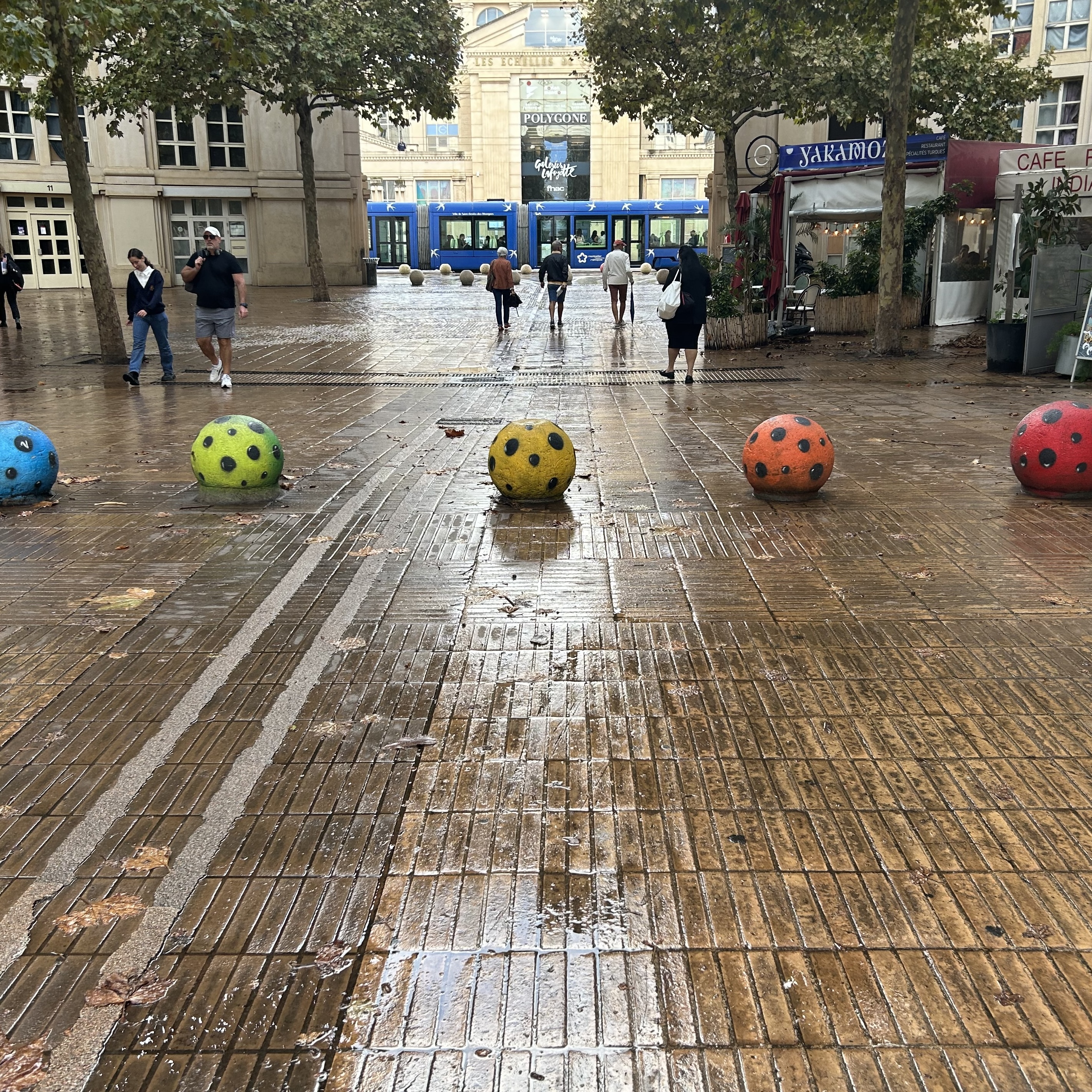
Reminders of France’s all-to-frequent terrorist attacks are built into the physical infrastructure of French cities.  Montpellier’s main pedestrian square, Place de la Comedie, is surrounded by painted K-rails to prevent vehicular assaults.  Sidewalks and entries to plazas are embedded with steel posts; granite stanchions; and, with an eye towards a bit of whimsy, painted concrete “balls.”  If you look closely, you see cut marks from when these protective measures were added to original design features.  Squads of heavily armed soldiers patrol parks, sidewalks, and shopping areas with their assault rifles at the ready.  France’s experiences of terrorism, including the 2015 Bataclan attack in Paris, 2016 truck ramming at a Bastille Day celebration in Nice, and 2018 mass shooting at the Strasbourg Christmas Fair are woven into the collective psyche of the French people.  And, lest you forget while sipping a café au lait at an outdoor café,  Vigipirate—an anti-terrorism security force vehicle may pass by, at a slow, watchful pace.

France is home to Europe’s largest Muslim population; Muslims represent approximately four percent of the population.  Women wearing hijabs and chadors are a common sight. France is also home to Europe’s largest Jewish population although their representation is much smaller, estimated at 0.67 percent of the population.  Preserving one’s culture while integrating into broader society, the latter being key to garnering social capital for oneself and one’s children, presents challenges.  Sadly, in France, all too often we learn of disaffected, disenfranchised Muslim youths who, feeling they have nothing to lose, are at risk of becoming radicalized.

Hamas’ brutal attack on Israeli citizens demands our attention and condemnation.  Hamas militants need to be brought to justice.  Innocent Palestinian civilians also deserve peace and security.  I remember travelling to New Zealand when President George W. Bush occupied the White House and engaged in military actions contrary to my political beliefs.  Some Kiwis were critical, assuming I supported the President when I did not.  I think of Jews who do NOT support Jewish settlements in the West Bank and Benjamin Netanyahu’s, right-wing, hawkish ways.  I think of Palestinians who do NOT support Hamas and who do NOT support the violence aimed at Israel. I think of Jews and Palestinians who simply want to live their lives in peace.  I worry about the death and destruction on all sides. 

I wonder how much of the Israeli-Palestinian conflict is about limited resources…limited water, limited land, limited agency.  It is so much easier to live peacefully when there is abundance.  Let us hope peaceful solutions can be found.

I invite you to follow my blog at https://presenttime.blog.

Sources:  https://www.jpr.org.uk/countries/how-many-jews-in-france, https://www.statista.com/statistics/868409/muslim-populations-in-european-countries/#:~:text=Approximately%205.72%20million%20Muslims%20were,million%20and%204.13%20million%20respectively.

https://www.lemonde.fr/en/france/article/2023/10/14/french-teacher-killed-in-arras-reignites-trauma-left-by-2020-murder_6174079_7.html

He did not choose war.  War caught up with him.  His photographs remain.

Note to Readers:  My heart is heavy as I think of current conflicts and suffering in our world.  If I had a magic wand, I would wave it and offer a healing incantation.  For now, I offer this story of war and remembering.

The family’s ancestral home near Barcelona was set to be demolished to make way for new construction.  Two red, cardboard boxes in the garage held a secret – five thousand, mostly unpublished, photos taken during the Spanish Civil War (1936-1939).  

Antoni Campana (1905-1989) documented scenes with his Leica Camera as his beloved Barcelona crumbled amid fighting between Republican (Loyalist) and Nationalist (Francoist) forces.  The Republicans, allied with the USSR, supported the democratically elected government of the Second Spanish Republic (1931-1939).  The Nationalists, allied with Germany and Italy, supported General Francisco Franco’s military junta that overthrew Spain’s democratically elected government.  

The Nationalists’ relentless bombing terrorized inhabitants and marked Barcelona as the first European city to experience indiscriminate attacks on civilian homes, hospitals, schools and shops.  This pattern of attacking civilians would continue into World War II.  An estimated 2,500 to 3,000 Barcelonans died amid 385 aerial attacks.

Campana’s images of children playing amid rubble, women waiting in line for bread, community feeding kitchens, and desperate and weary refugees from Malaga show the impact of war on everyday people.  He also documented the destruction of Roman Catholic churches alongside banners displaying handsome, “fatherly” images of Lenin and Stalin—reflecting the politics of anticlerical factions among the Republicans.  Campana’s photo of a young, pregnant, anarchist militia member named Anita Garbin (1915-1977) made her the “Madonna” of her movement, a revolutionary saint.  Franco’s forces prevailed and Anita became one among hundreds of thousands of Spaniards who escaped and lived in exile.  Campana was there to document Franco’s Victory Parade in Barcelona in February 1939.  German, Italian, and Moroccan soldiers—allies of the Nationalists—marched alongside Franco’s troops.

An estimated 500,000 Spanish soldiers and civilians, loyal to the Republican cause, fled to the border, to France, in the La Retirada (retreat).  Most were on foot.  This slow-moving mass of humanity—comprised of civilians and soldiers, some of whom were injured—were escaping Franco’s vengeance.  French authorities, unprepared for this massive influx, were hostile and suspicious of incoming refugees which included anarchists and communists.  

Families were separated at the border.  Women, children, the elderly, and the disabled were transferred to accommodation centers.  Men were sent to internment camps in Argeles-sur-Mer, St. Cyprien, and Le Barcares.  Surrounded by barbed wire and guarded by Senegalese troops, an estimated 60,000 Spanish men were held in humane conditions.  Robert Capa (1913-1954), the Hungarian photojournalist, documented detainees sleeping in holes they dug in the soil. Food was scarce.  Sanitation facilities were non-existent; 1,500 detainees died of dysentery.  

In a lesser-known aspect of history, French officials moved the male detainees to “concentration camps” in the South of France in Bram, Agde, Vernet, and Rivesaltes.  Germany invaded France in May 1940.  These Spanish prisoners would be joined by East European Jews and Romany. 

War continued in Europe.  Some detainees emigrated.  Some returned to Spain at risk of persecution, prison, or death.  The majority were conscripted into unpaid “Squads of Foreign Workers” or the French Foreign Legion.  Some were sent to the gas chambers at Mauthausen, caught up in the German deportations.  Others joined the French Resistance, contributing to France’s liberation on June 6, 1944.  They were finally granted status as “Political Refugees on March 15, 1945. 

Campana, a liberal, Roman Catholic and Catalan nationalist, captured images from varying sides during the Spanish Civil War.  He worked at the propaganda offices of the Catalan government and the Iberian Anarchist Federation.  He served in the air force of the Spanish Republic which opposed Franco.

Campana chose to remain in Spain when the war ended, despite personal risk. Franco’s government set out on a path of revenge, unleashing a massive purge campaign to weed out those who had been loyal to the Republic.  Franco’s extensive list of “enemies” included Republicans; liberals; socialists; Protestants; intellectuals; homosexuals; freemasons; Romany; Jews; and Basque, Catalan, Andalusian and Galician nationalists.  Thousands were expelled from the military and the civil service. Professorships at universities and teaching posts in schools were targeted.  One quarter of Spain’s school teachers lost their jobs.

Campana maintained a friendship with Jose Ortiz Echague, a photographer who had been a Francoist soldier.  Echague helped Campana find work amid the post-war, politically charged witch hunts.  Campana also took chances.  He bravely refused to comply with Franco’s order for photographers to surrender negatives and prints made during the war.  He kept them hidden, not wanting to put former Republicans at risk.

Campana pursued her career as a photographer and photo shop owner in the decades following the war.  He continued to keep the photos hidden, even after Franco’s death in 1975.  He expressed the wish that the photos not be exhibited.  His grandchildren discovered them when cleaning out the family home in 2018.  His family made the decision to share the photos publicly.

I wonder why Campana chose to keep the photos a secret—even after Franco’s death when it was safe to reveal them.  Was this about his own personal trauma and not wanting to revisit the pain of war?  Was it about protecting contemporary Spanish society from images of a deadly, divisive time in their history?

Campana could easily have destroyed the photos, but he chose to keep them.  I wonder if he intentionally “left” the photos in the garage, hoping his descendants would discover them with enough time and emotional distance to receive them as an honored and sacred message from the past.

To learn more and see some of Campana’s photos:  Antoni Campana exhibit at Pavillon Populaire, Montpellier, France:  https://www.montpellier.fr/506-les-expos-du-pavillon-populaire-a-montpellier.htm

I invite you to follow my blog at https://presenttime.blog.

Pola:  We are a small nation in the middle of Europe, wedged between powerful nations and, therefore, subject to their whims

Pola wears whimsical eyeglass frames and loves spending time in the mountains, walking and skiing.  She is a forty-year-old, mid-career Polish professional who earned degrees in journalism and cultural studies.  Pola is a recipient of both ERASMUS and Leonardo da Vinci Scholarships from the European Union, supporting graduate studies and career internships.  She works in guest services at home and abroad, often in mountainous areas where she can hike and ski.  Her deepest aspiration is to become a writer.  Pola agreed to share her perspective on recent events in and near her homeland.

Talk about the COVID-19 Pandemic:  This is a very complex question to consider.  Polish society is very divided, politically and in mentality.  Responses to the virus and lockdowns were highly individualized.  It depended on personality.  Some people did not believe there was a threat.  There is a sentiment among some Poles, given recent past history with an authoritarian communist regime, that “If the government tells us to do something, we still do it our way.”  I lived in Germany and view Germans as more “rule followers.”  People who could, worked from home, creating “home offices” that many continue to work from.  My close friend is a physician and she was super careful about avoiding the risk of infecting others given her place of work.  This meant we could not meet for a beer or a cup of coffee.  Russia’s February 2022 invasion of Ukraine has proven more traumatic for Poles than the pandemic.  

Talk about Poland’s Membership in the North Atlantic Treaty Organization (NATO):  Poland’s membership in NATO is a good thing; it makes me feel a little safer.  I’m not sure, if something happens, that NATO will come help us.  Poland held mutual aid treaties with Great Britain and France on the eve of World War II.  These two western allies declared war on Germany in response to their September 1939 invasion, but did not send troops to help Poland.  One thing is certain, if Russia and NATO engage directly in combat, Poland will be a battlefield again—as in WWI and WWII–between powerful, external forces.  Our geography is not helpful.  

Talk about Poland’s Membership in the European Union (EU):  I have benefited greatly from Poland’s membership in the EU as have many Poles.  I no longer need a visa to travel, study or work with the EU’s twenty-eight member countries.  I’m fortunate to have received EU scholarships.  The concept of a fully integrated body of nations, working collaboratively, is a beautiful idea.  We are learning that national interests are often stronger than communal interests.  France and Germany were early proponents of the EU.  Poland joined later.  Poland received a lot of EU money—for economic, cultural, environmental, etc. improvements.  Our government grew used to being on the “receiving end” of EU funds; they seem less willing to be on the “giving end” as needs arise.  In my view, some Poles have a bit of a “victim syndrome.”

Talk about Women’s Rights in Poland:  There are no rights for women in Poland at this time.  Right now, we are in the middle of Europe and it feels like we are living in the Middle Ages.  It is terrible.  Our government, controlled by the conservative Law and Justice Party (PiS), is in the Middle Ages, closely aligned with a highly political Roman Catholic Church. If you become pregnant in Poland today, you essentially have to give birth.  Doctors are required to register if women are pregnant. Protections for victims of rape and incest of women whose health is endangered by carrying a birth to term, though technically legal, are, in practice, eroded. Some women are afraid to go to the doctor if they suspect they are pregnant.  Doctors who do not abide by the government’s anti-choice laws face prosecution as do private citizens who help women obtain abortions.  Many Polish women travel abroad to obtain abortions as soon as they learn they are pregnant.  I am so angry.  Thousands of women, and their allies, took to the streets to protest—aka “Black Monday” or “Black Protest” on October 3, 2018 following a supreme court ruling severely limiting access to abortion.

Talk about Refugees in Poland:  Different Constituencies, Different VoicesOur government uses fear to control its citizens.  Our government actively searches for “enemies”, demonizing feminists, migrants, the EU, and members of the LGBTQ community.  To me, Jaroslaw Kaczynski, leader of the PiS Party, is similar to Putin; he rules via manipulation and fear mongering.  Kaczynski promotes a narrative that “Poles are white, Roman Catholic and hetero and that everything that is ‘different’ is bad.  God, Honor and Fatherland are very important words for PiS.  If a populace is steered to focus on imagined “enemies”, they are less likely to challenge and/or notice the failings of their government.

  • Crisis on Belarusian Border: Background:  Poland forms part of the Eastern border of the EU and NATO.  Belarusian President Alexander Lukaschenko manufactured a migrant crisis by inviting desperate migrants, largely from Afghanistan and Syria, to fly to Minsk and then bussing them to the Polish and Lithuanian borders where conflicts arose with border personnel.  Some Poles helped migrants who managed to cross; they traveled to the border to provide humanitarian aid.  Some placed Green Lights in the windows, indicating their willingness to help.  Lukaszhenko’s weaponizing of refugees is similar to the governors of Texas and Florida in the U.S.  bussing and flying migrants to New York and Massachusette.  Pola’s thoughts:   In the beginning, very little was written about this in the Polish press.  The border crisis was not present in mainstream conversation.  NGOs shined a light on the humanitarian crisis; unfortunately, these NGOs are not supported by government subsidies. The government rhetoric beat that fearmongering drum with echoes of “Terrorists are coming.”  
  • Refugees entering Poland following Russia’s invaded Ukraine on February 24, 2022: Background:  An estimated 7.4 million Ukrainian refugees have crossed Poland’s border since Russia launched an invasion on February 24, 2022. Ukrainians and Poles share cultural similarities, and shared histories of experiencing Russian “influence”, and shared fear of Russian aggression.   Pola’s thoughts:  When Ukrainians first began arriving, Poland showed its big heart.  Many people opened their homes to Ukrainians.   As inflation soars, the war drags on, and Putin speaks of expanding threats to its former satellite nations (e.g., Poland, Czech Republic, Slovakia, etc.), people are genuinely frightened of what the future holds as winter approaches.  These conditions play into the hands of Kaczynski’s efforts to stoke the embers of ksenofobia—xenophobia. 

Talk about LGBTQ Rights in Poland:  It feels the same as women’s rights in Poland:  members of the LGBTQ community do not have rights.  This follows the government’s narrative of  “Everything that is ‘different’ is bad and, somehow, a threat to society.”  

Talk about Poland’s response to the Climate Crisis:  There is a bit of dichotomy here.  Many Poles see the value of and are embracing practices to reduce their environmental footprint.  People are moving towards vegan and vegetarian diets; some avoid leather products.  Municipalities are launching large-scale recycling efforts.  On the other hand, Poland’s national government doesn’t seem to care. Russia has threatened to cut off natural gas supplies and Kaczynski said, “It’s going to be a difficult winter.” Efforts to reduce coal use and woodburning are being suspended at this time.

Talk about Poland’s 2023 Parliamentary Elections:  I hope the current government will lose.  I’m going to vote against PiS.  I support the opposition—even if I feel they are not pushing for reforms as quickly as I feel they are needed.  There will be a big mess to clean up.  In my view, the Roman Catholic Church hierarchy meddles in politics, exerting too much influence on the government. 

What do you feel Americans should know about Poland and the Polish people?  We have wonderful mountains, a strong sense of hospitality, and our cuisine is very good.   Our language is very difficult for foreigners to speak.  We love foreigners as tourists; we are not, however, as welcoming to people who are ‘different.’  More seriously, we are a small nation in the middle of Europe, wedged between powerful nations and, therefore, subject to their whims.  We have had a hard history with centuries of invasions and partitions.  We love our country.  We are also able to leave Poland and live abroad while still carrying Poland in our heart.  Understanding the Polish mentality takes time, given our unique history.  I think one needs to visit Poland and live here for a while to truly understand.  

What makes you hopeful about Poland?  Many Polish people now have the opportunity to travel and live abroad.  They return to Poland with new ideas and fresh perspectives.  I am not speaking of Poles who live abroad in insular communities as I saw in Reykjavik in what I call “Polish ghettos.”  The young generation grew up with access to a world of ideas via the Internet.  Broadened perspectives are less easily manipulated by authoritarian-leaning leaders.  We are living in uncertain times—with the pandemic and war just over the border in Ukraine.  Hope is still there.

Our history is burdened with ups and downs, but somehow, we still manage to pull ourselves together.  I think also that these uncertain times will pass and the sun will shine again.  There is a Polish proverb, nadzieja umiera ostatnia – hope dies last.  Hope remains, even when times are difficult.

This Time, This Place interviews capture perspectives from Poles and non-Poles, living in Poland today.  Views expressed are those of the interviewees and not necessarily those of the interviewer.

Note:  Pola is a pseudonym selected by the interviewee.

Magda: As a woman and a mother of a daughter, I am counting on women’s rights being restored in Poland

Magda, 37, is a speech and neuro-sensory integration therapist living in southeastern Poland, near the Czech border.  She is married and the parent of three children, ranging in age from eight months to ten years old.  She identifies as Roman Catholic.  

Reflect on your experience during COVID-19 Pandemic:

It was a very difficult time, especially with two small children at home.  There was much uncertainty about the virus.  We felt fear.  We felt concern.  One child was in preschool and one attended primary school.  

A two-week lockdown was imposed on April 10th, 2020.  We could not leave our homes–except for food or medical purposes.  We couldn’t even take our children for walks in the forest.  Regardless, my husband and I resolved to respect the rules and stay positive.  We thought life would return to normal after two weeks, but then, the lockdown kept being extended.   Our children’s classes were virtual until the end of the school year. This was particularly hard for my oldest child who is a special needs student.  We were all emotionally exhausted due to the isolation and quarantining mandates. Still, we all caught COVID-19 early in the pandemic, despite precautions.  Thankfully, we got through it with relatively mild symptoms.  

I worked from home while also supporting our children’s learning.  My husband’s job required his in-person (not virtual) presence.  He engaged the children as soon as he returned from work each day, supporting me in finishing my work or taking time for myself.  I tried to remain positive, reading lots of books and beginning to learn a new language, Spanish.

Summer’s arrival brought somewhat looser restrictions. We went outside as much as possible, taking the kids for walks in nature.  We took a family vacation to Greece.  My husband and I supported each other throughout which was very important.

How do you feel about Poland’s membership in the North Atlantic Treaty Organization (NATO)?

We feel safer as a country, particularly given the invasion of Ukraine—our neighbor—by Russia.  I feel better knowing that the United States is stationing soldiers in Poland with plans to establish a formal military base here.

How do you feel about Poland’s Membership in the European Union (EU)?

As with so much in life, there are pluses and minuses to most every situation.  Open borders and the freedom to travel with ease is a huge PLUS.  We live close to the Czech border and visit frequently. Polish university students are eligible to participate in ERASMUS (an EU student exchange program) and there are entrepreneurial grants available to people opening new businesses.  I was able to establish my neuro-sensory integration practice with EU funding assistance.  Members of my extended family and friends tend to support Poland’s membership in the EU.  We see the clear benefits for ourselves and our children.  That said, I think it is a good thing that Poland did not change its currency from  zloty  to Euros.  

Talk about women’s rights in Poland today:

Women’s rights is a very complicated topic.  I think it’s fair to say that women—regardless of the country in which they are residing—experience difficulty finding balance between “career” and “family” demands.  In Polish, we call this balance zloty srodek [the golden middle].  I am fortunate that my husband is a true partner who helps with the children and supports my career.

(Background:  Poland’s Constitutional Tribunal issued a decision on October 22, 2020 eliminating Polish women’s constitutional right of access to abortion based on, “severe and irreversible fetal defects or incurable illness that threatens the fetus’ life.” Current Polish law, in theory, permits abortion up to 12 weeks in cases of rape or incest and if the pregnancy presents a serious threat to a woman’s life or health.  In practice, this is often not the case.  Source:  https://www.nytimes.com/2020/10/22/world/europe/poland-tribunal-abortions.html)

As a woman and as a mother of a daughter, I do not support the ruling of October 2020.  At the time, 100,000 women took the streets in Warsaw to protest the decision.  Today, in Poland, every pregnancy, verified by a medical visit, must be registered and monitored by the physician.  Doctors can be prosecuted if they do not follow these new rules.  Poland has been identified as having the harshest anti-abortion laws in Europe.  I believe women should have control over their bodies.  I believe women should have a choice.  

As a parent of a child with special needs, I speak from experience when I say that governmental financial assistance for such children is inadequate.  Women of special needs children who stay home to care for them receive a small, monthly stipend of 2,458 zloty (about $554 USD) and are not allowed to work outside the home as a condition of receiving the stipend.  

Our current government (led by the right-wing Law and Justice Party) established the “500 plus” program which, since 2016, pays families 500 zloty ($112 USD) per month for each child under eighteen.  In my view, this is fostering a pathological state in which Polish women are expected to relinquish careers and live as women did in the 1950s.  This, in my view, is a step backward for women as they are pressured to have more children.

Talk about the fall 2021 refugee Crisis on the Belarusian Border when Alexander Lukaschenko, President of Belarus, lured desperate Middle Eastern and African migrants to Minsk and he bussed them to the Polish/EU border.

This was a horrible situation.  From the humanitarian side, innocent people, including those with children were simply dropped off by Belarusian officials and pushed, literally, towards the Polish border.  From the political side, Lukaschenko was manipulating these people and placing them in life-threatening circumstances.  Poles were very divided on this issue.  Some wanted to and actually went to the border to help the migrants.  Others called for Poland to build a wall—like some Americans say about the U.S.’ southern border with Mexico.  

Talk about refugees entering Poland following Russia’s February, 24, 2022 invasion of Ukraine on February 24, 2022.

The Ukrainian refugee crisis feels different.  Poles and Ukrainians share a common distrust of Russia, a distrust born of historical oppression.  We share a similar culture and language, easing the integration of Ukrainians into our country.  I remain astonished by the solidarity Poles are demonstrating by welcoming millions of Ukrainians fleeing the war.  Many Poles host Ukrainians in their homes.  Our small town opened a shelter for Ukrainian refugees and people continue to donate food, clothing, etc.  

A more delicate aspect of hosting so many refugees is that our government immediately provided access to social supports such as education and healthcare and the right to work for all Ukrainian refugees.  The sheer volume placed a burden on Poland’s social services where there were already waitlists for preschool slots and waiting times to see some doctors. As the war continues, some Poles are starting to wonder, privately—not in a public way—how long this will last.  We also realize that some Ukrainians will choose to remain in Poland.  Even in peacetime, the standard of living in Poland is higher than in Ukraine.

Talk about LGBTQ Rights in Poland:  

I am not bothered by how others choose to live their lives and whom they choose to love.  I also do not have friends who are openly gay.  In my view, the PiS government is homophobic.  I read that Poland is considered the “worst” in Europe in terms of rights for LGBTQ people.  I feel really bad because I think that everyone of us has the right to live according to their own rules, provided they don’t hurt others.

Talk about Poland’s 2023 Parliamentary Elections:  

I hope things will change, politically.  As a woman and a mother of a daughter, I am counting on women’s rights being restored.  I believe a woman deserves a right to the decisions made about her body.  My friends who are mothers of daughters are all saying this.

What do you feel Americans should know about Poland and the Polish people?  

I worry, sometimes, that Americans think Poland is somewhat backward.  I want them to know that Poland is a country that has been devastated, for centuries, by wars and partitions, and this knowledge is embedded in the Polish psyche.  I want Americans to know that our history makes us resourceful and entrepreneurial and we are able to unite in crisis. People in Poland are also well educated and intelligent.

This Time, This Place interviews capture perspectives from Poles and non-Poles, living in Poland today.  Views expressed are those of the interviewees and not necessarily those of the interviewer.