

It was a sunny, breezy morning in Warsaw. The Heat Dome which would soon engulf Central Europe in steamy, perspiring heat had not yet arrived. Our brunch reservation was at 11:00. This was a brunch at a special hotel, delayed six years by the COVID-19 Pandemic.
True to form, I woke early, showered, dressed and emerged from our hotel on Grzybowska Street. My departure cleared a path to the one bathroom shared with my sister Chris and her fashion-attentive son who is entering his senior year of college. I’m a bit more “wash and wear.” Joseph met us in Warsaw after completing a semester abroad at FAMU, the renowned film school in Prague.
Walking Warsaw’s streets along with Monday morning commuters, I was struck by the youth, the pace, and the sartorial displays. Young women with perfect hair and subtle make-up navigated sidewalks in sleek ensembles; young men sported fine shoes and crisp, collared shirts. These young professionals were accessorized with ear buds and the occasional, tasteful tattoo. Middle-aged folks like me were trying to keep up — appearances and momentum. I suspect my “sensible shoes” stuck out, just a little.
It seems impossible to believe that this vast, beautiful, tree-lined city, with Paris-like boulevards and stunning architecture was reduced to rubble and ash in WWII. By war’s end, German forces leveled the city, leaving approximately 85% of this Central European capital city destroyed. (Comparison: Approximately 20% to 30% of London was damaged or destroyed during the Blitz.) Ninety percent of Warsaw’s historical monuments and 100% of its bridges were destroyed.
Warsaw’s pre-war population was 1.3 million in 1938. It’s estimated that 700,000 to 800,000 residents died during WWII. This represents a range of 53.8% to 61% loss of life in the capital city. Jews comprised an estimated 10% of Warsaw’s pre-war population
Thousands upon thousands of Varsovians – including those who participated in the Warsaw Uprising of 1944*, the single largest military effort by a European resistance movement during World War II – lay buried in the rubble. Unlike Berlin, there would be no Marshall Plan money from the United States to assist in rebuilding. Poles paid a tax on every single box of matches sold in the country, for decades, to pay to rebuild their capital city. Areas of the city were referred to as Dziki Zachod – the Wild West – into the 1960s as rebuilding continued.
What if our capital, Washington, DC, was reduced to rubble? Imagine the majestic Lincoln Memorial a battered, incongruous heap of granite and marble. Think of the vast holdings of the Smithsonian. Picture the 45.52-carat Hope Diamond or the Napoleon Diamond Necklace, scattered in pieces amid broken glass with security alarms screeching — and looted by an invading army? Warsaw lost its people; its cultural treasures; and its basic infrastructure of roads, bridges, heat, hot water and sewage. All had to be rebuilt in a truly Herculean effort.
I scoped out our brunch meeting place with time on my hands. I entered the vestibule of the nearby Visitation Sisters’ Church of St. Joseph intent on quiet meditation. The original wooden church, dating from 1660, was replaced by a stone structure, with Baroque and Rococo elements, completed in 1763. I heard the sound of a vacuum and noted a layperson at work inside. The sanctuary was closed. It was Cleaning Day.
That’s when I found the Secret Garden. An adjacent doorway attached to the church revealed a serene, walled oasis, sans the hum of the city. I passed the cream colored klasztor – convent – built in 1654, flanked by creamy white roses and sculpted bushes. The resident cat, a gray tabby with amber eyes, followed me around before disappearing in the undergrowth. I was treated to mini-daisies, beautiful purple berries I could not identify, and a vegetable garden with three long rows of tomato plants. A bench under a larch tree invited visitors to sit. I walked deeper into the garden, passing an open window from which emanated a radio broadcast. Small ornaments made of stained glass — a ladybug, a religious image of Our Lady – were suspended on an upstairs window. I didn’t see a single nun. Did they notice me, I wondered?
I hold in my heart a fond memory of staying with cloistered, Benedictine nuns in Warsaw in 1985. We communicated via hand-written notes on a Lazy Susan in our guest room. I learned then that these nuns shut themselves away FROM the world in order to focus on praying FOR the world.
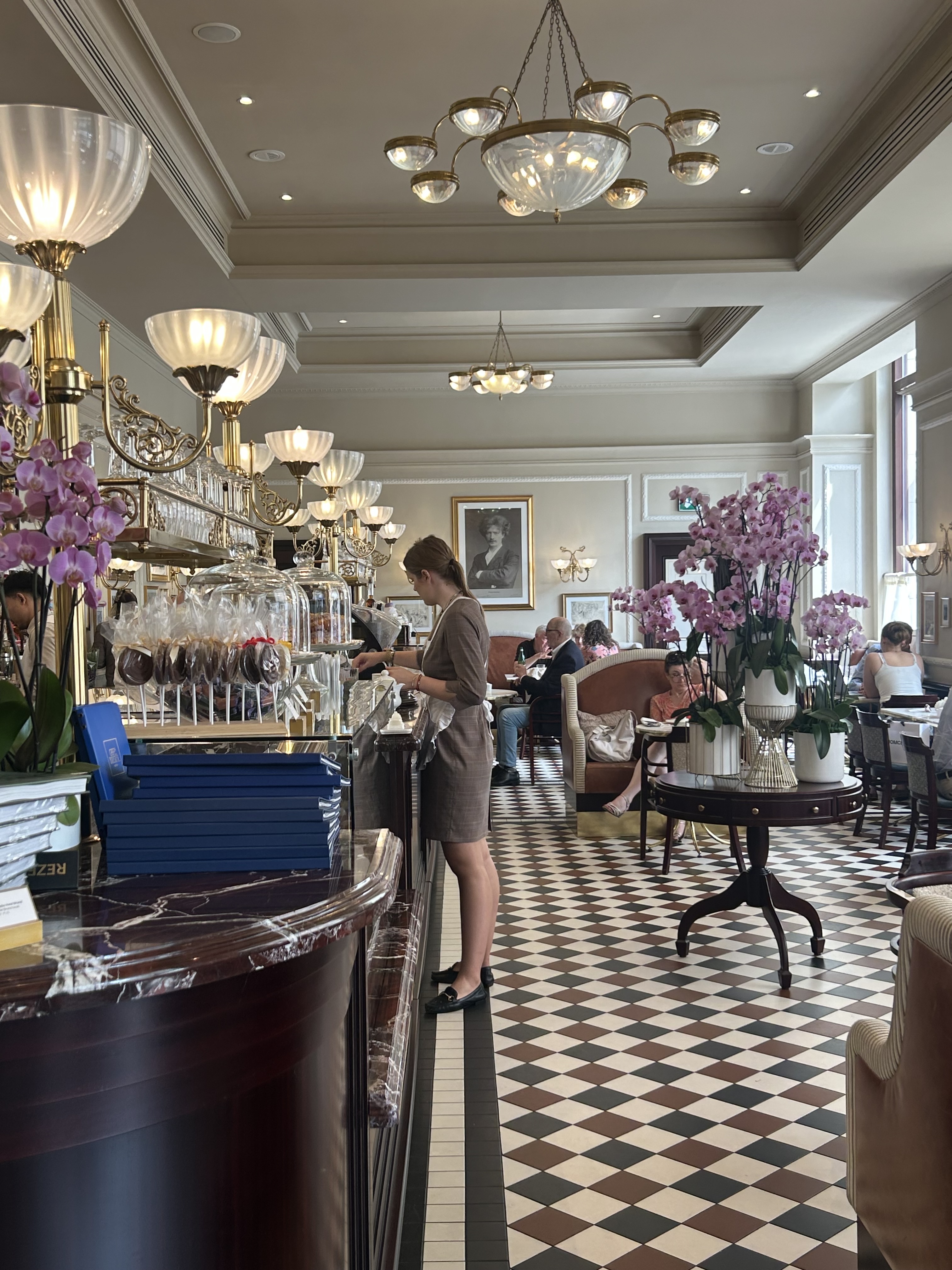
My sister met me for our brunch reservation at the very elegant Cafe Bristol. Joseph overslept, as a young person might do. I have a “thing” for luxurious breakfasts and brunches at fancy hotels. It’s a way to experience the glitz and glamour without a hefty room charge.
Why the Bristol Hotel? This Art Nouveau hotel with Viennese interiors, co-founded in 1901 by Polish pianist and statesman Jan Paderewski, survived World War 1 and World War II INTACT. This makes its existence a small miracle in Warsaw.
Cafe Bristol was “the place” to be seen in Warsaw during the interwar period. Artists, writers and politicians, women in bell-shaped cloche hats and men in Homburgs, sipped vermouth and aperol spritzes. Then, German occupiers requisitioned the hotel during WWII. It fell under state control during the Communist Era, reserved mostly for party elites and foreigners. The hotel closed in 1981, after years of neglect. The 1989 fall of Communism launched reinvestment and restorations of Polish architectural gems that languished for decades. The Hotel Bristol, with its Viennese-style Cafe Bristol, was meticulously restored and re-opened in 1993.
Upon entering the cafe, I noticed the black, copper and white tiled floors. Pressed glass chandeliers were suspended overhead like so many celestial bodies. We were guided to a table by a window, enveloped in natural light amid wood and marble furnishings. It proved the perfect perch to people watch as we dined. We indulged in Cafe Bristol Lattes, topped with real whipped cream, and Turkish-style, poached eggs with yogurt and harissa. We extended the experience by sharing a slice of kremowka – cream cake – reasoning our planned miles of walking that day would justify the caloric intake.
The food was excellent. The service was friendly and professional. The place was deeply evocative and STILL STANDING.
* Warsaw Ghetto Uprising was in 1943.
I invite you to follow my blog at: https://presenttime.blog/

