


Uncle Tomek

Uncle Tomek winked his eye, offered a mischievous grin, and gestured for Aleksandra to follow him. I trailed behind, curiosity piqued and mind prepared to translate my uncle’s Polish to my five-year-old daughter’s English.

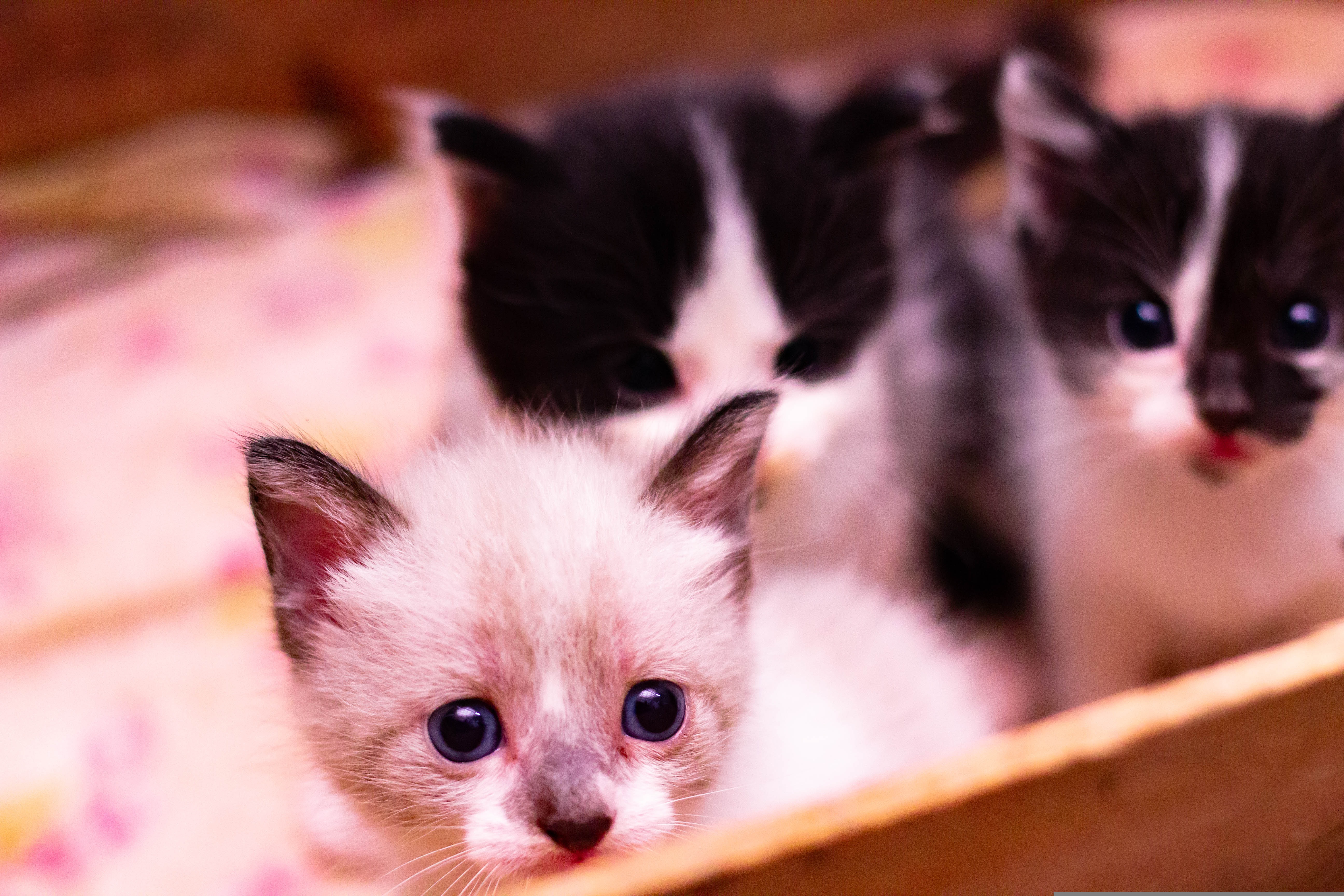
We followed Tomek to the bedroom he shared with my Aunt Genia, my mother’s oldest sister. Tomek knelt down and slid a small, cardboard box out from underneath the bed. What did we see? A brand new momma cat surrounded by mewling kittens. Tomek modeled gentleness, caressing the newly-arrived felines. Aleksandra followed, dipping her little hand into the warm, purring fuzziness. Shared delight and wonder transcended any linguistic barriers.

Tomek loved animals. He worked as a veterinary technician, riding his bicycle or getting lifts from farmers to tend to ailing cows, horses and goats on nearby farms. At home, he favored dogs, small breeds – terriers or pugs – and took pride in training them well. Tomek reveled in giving his LITTLE dogs BIG names like Cesarz (Emperor) and Tyran (Tyrant). He loved cats, too, as evidenced by the box under his bed.

Tomek and Genia built their beautiful, tidy home in Radgoszcz, a small farming village in southeastern Poland during the communist era. Securing cement and rebar amid chronic shortages required tapping into Poland’s then-black market. My uncle designed an advanced heating system. My aunt hand-stenciled walls in traditional Polish nature motifs and sewed lace curtains. I loved visiting them when I was a university student in Krakow. “My” room had a balcony overlooking their fruit trees and garden.

Tomek and Genia also shared a wonderful sense of humor. I loved witnessing their light-hearted banter. They cared deeply for each other. Tomek and Genia were unable to have children. My uncle once told me, “If we’d been able to have children, I’d have hoped to have a daughter like you.” Tomek & Genia taught me what it meant to be a loving aunt and uncle. Growing up in the U.S., I had no aunts, uncles, cousins or grandparents on the continent. Tomek and Genia helped fill a void I didn’t know I had.

Tomek would tease me that I talked too much during dinner. “The table is for eating,” he’d say. “We’ll enjoy conversation with tea and cake in the kawiarnia after dinner.” Kawiarnia means “cafe” in Polish – this is what Tomek called their living room. 

My aunt and uncle were good people. They worked and tended their garden. They helped their neighbors. Genia packed homemade sandwiches and jars of compote made from plums or strawberries for my journey back to school. Tomek, a man of precision, gathered eggs from their coop, wrapping them in elaborately engineered “constructions” of paper and string designed to withstand my cramped bus and train ride back to Krakow. 

Tomek was thirteen years old when Germany invaded Poland on September 1, 1939. Within weeks, Radgoszcz experienced brutal German occupation and pacification. Tomek’s father, Jan, was a politically active farmer before the war, striving to improve standards of living for the community. Jan and Tomek joined the Polish underground as father and son, risking their lives to disrupt German occupation via covert acts of sabotage. 

Tomek’s father died at Auschwitz. Jan was arrested in the spring of 1943 and murdered by the Germans within weeks. My uncle never spoke to me about his father and the immense loss he endured when just a teenager.

I am left wondering why, during the 2026 International International Day of Commemoration in Memory of the Victims of the Holocaust, German Diplomat and President of the United Nations General Assembly, Annalena Baerbach, acknowledged the suffering of  the Jews, Roma, Sinti, LGBTQ+ and people living with disabilities BUT LEFT OUT POLES. See text: https://www.un.org/pga/80/2026/01/27/pga-remarks-at-holocaust-memorial-observance-2026/

Annalena neglected to mention that Poles were the SECOND LARGEST GROUP OF DEPORTEES TO AUSCHWITZ, after Jews. An estimated 140,000-1500,000 Poles were sent to Auschwitz, with 70,000 dying there. Comparatively speaking, an estimated 21,000 Roma and Sinti and an estimated 15,000 Soviet prisoners died at Auschwitz. 

Clarifying this loss of life does not diminish recognition of the enormous loss of Jewish lives, estimated at 1 million, at Auschwitz. Actually, it provides a more accurate picture of the magnitude of German crimes.

I am left to wonder WHY German acknowledgement is lacking. My suspicion? Germans were socialized to believe Poles were untermenschen (subhumans) during WWII. Might it be that they have difficulty shaking this dehumanizing prejudice?

Jan Gondek, my Uncle Tomek’s beloved father, was living a life of meaning. He, too, deserves acknowledgement of his murder at Auschwitz.

Unacknowledged harm reverberates like so many waves of sadness, across generations. Annalena could have done better.

Source: https://www.auschwitz.org/en/history/auschwitz-and-shoah/the-number-of-victims/

I invite you to follow my blog at https://presenttime.blog/
Still Standing: An Enduring Warsaw Cafe

It was a sunny, breezy morning in Warsaw. The Heat Dome which would soon engulf Central Europe in steamy, perspiring heat had not yet arrived. Our brunch reservation was at 11:00. This was a brunch at a special hotel, delayed six years by the COVID-19 Pandemic.

True to form, I woke early, showered, dressed and emerged from our hotel on Grzybowska Street. My departure cleared a path to the one bathroom shared with my sister Chris and her fashion-attentive son who is entering his senior year of college. I’m a bit more “wash and wear.” Joseph met us in Warsaw after completing a semester abroad at FAMU, the renowned film school in Prague. 

Walking Warsaw’s streets along with Monday morning commuters, I was struck by the youth, the pace, and the sartorial displays. Young women with perfect hair and subtle make-up navigated sidewalks in sleek ensembles; young men sported fine shoes and crisp, collared shirts. These young professionals were accessorized with ear buds and the occasional, tasteful tattoo. Middle-aged folks like me were trying to keep up — appearances and momentum. I suspect my “sensible shoes” stuck out, just a little.

It seems impossible to believe that this vast, beautiful, tree-lined city, with Paris-like boulevards and stunning architecture was reduced to rubble and ash in WWII. By war’s end, German forces leveled the city, leaving approximately 85% of this Central European capital city destroyed. (Comparison: Approximately 20% to 30% of London was damaged or destroyed during the Blitz.) Ninety percent of Warsaw’s historical monuments and 100% of its bridges were destroyed. 

Warsaw’s pre-war population was 1.3 million in 1938. It’s estimated that 700,000 to 800,000 residents died during WWII. This represents a range of 53.8% to 61% loss of life in the capital city. Jews comprised an estimated 10% of Warsaw’s pre-war population

Thousands upon thousands of Varsovians – including those who participated in the Warsaw Uprising of 1944*, the single largest military effort by a European resistance movement during World War II – lay buried in the rubble. Unlike Berlin, there would be no Marshall Plan money from the United States to assist in rebuilding. Poles paid a tax on every single box of matches sold in the country, for decades, to pay to rebuild their capital city. Areas of the city were referred to as Dziki Zachod – the Wild West – into the 1960s as rebuilding continued.

What if our capital, Washington, DC, was reduced to rubble? Imagine the majestic Lincoln Memorial a battered, incongruous heap of granite and marble. Think of the vast holdings of the Smithsonian. Picture the 45.52-carat Hope Diamond or the Napoleon Diamond Necklace, scattered in pieces amid broken glass with security alarms screeching — and looted by an invading army? Warsaw lost its people;  its cultural treasures; and its basic infrastructure of roads, bridges, heat, hot water and sewage. All had to be rebuilt in a truly Herculean effort.

I scoped out our brunch meeting place with time on my hands. I entered the vestibule of the nearby Visitation Sisters’ Church of St. Joseph intent on quiet meditation. The original wooden church, dating from 1660, was replaced by a stone structure, with Baroque and Rococo elements, completed in 1763. I heard the sound of a vacuum and noted a layperson at work inside. The sanctuary was closed. It was Cleaning Day.  

That’s when I found the Secret Garden. An adjacent doorway attached to the church revealed a serene, walled oasis, sans the hum of the city. I passed the cream colored klasztor – convent – built in 1654, flanked by creamy white roses and sculpted bushes. The resident cat, a gray tabby with amber eyes, followed me around before disappearing in the undergrowth. I was treated to mini-daisies, beautiful purple berries I could not identify, and a vegetable garden with three long rows of tomato plants. A bench under a larch tree invited visitors to sit. I walked deeper into the garden, passing an open window from which emanated a radio broadcast. Small ornaments made of stained glass — a ladybug, a religious image of Our Lady – were suspended on an upstairs window. I didn’t see a single nun. Did they notice me, I wondered? 

I hold in my heart a fond memory of staying with cloistered, Benedictine nuns in Warsaw in 1985. We communicated via hand-written notes on a Lazy Susan in our guest room. I learned then that these nuns shut themselves away FROM the world in order to focus on praying FOR the world.

My sister met me for our brunch reservation at the very elegant Cafe Bristol. Joseph overslept, as a young person might do. I have a “thing” for luxurious breakfasts and brunches at fancy hotels. It’s a way to experience the glitz and glamour without a hefty room charge.

Why the Bristol Hotel? This Art Nouveau hotel with Viennese interiors, co-founded in 1901 by Polish pianist and statesman Jan Paderewski, survived World War 1 and World War II INTACT. This makes its existence a small miracle in Warsaw.

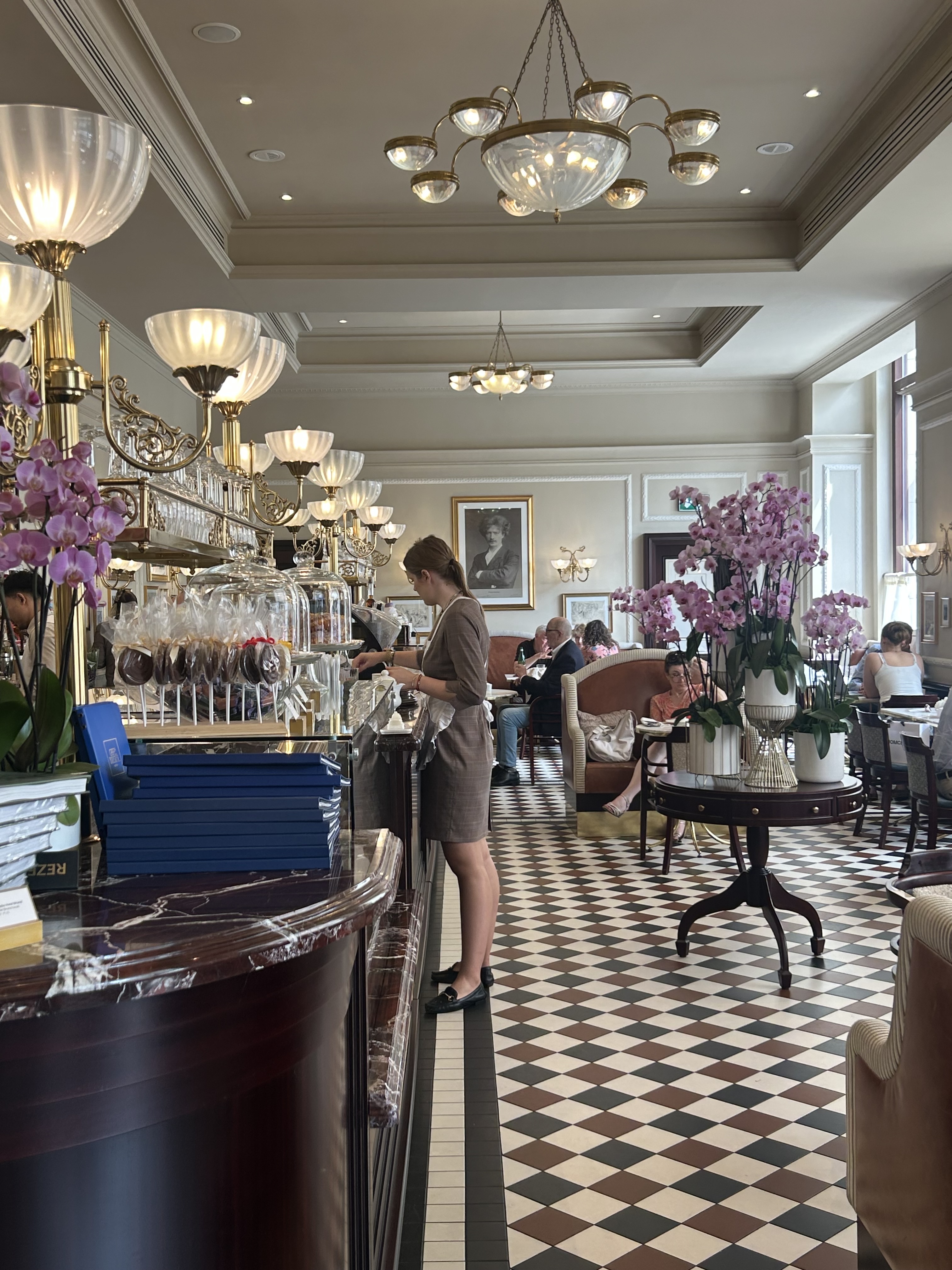
Cafe Bristol was “the place” to be seen in Warsaw during the interwar period. Artists, writers and politicians, women in bell-shaped cloche hats and men in Homburgs, sipped vermouth and aperol spritzes. Then, German occupiers requisitioned the hotel during WWII. It fell under state control during the Communist Era, reserved mostly for party elites and foreigners. The hotel closed in 1981, after years of neglect. The 1989 fall of Communism launched reinvestment and restorations of Polish architectural gems that languished for decades. The Hotel Bristol, with its Viennese-style Cafe Bristol, was meticulously restored and re-opened in 1993. 

Upon entering the cafe, I noticed the black, copper and white tiled floors. Pressed glass chandeliers were suspended overhead like so many celestial bodies. We were guided to a table by a window, enveloped in natural light amid wood and marble furnishings. It proved the perfect perch to people watch as we dined. We indulged in Cafe Bristol Lattes, topped with real whipped cream, and Turkish-style, poached eggs with yogurt and harissa. We extended the experience by sharing a slice of kremowka  – cream cake – reasoning our planned miles of walking that day would justify the caloric intake. 

The food was excellent. The service was friendly and professional. The place was deeply evocative and STILL STANDING.

* Warsaw Ghetto Uprising was in 1943.

I invite you to follow my blog at: https://presenttime.blog/

Veteran’s Day: Soldiers, Known and Unknown

“When this war is over, I’ll travel to Poland, wrap my arms around my wife and daughter, and bring them home to Zaporizhzhia.” 

I caught a train from Krakow to Przemysl, near the Ukrainian border, to visit my paternal grandfather’s hometown. I never knew Wladyslaw Bielawa. What I did know of him was that he was a gentle, hardworking man of great faith, like my Dad. My purpose? Visit military cemeteries in this town straddling the San River. 

Przemysl, founded in the 8th century, is called “Little Lviv” with neoclassical and neogothic architecture associated with the Austro-Hungarian Empire. Przemysl has been invaded, occupied and burned by marauding armies over the centuries; it’s been rebuilt many times. Tatar hordes “passed through” in 1657, raping and pillaging. My sisters were teased in school for their “slanted eyes” — I suspect our family carries expressions of genetic material from Eurasia. For the record, I was the odd sister out, left-handed and with decidedly slantless eyes.

Guided by map and iPhone, with a just-in-case compass in my pocket, I passed tenement houses with intricate wrought iron balconies and decorative elements evoking nature and mythology. Some buildings were beautifully restored in pastel shades of green, pink and yellow. Others embodied a gray, haggard, communist look, presumably awaiting restoration.

I paused in the sanctuary of the Fransican Church. This holy place survived six fires over the last seven centuries. Austrian occupiers turned the church into a stable during the partitions.*  I noticed hints of past grandeur of the 1910 Scheinbach Synagogue, now an apartment building. The Germans turned this house of worship into a stable during WWII. I will write more about what I learned about Przemysl’s Jewish community in a subsequent post. Violating the holy places of Roman Catholics and Jews seemed the invaders’ heinous prerogative. 

I crossed the marketplace square and passed businesses and homes along Slowackiego Avenue, named for Juliusz Slawacki, a 19th century Polish Romantic poet. I found the cemetery, entered its arched gateway and walked past elaborately decorated civilian graves — All Saints Day was November 1st — en route to the military burial sites. I paused to read some of the names and was struck by the graves of little children that spanned the upper wall, dividing eternal resting spaces for civilians and soldiers. The little ones’ epitaphs mentioned Heaven gaining new angels.

I found WWI Austro-Hungarian soldiers graves under a canopy of trees as late autumn leaves fell around me. Worn by time, the crosses yielded no perceptible names. My grandfathers, as Polish subjects of the Austro-Hungarian Empire, were drafted in WWI to serve the Emperor’s military whims conceived in faraway Vienna.

WWI ended at the eleventh hour on the eleventh day in the eleventh month of 1918. Empires collapsed and new, independent countries, including Poland, Czechoslovakia and Hungary emerged from the rubble. Redefining borders sparked conflicts. I visited the graves of Poles who died in the Polish-Ukrainian War of 1918-1919. My paternal grandfather was among the ranks of Poles who fought Ukrainians over control of Eastern Galicia. Names like Jan, Przemyslaw and Mieczyzlaw were etched into the stones.

I visited the elaborate, walled necropolis of WWII German soldiers’ graves. There were no flowers, just stade elements in black, white and gray marking where the remains of an estimated four thousand German soldiers were buried. 

So many soldiers. So many buried as “unknown.”

I stopped in a cafe for a pot of black tea and a slice of Szarlotka, sampling the local variation on Poland’s ubiquitous and delicious apple cake. This version was “z beza” topped with meringue, something I first experienced in a Ukrainian cafe in Krakow. 

I arrived early and sat in the waiting area of  Przemysl’s railway station. Archduke Charles Louis christened the palace-like structure in 1860. It’s been beautifully restored with soaring ceilings, frescoes, and the occasional chandelier. The station has been a major transit hub for Ukrainians since Russia’s 2022 full-scale invasion. The Help Desk for Ukrainians was staffed on this Saturday night.

My train pulled into the station for boarding. My phone was nearly dead. The only proof of my ticket purchase would flicker off at any moment.  I asked my compartment-mates in Polish and English  if there were any plugs. It turned out they were Ukrainians. They got up to help look. With no plugs to be found, the forty-something man on my right — he had the longest eyelashes — pulled out a portable power bank from his backpack and handed it to me. I had no idea how far he was travelling (From Lviv? From Kyiv?) and didn’t want to deplete his source. He gently insisted. My phone quickly juiced up. I flashed my ticket with ease when the conductor came around.

“Where are you travelling?” I asked the man.

“I’m travelling from Zaporizhzhia,” he said in an Eastern-Ukrainian dialect that was hard for me to understand. 

Images of the war flashed in my mind. I’d read about Russian attacks on Zaporizhzhia. I remember it hosts a massive nuclear power plant.

Kateryna, our fellow compartment-mate, spontaneously helped further my communication with her compatriot. She’s Ukrainian and has been living in Poland with her daughter since before the full-scale war. She speaks Polish fluently.

“I’m on leave for two weeks,” the soldier said. “I’m visiting my wife and daughter Anastasia (Nasta). They’ve been living in Poznan.”

I noted his clothing was not at all military — no camouflage, no duffel bag. He was dressed all in black with a North Face hoodie and black sneakers. He  was a journalist before the war and, most recently, worked in marketing. He now shoots down lethal Russian drones over Zaporizhzhia. He said Russian troops were just outside of his city. 

I asked if his wife and daughter felt well-treated by Poles. This matters as my father was a war refugee in the U.S. Some Americans treated him kindly. Some were pretty horrible and demeaning, telling him to “go back to where you came from.” (If you know history, you know he had no “home” to return to.) The soldier confirmed that Nasta and her mom felt safe and welcomed in Poznan. Nasta evacuated to Poland at fifteen and is now eighteen. Her father proudly said she quickly learned Polish and is doing well academically at her high school.

I realized this soldier was tired. I thanked Kateryna and him for the conversation and settled in to write in my journal. My train neared Krakow’s main station. I quietly removed a fifty-zloty note from my wallet and, as I exited the compartment, handed it to the soldier, encouraging him to  “treat Nasta to ice cream, on me.”  I wished him safety. I wished victory for Ukraine.

I realized I never learned his name.

*Poland was partitioned three times over the course of its history. The third partition, by the Russian, Prussian and Austro-Hungarian Empires, lasted from 1795 to 1918. Poland was wiped off of the map.

I invite you to follow the Present Time Blog: https://presenttime.blog/

Parting Words: Traveler come. Enter under my leaves for a rest.

As my six weeks in Poland come to an end, I return to a country that has elected a convicted felon, misogynist, and xenophobe who lacks understanding of and allegiance to the U.S. Constitution. Sadly, Donald J. Trump “missed the lecture” on constitutional separation of powers while at Wharton.  I return to a country — that my Polish family and friends remind me — has its own complicated history of genocide against Native Americans and enslavement of Black people. And now, we’ve, again, elected an authoritarian.

I leave my beloved “second home” with its deep, rich, and, yes, complex history in Central Europe. If only Poland had been gifted with a peaceful spot on the world’s stage, like an isolated island somewhere in the Pacific. If only Poland had been spared aggressive neighbors seeking to subsume its land, its culture, and its people. The impacts endure, shaping the collective psyche.

This has been a treasured time of observing, connecting, and sampling from a vast menu of human experiences. I offer a few reflections below.

Observing:  My “Little Ones” this year were five, six and seven. What was different after two previous autumns of volunteering with Ukrainian children displaced to Poland by the Russian invasion? These children are now tri- or quadri-lingual, speaking Ukrainian, Russian (as was often spoken in Eastern Ukraine), Polish, and English. Beautiful Mia with the long brown hair and shy eyes found courage to speak up to help her classmates, translating for them in Ukrainian, when they didn’t understand a question in English. I will NEVER FORGET the little boy who remembered he was “from Ukraine” but has NO MEMORY of living there. This is what the war has taken from countless Ukrainian children whose fathers remain across the border, defending their homeland from Putin.

Connecting: I’m grateful to my cousin, Adam, for showing me our grandmother Ludwika’s Autograph Book, dating from World War I. This was a time when her Polish brothers were drafted to serve in the Austro-Hungarian Army in Serbia and Italy, while she and her mother were evacuated from Jaroslaw to Graz because of dangerous proximity to the Eastern Front. Reading entries with devotions to friendship in flowery script reminded me that my grandmother was once young and full of dreams. Elzbieta, writing on May 28, 1917, penned that my grandmother was a beloved friend possessing “countless dear hearts.”  How could grandmother have foreseen that war would return in twenty years? WWII took her freedom, her safety, her home, her three eldest children to the Reich as forced laborers, and her infant son who died of starvation. And yet, these losses did not break her spirit — she maintained her signature feistiness. 

Sampling:  You might think this is about food. Spending time in Poland is more about sampling the culture and taking the political temperature to the extent my language skills allow. I attended a Rosh Hashanah celebration at Krakow’s Jewish Community Center where friends introduced me to Sarah, the rabbi’s wife. She and her family relocated to Poland from Israel. She said that people in Israel questioned their decision to move to Poland. She told me, “We feel safe here. There is a growing community here with so many families and children.” I also attended a Palestinian Film Festival to see Basel Adra’s No Other Land. The cinema was filled to capacity for the screening and post-film discussion. Watching documentary footage of West Bank Palestinian homes destroyed by bulldozers was a visual gut punch. Learning from past experience, I proactively purchased tickets to weekly Poetry Salons at Teatr Stary (The Old Theater). These sold-out poetry recitations by professional actors and/or theater students feature dramatic interpretations of Poland’s best bards. A phrase that will remain with me is from Jan Kochanowski’s (1530-1584) poem Na Lipę (The Linden Tree): “Gościu, siądź pod mym liściem, a odpoczni sobie.” “Traveler, come. Enter under my leaves for a rest.”

I arrived in Poland when leaves were just beginning their slow transformation to autumn hues. Greens shifted to deep reds of macintosh apples and shimmering golds of sunsets on the Vistula. This morning, bronze leaves crunched underfoot as I made my way from my flat to a favored writing space on Bracka Street. I leave tomorrow, my heart filled with gratitude for this time, these people, this place. 

I am gathering my hopes like so many shells from Poland’s Jelitkowo Beach on the Baltic, mustering courage for what lies ahead. I pray for a just peace in Ukraine. I pray for a just peace in the Middle East. I pray for a just United States. I pray for a just world.

I invite you to follow my blog at https://presenttime.blog/
Migration: Here, There, Everywhere

The April 4, 1949 edition of the Boston Daily Globe printed a small article on page seven: “D.P. Ship Here Tomorrow Morning.” My father, Mieczyslaw Bielawa, a survivor of inhumane Nazi forced labor camps, was on board. He was taken from his family by the Germans when he was sixteen, liberated by Americans at twenty, and arrived in Boston at twenty-four following a stint working for the American military in postwar occupied Germany. 

Dad made the two-week, transatlantic crossing from Bremerhaven, Germany, aboard the Marine Flasher. The ship carried 543 war survivors, mostly from Eastern Europe, who awaited a new and uncertain future in the West after their homelands fell to communism. Some Americans welcomed and helped the refugees find their footing. Others opposed the influx. Worse yet, some turned DP (Displaced Person) into a slur. My father was called this on more than one occasion when he settled in Peabody, Massachusetts. He was told to “Go home” even though shifted borders meant “home” no longer existed.

I carry this story in my heart as I read about Europe’s migrant crisis. The sheer volume of migrants seeking refuge — from political instability, war, and the ravages of climate change — presses up against the borders of the European Union with increasing intensity. We read about the tragedies at sea of overloaded, unsteady boats trying to reach Europe from Africa. Desperate migrants attempt to swim from “The Jungle” in Calais, France — a former landfill turned into a migrant encampment — across the English Channel.

And what are we seeing? England proposed an ill-fated plan to relocate migrants to Rwanda amid a surge in right-wing, anti-immigrant rancor. Italy’s Prime Minister Giorgia Meloni launched an effort to divert migrants to Albania and was overruled by the Italian judiciary. Ireland’s Ross Lake House Hostel in Rosscahill, County Galway, was torched by arsonists in December 2023 as it was being renovated to house seventy asylum seekers. Denmark is, literally, DEMOLISHING affordable housing estates to dismantle so-called “parallel societies”—ethnic enclaves where immigrants are not learning Danish and are not engaging in Danish society.  France’s recently re-elected government, in a nod to a burgeoning far-right, agreed to target illegal immigration. Germany reintroduced document checks at all land crossings with Poland in October 2023. Disaffected youth from migrant communities are readily accessible targets for  those seeking to radicalize them. What matters if you think you have nothing to lose?

Russia and Belarus are pariahs in the neighborhood that is Europe. They conspire to destabilize the EU via espionage, economics, social media and, sadly, exploitation of the global migrant crisis. Finland’s and Poland’s national borders with Russia and Belarus carry the added responsibility of being EU access points. Russia and Belarus are exploiting migrants in an attempt to undermine border security with human beings.

Finland, an EU member since 1995 and a NATO member since 2023, shares an 830-mile border with Russia. Finland accused Russia of weaponizing migration by luring migrants, largely from the Middle East and Africa, to Russia and then transporting them to the Finnish border to attempt illegal crossings. Russia drives them towards the border and provides bicycles for the last leg. Finland’s Parliament took an extraordinary and questionable step: They passed a law on July 12, 2024, closing all border crossings with Russia and temporarily suspending asylum requests. Human rights activists sounded the alarm. The border remains closed.

Poland, an EU member since 2004 and a NATO member since 1999, shares a 258-mile border with Belarus. Poland accused Belarus of engaging in hybrid warfare at the expense of desperate migrants. Belarus’ Belavia Airlines partnered with Turkish Airlines to increase flights from Istanbul to Minsk from where migrants were bussed to the Polish border. The Turkish government originally denied complicity; they have since begun cooperating with Poland to limit such flights. Poland’s centrist Prime Minister Donald Tusk, recently announced that Poland—taking a page from Finland’s playbook—intends to temporarily suspend asylum requests with a plan to create integration centers across the country and further fortify the border to discourage those who would seek illegal entry. Poland currently hosts approximately 1,000,000 Ukrainian war refugees and can apply lessons learned from integration efforts.

“Pushbacks”—harmful, deadly and inhumane—occur at the Russian-Finnish and Belarus-Polish Borders. Russian and Belarusian border guards literally “push” migrants toward the Finnish and Polish borders. Finnish and Polish border guards literally “push” migrants back. This back and forth is demoralizing and dangerous. Some humanitarian aid reaches migrants via volunteers as in the case of Poland’s Grupa Granica  (https://www.facebook.com/grupagranica/?locale=pl_PL). Agnieszka Holland’s film Green Border (https://www.rottentomatoes.com/m/green_border) is a difficult but important film. It pains me to think of humans treated in this way. I am reminded of my own country’s legacy of slavery of inhumane treatment of Native Americans and Black people. 

My mind returns to that refugee ship that arrived in Boston in 1949. Massachusetts prides itself on a perceived history of liberal values. The state enacted our nation’s first “right to shelter” law in 1983, guaranteeing shelter for all homeless families and pregnant women. 

Texas Governor Greg Abbott, embracing a variation on Russian and Belarusian tactics, flew approximately 50 migrants to Martha’s Vineyard in May 2022 depositing them, unannounced, at the airport. The community rallied around the group. 

More immigrants began arriving in Massachusetts, with one-way travel paid for by the states of Texas and Florida. Public sentiment has since shifted. The international arrivals hall at Boston’s Logan Airport became an impromptu shelter for migrants until it was disbanded in July 2024. Massachusetts’ Democratic Governor Maura Healey dispatched representatives to the U.S.-Mexico Border to convey the message that the states’ emergency shelter system is at capacity. The Boston Globe reported on the impact on public schools as more ESL teachers and supports are needed. 

Anti-immigrant rhetoric in the U.S. is fueled by increasing economic disparity. Tensions are rising as some in Massachusetts raise the nativist flag asking why new arrivals are housed while so many locals remain homeless. Donald Trump and JD Vance disperse the embers of this vitriol to fuel raging fires along the campaign trail across the country.

As the child of refugees, my knee-jerk reaction has always been to support immigrants. As a thinking person, I realize the unsustainability of current responses. Humans with hopes, dreams and aspirations like you and me are suffering. This prompted me to research possible, evidence-based solutions to tackle poverty on a country-by-country level.

The United Nations 17 Sustainability Goals offer a blueprint with opportunities to advance this initiative:

End PovertyClean and Affordable EnergyClimate Action
End HungerDecent Work and Economic GrowthLife Below Water
HealthcareIndustry, Innovation and InfrastructureLife on Land
EducationReduced InequalityPeace, Justice and Strong Institutions
Gender EqualitySustainable CommunitiesPartnerships
Clean WaterResponsible Consumption and Production

You can read the full report here: https://www.un.org/sustainabledevelopment/sustainable-development-goals/

The question remains: Do we have the COLLECTIVE WILL to make the necessary sacrifices and investments to achieve these goals? I certainly hope so.

Sources and to learn more:

https://freshfrompoland.com/project/gapinski-kubiak-jungle

https://www.bbc.com/news/uk-33584706

https://nonprofitquarterly.org/massachusetts-governor-halts-decades-old-right-to-shelter-for-homeless-families/

https://apnews.com/article/france-migrants-government-barnier-macron-far-right-3242a5dbf366bb7fbc7ba050700c9571

https://www.aljazeera.com/news/2024/7/12/finland-passes-law-to-block-asylum-seekers-crossing-from-russia

https://anfenglishmobile.com/news/eu-migrants-transported-from-istanbul-to-minsk-in-cooperation-with-turkish-airlines-56153

https://www.politico.eu/article/poland-donald-tusk-asylum-right-border-migration-belarus-russia-hybrid-war-eu/

https://edition.cnn.com/2024/07/09/us/boston-logan-airport-migrants-cec/index.html

https://www.bostonglobe.com/2024/10/24/metro/massachusetts-west-springfield-school-migrants-immigration/?p1=BGSearch_Advanced_Results

https://www.bostonglobe.com/2024/08/15/metro/saugus-migrant-students-warning/?p1=BGSearch_Advanced_Results
Image:  https://sousamendesfoundation.org/ships/marine-flasher

I invite you to follow my blog: https://presenttime.blog