
Still Standing: An Enduring Warsaw Cafe

It was a sunny, breezy morning in Warsaw. The Heat Dome which would soon engulf Central Europe in steamy, perspiring heat had not yet arrived. Our brunch reservation was at 11:00. This was a brunch at a special hotel, delayed six years by the COVID-19 Pandemic.

True to form, I woke early, showered, dressed and emerged from our hotel on Grzybowska Street. My departure cleared a path to the one bathroom shared with my sister Chris and her fashion-attentive son who is entering his senior year of college. I’m a bit more “wash and wear.” Joseph met us in Warsaw after completing a semester abroad at FAMU, the renowned film school in Prague. 

Walking Warsaw’s streets along with Monday morning commuters, I was struck by the youth, the pace, and the sartorial displays. Young women with perfect hair and subtle make-up navigated sidewalks in sleek ensembles; young men sported fine shoes and crisp, collared shirts. These young professionals were accessorized with ear buds and the occasional, tasteful tattoo. Middle-aged folks like me were trying to keep up — appearances and momentum. I suspect my “sensible shoes” stuck out, just a little.

It seems impossible to believe that this vast, beautiful, tree-lined city, with Paris-like boulevards and stunning architecture was reduced to rubble and ash in WWII. By war’s end, German forces leveled the city, leaving approximately 85% of this Central European capital city destroyed. (Comparison: Approximately 20% to 30% of London was damaged or destroyed during the Blitz.) Ninety percent of Warsaw’s historical monuments and 100% of its bridges were destroyed. 

Warsaw’s pre-war population was 1.3 million in 1938. It’s estimated that 700,000 to 800,000 residents died during WWII. This represents a range of 53.8% to 61% loss of life in the capital city. Jews comprised an estimated 10% of Warsaw’s pre-war population

Thousands upon thousands of Varsovians – including those who participated in the Warsaw Uprising of 1944*, the single largest military effort by a European resistance movement during World War II – lay buried in the rubble. Unlike Berlin, there would be no Marshall Plan money from the United States to assist in rebuilding. Poles paid a tax on every single box of matches sold in the country, for decades, to pay to rebuild their capital city. Areas of the city were referred to as Dziki Zachod – the Wild West – into the 1960s as rebuilding continued.

What if our capital, Washington, DC, was reduced to rubble? Imagine the majestic Lincoln Memorial a battered, incongruous heap of granite and marble. Think of the vast holdings of the Smithsonian. Picture the 45.52-carat Hope Diamond or the Napoleon Diamond Necklace, scattered in pieces amid broken glass with security alarms screeching — and looted by an invading army? Warsaw lost its people;  its cultural treasures; and its basic infrastructure of roads, bridges, heat, hot water and sewage. All had to be rebuilt in a truly Herculean effort.

I scoped out our brunch meeting place with time on my hands. I entered the vestibule of the nearby Visitation Sisters’ Church of St. Joseph intent on quiet meditation. The original wooden church, dating from 1660, was replaced by a stone structure, with Baroque and Rococo elements, completed in 1763. I heard the sound of a vacuum and noted a layperson at work inside. The sanctuary was closed. It was Cleaning Day.  

That’s when I found the Secret Garden. An adjacent doorway attached to the church revealed a serene, walled oasis, sans the hum of the city. I passed the cream colored klasztor – convent – built in 1654, flanked by creamy white roses and sculpted bushes. The resident cat, a gray tabby with amber eyes, followed me around before disappearing in the undergrowth. I was treated to mini-daisies, beautiful purple berries I could not identify, and a vegetable garden with three long rows of tomato plants. A bench under a larch tree invited visitors to sit. I walked deeper into the garden, passing an open window from which emanated a radio broadcast. Small ornaments made of stained glass — a ladybug, a religious image of Our Lady – were suspended on an upstairs window. I didn’t see a single nun. Did they notice me, I wondered? 

I hold in my heart a fond memory of staying with cloistered, Benedictine nuns in Warsaw in 1985. We communicated via hand-written notes on a Lazy Susan in our guest room. I learned then that these nuns shut themselves away FROM the world in order to focus on praying FOR the world.

My sister met me for our brunch reservation at the very elegant Cafe Bristol. Joseph overslept, as a young person might do. I have a “thing” for luxurious breakfasts and brunches at fancy hotels. It’s a way to experience the glitz and glamour without a hefty room charge.

Why the Bristol Hotel? This Art Nouveau hotel with Viennese interiors, co-founded in 1901 by Polish pianist and statesman Jan Paderewski, survived World War 1 and World War II INTACT. This makes its existence a small miracle in Warsaw.

Cafe Bristol was “the place” to be seen in Warsaw during the interwar period. Artists, writers and politicians, women in bell-shaped cloche hats and men in Homburgs, sipped vermouth and aperol spritzes. Then, German occupiers requisitioned the hotel during WWII. It fell under state control during the Communist Era, reserved mostly for party elites and foreigners. The hotel closed in 1981, after years of neglect. The 1989 fall of Communism launched reinvestment and restorations of Polish architectural gems that languished for decades. The Hotel Bristol, with its Viennese-style Cafe Bristol, was meticulously restored and re-opened in 1993. 

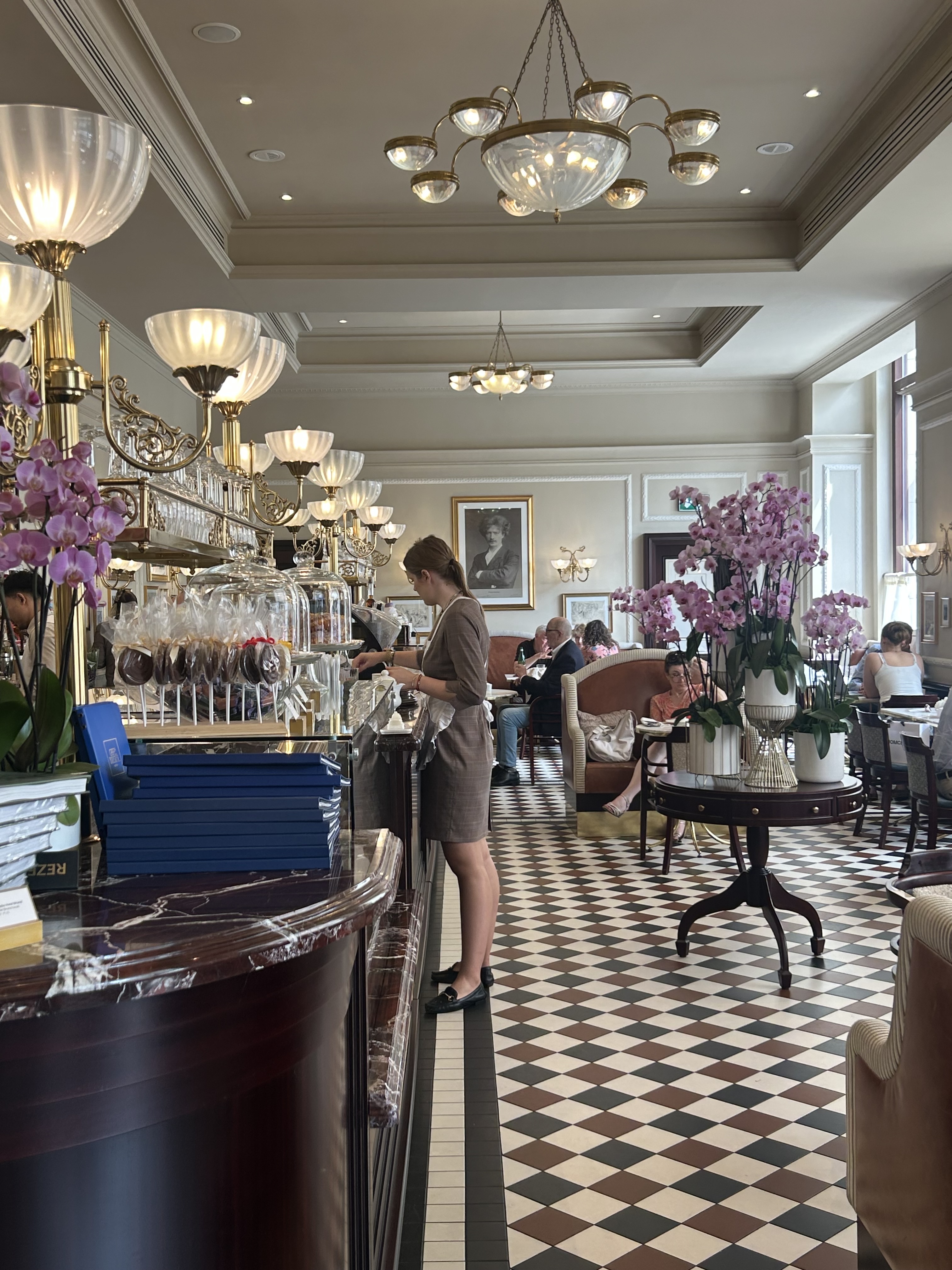
Upon entering the cafe, I noticed the black, copper and white tiled floors. Pressed glass chandeliers were suspended overhead like so many celestial bodies. We were guided to a table by a window, enveloped in natural light amid wood and marble furnishings. It proved the perfect perch to people watch as we dined. We indulged in Cafe Bristol Lattes, topped with real whipped cream, and Turkish-style, poached eggs with yogurt and harissa. We extended the experience by sharing a slice of kremowka  – cream cake – reasoning our planned miles of walking that day would justify the caloric intake. 

The food was excellent. The service was friendly and professional. The place was deeply evocative and STILL STANDING.

* Warsaw Ghetto Uprising was in 1943.

I invite you to follow my blog at: https://presenttime.blog/

Veteran’s Day: Soldiers, Known and Unknown

“When this war is over, I’ll travel to Poland, wrap my arms around my wife and daughter, and bring them home to Zaporizhzhia.” 

I caught a train from Krakow to Przemysl, near the Ukrainian border, to visit my paternal grandfather’s hometown. I never knew Wladyslaw Bielawa. What I did know of him was that he was a gentle, hardworking man of great faith, like my Dad. My purpose? Visit military cemeteries in this town straddling the San River. 

Przemysl, founded in the 8th century, is called “Little Lviv” with neoclassical and neogothic architecture associated with the Austro-Hungarian Empire. Przemysl has been invaded, occupied and burned by marauding armies over the centuries; it’s been rebuilt many times. Tatar hordes “passed through” in 1657, raping and pillaging. My sisters were teased in school for their “slanted eyes” — I suspect our family carries expressions of genetic material from Eurasia. For the record, I was the odd sister out, left-handed and with decidedly slantless eyes.

Guided by map and iPhone, with a just-in-case compass in my pocket, I passed tenement houses with intricate wrought iron balconies and decorative elements evoking nature and mythology. Some buildings were beautifully restored in pastel shades of green, pink and yellow. Others embodied a gray, haggard, communist look, presumably awaiting restoration.

I paused in the sanctuary of the Fransican Church. This holy place survived six fires over the last seven centuries. Austrian occupiers turned the church into a stable during the partitions.*  I noticed hints of past grandeur of the 1910 Scheinbach Synagogue, now an apartment building. The Germans turned this house of worship into a stable during WWII. I will write more about what I learned about Przemysl’s Jewish community in a subsequent post. Violating the holy places of Roman Catholics and Jews seemed the invaders’ heinous prerogative. 

I crossed the marketplace square and passed businesses and homes along Slowackiego Avenue, named for Juliusz Slawacki, a 19th century Polish Romantic poet. I found the cemetery, entered its arched gateway and walked past elaborately decorated civilian graves — All Saints Day was November 1st — en route to the military burial sites. I paused to read some of the names and was struck by the graves of little children that spanned the upper wall, dividing eternal resting spaces for civilians and soldiers. The little ones’ epitaphs mentioned Heaven gaining new angels.

I found WWI Austro-Hungarian soldiers graves under a canopy of trees as late autumn leaves fell around me. Worn by time, the crosses yielded no perceptible names. My grandfathers, as Polish subjects of the Austro-Hungarian Empire, were drafted in WWI to serve the Emperor’s military whims conceived in faraway Vienna.

WWI ended at the eleventh hour on the eleventh day in the eleventh month of 1918. Empires collapsed and new, independent countries, including Poland, Czechoslovakia and Hungary emerged from the rubble. Redefining borders sparked conflicts. I visited the graves of Poles who died in the Polish-Ukrainian War of 1918-1919. My paternal grandfather was among the ranks of Poles who fought Ukrainians over control of Eastern Galicia. Names like Jan, Przemyslaw and Mieczyzlaw were etched into the stones.

I visited the elaborate, walled necropolis of WWII German soldiers’ graves. There were no flowers, just stade elements in black, white and gray marking where the remains of an estimated four thousand German soldiers were buried. 

So many soldiers. So many buried as “unknown.”

I stopped in a cafe for a pot of black tea and a slice of Szarlotka, sampling the local variation on Poland’s ubiquitous and delicious apple cake. This version was “z beza” topped with meringue, something I first experienced in a Ukrainian cafe in Krakow. 

I arrived early and sat in the waiting area of  Przemysl’s railway station. Archduke Charles Louis christened the palace-like structure in 1860. It’s been beautifully restored with soaring ceilings, frescoes, and the occasional chandelier. The station has been a major transit hub for Ukrainians since Russia’s 2022 full-scale invasion. The Help Desk for Ukrainians was staffed on this Saturday night.

My train pulled into the station for boarding. My phone was nearly dead. The only proof of my ticket purchase would flicker off at any moment.  I asked my compartment-mates in Polish and English  if there were any plugs. It turned out they were Ukrainians. They got up to help look. With no plugs to be found, the forty-something man on my right — he had the longest eyelashes — pulled out a portable power bank from his backpack and handed it to me. I had no idea how far he was travelling (From Lviv? From Kyiv?) and didn’t want to deplete his source. He gently insisted. My phone quickly juiced up. I flashed my ticket with ease when the conductor came around.

“Where are you travelling?” I asked the man.

“I’m travelling from Zaporizhzhia,” he said in an Eastern-Ukrainian dialect that was hard for me to understand. 

Images of the war flashed in my mind. I’d read about Russian attacks on Zaporizhzhia. I remember it hosts a massive nuclear power plant.

Kateryna, our fellow compartment-mate, spontaneously helped further my communication with her compatriot. She’s Ukrainian and has been living in Poland with her daughter since before the full-scale war. She speaks Polish fluently.

“I’m on leave for two weeks,” the soldier said. “I’m visiting my wife and daughter Anastasia (Nasta). They’ve been living in Poznan.”

I noted his clothing was not at all military — no camouflage, no duffel bag. He was dressed all in black with a North Face hoodie and black sneakers. He  was a journalist before the war and, most recently, worked in marketing. He now shoots down lethal Russian drones over Zaporizhzhia. He said Russian troops were just outside of his city. 

I asked if his wife and daughter felt well-treated by Poles. This matters as my father was a war refugee in the U.S. Some Americans treated him kindly. Some were pretty horrible and demeaning, telling him to “go back to where you came from.” (If you know history, you know he had no “home” to return to.) The soldier confirmed that Nasta and her mom felt safe and welcomed in Poznan. Nasta evacuated to Poland at fifteen and is now eighteen. Her father proudly said she quickly learned Polish and is doing well academically at her high school.

I realized this soldier was tired. I thanked Kateryna and him for the conversation and settled in to write in my journal. My train neared Krakow’s main station. I quietly removed a fifty-zloty note from my wallet and, as I exited the compartment, handed it to the soldier, encouraging him to  “treat Nasta to ice cream, on me.”  I wished him safety. I wished victory for Ukraine.

I realized I never learned his name.

*Poland was partitioned three times over the course of its history. The third partition, by the Russian, Prussian and Austro-Hungarian Empires, lasted from 1795 to 1918. Poland was wiped off of the map.

I invite you to follow the Present Time Blog: https://presenttime.blog/

Note from Vienna


Aloisia commissioned the artwork in her husband Franz’s memory in 1906. The mosaic, depicting St. Jerome holding a cross and skull, is one of several adorning the exterior of the St. Anthony of Padua Church in the Favoriten DIstrict of Vienna. I wondered about Aloisia and Franz and their lives in Vienna as subjects of the Austro-Hungarian Empire. I loved how the mosaic serves as an enduring representation of their love.

Franz Joseph 1 (1830-1916), Emperor of Austria and King of Hungary, laid the corner stone of St. Anthony’s on November 10, 1896. The massive Romanesque and Byzantine church was created to meet the demand of a burgeoning Roman Catholic population. There were marriages to consecrate, babies to baptize, and funerals to commemorate lives lived. I stood outside taking in the soaring towers, arched windows and raised dome of the red brick edifice.

I chose to stay in the Favoriten District of Vienna for its proximity to the main train station and walkability to the city center. I booked a room at the newly renovated Boutique Hotel Kolbeck, noted for being friendly to solo travelers. I’ve learned—from my mistakes—to scrupulously study reviews of accommodations, inserting words like “clean” and “quiet” into search tools. My room was, indeed, clean and quiet with crisp sheets and a pristine private bathroom. My space was small, reminiscent of a single in a dorm. It suited me just fine as I was only there to sleep. My window overlooked an inner courtyard. 

The five-hour train from Katowice, Poland, chugged through the Czech Republic and skimmed near the Hungarian border before depositing me in Vienna. The largely agrarian landscape hosted occasional solar arrays and wind farms, reminders of the need to seek alternative energy as the region recovers from Storm Boris. 

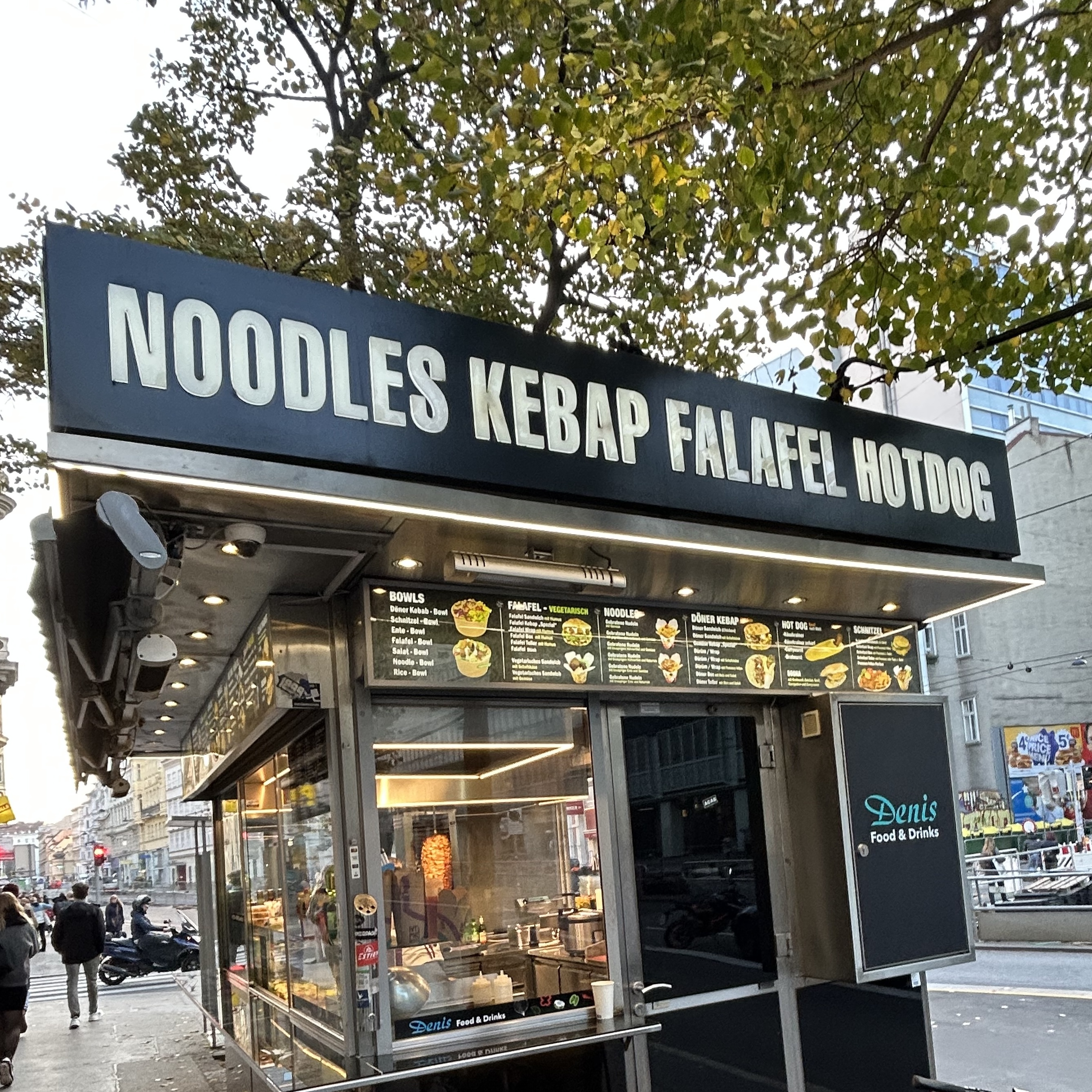
Arriving in Vienna in late afternoon, I ditched my luggage and set out in search of dinner and familiarity—on foot. The pedestrian way along Favoriten Street was bustling. Packs of high schoolers carried backpacks and ate kaiser pommes (french fries) doused with mayonnaise or ketchup. Toddlers played on the plaza under the watchful eyes of their mothers. The neighborhood evoked a familiar, working class vibe, with practical shops dispensing kitchen utensils, linens, and hosiery. I noticed many women wearing hijabs as I walked past Halal butchers and grocery stores. A food kiosk boldly advertised “Noodle – Kebap- Falafel – Hotdog” in a nod to diversity.  Men sat at outdoor cafes sipping tiny cups of coffee or glasses of hot tea. So many of them smoked. The smoke triggered a headache, thankfully cured by Advil in my backpack. I heard lots of German and Arabic with smatterings of English, Polish and Ukrainian. 

It was on this walk the I happened upon St. Anthony’s. Its spires caught my eye, peripherally, as I walked along Favoriten Street. I chose to detour.  A young boy was shooting baskets with his father on a court adjacent to the church. A group of teens sat outside on a bench, smoking. A woman left the church and I noted graffiti on the door as it closed. The massive entrance doors were locked due to the late hour. Signs advised visitors to not smoke, eat, or skateboard along the entryway.

I circled the building, snapping photos of its external mosaics peering down from above. This is how I found Aloisia and Franz. Graffiti, in German and Arabic encircled the exterior of the church. For the record, I am not a fan of graffiti. Encountering it on a place of worship is particularly troubling to me.

Later that evening, I conducted some research. I learned St. Anthony’s was vandalized with spray-painted statements including “Islam will win” and “religion over secular life.” Additionally, fifty youths broke into the sanctuary in October 2020, shouting “Allahu Akbar” (“God is the greatest”). This occurred shortly after the murder of teacher Samuel Paty in France. I further learned there has been an uptick in graffiti targeting Vienna’s Muslim, Jewish and Christian houses of worship since the October 7, 2023 Hamas attack on Israel.

So, what are peace-seeking people to do? The website for St. Anthony’s cites a kindergarten open to and respectful of all children of varying faiths, a weekly flea market and free community meal, a meet-up for seniors every Sunday at 3:00 p.m. and, of course, Masses—in German, Polish and English, the latter for African congregants.

Here’s to the peace-seekers, the bridge-builders, and the enduring legacy of love.

Sources:   https://at.usembassy.gov/wp-content/uploads/sites/70/2020/12/2023-Report-on-International-Religious-Freedom-in-Austria.pdf, https://www.intoleranceagainstchristians.eu/index.php?id=12&case=8021

I invite you to follow my blog: https://presenttime.blog

What would George think?


I slid open the wooden drawer of the university library’s card catalog to thumb through weathered index cards bearing authors’ names, titles of their works, and call numbers. I searched for a particular mid-alphabet author. Somewhere between Okolski, Szymon and Orzeszkowa, Eliza, I found what I was looking for:  Orwell, George (1903-1950), 1984. This listing contained a subtle warning: Access requires permission from faculty. 

It was 1984. I was studying on exchange in Communist Poland at Krakow’s Jagiellonian University. Soviet-style repression—limiting freedom of movement, freedom of expression, freedom to gather, and freedom to read books censored by the government—like Orwell’s—defined the confining parameters under which Poles lived. 

To seek permission from a professor to read a censored book could bring one under suspicion and, potentially, risk a highly-coveted place at the university. 

I arrived in Poland a few months before, a wet-behind-the-ears, novice traveler. At nineteen, I’d flown only twice before. I purchased a Boston to Brussels plane ticket and another ticket for a thirty-hour train to Warsaw. The last leg of the trip would be a three-hour express train from Warsaw to Krakow. I was young, excited and looking forward to the 60-hour, 4092-mile journey.

I purchased an enormous travel trunk. Ten months of clothing, shampoo, soap and deodorant were stuffed inside as I prepared for fall, winter and spring in a country where consumer goods were in short supply. I stupidly packed (heavy) books. My Mom commandeered part of my trunk, adding clothing, coffee, chocolate and Polish ham for me to bring to family. The irony of the last item: Polish ham was sent out for export to bring in cold, hard cash from the West. Ham was rarely available in Polish stores.

My carry-on luggage included sealed envelopes bearing names of family members containing hard-earned cash gifts from my parents. Amid shortages and rationing, the Communist government established special stores called Pewex that sold medicines, coffee, chocolate, calculators and appliances—items not readily available in shops. What was the hitch? You could only buy these items with foreign hard currencies like U.S. Dollars, West German Deutsche Marks, French Francs and British Pounds. What was the problem? Private ownership of hard currencies was forbidden by the government. This spawned an elaborate Czarny Rynek – Black Market of currency exchanges. I remembered my Aunt Jancia hid carefully folded dollars in a nondescript coffee can in her kitchen.

Landing in Brussels, I retrieved my enormous trunk from the conveyor belt. One of its four wheels went missing somewhere between Boston and Brussels. I spent the day DRAGGING my laden luggage around Brussels. Bumping along the cobbled Grand-Place square provided lots of “eye candy” for my sleep-deprived eyes. I remember ornate guild houses, the soaring Cathedral of St. Gudula, and Manneken Pis, the famed water fountain with a sculpture of a little boy peeing. 

I dragged my trunk and myself to Brussels’ Central Station for the thirty-hour train to Warsaw. I slept haphazardly, keeping half an eye on my trunk in the corridor – it was too large to fit in the compartment. 

Somehow, I landed at my Krakow dorm – Dom Studencki “Piast” at 47 Piastowska Street in Krakow. Directed to my room, I walked through the dimly lit corridor on the second floor and noticed two things: cloth baby diapers drying on an improvised clothesline in the hallway and the aroma of simmering soup.

I entered a new world, a Communist world. I learned. I listened. I observed.

My classroom lessons were complemented by learning to covertly trade dollars on the Black Market while mastering the art of securing a spot in long lines for rationed pieces of kielbasa and scratchy, gray and speckled toilet paper. I passed large images of Lenin and red-lettered banners around the city extolling the virtues of socialism and the ills of capitalism. I quietly gathered illegal, pro-Solidarity newsletters dispersed by the underground. A vicious political regime imprisoned dissenters. Soon after I arrived, secret police kidnapped and murdered Jerzy Popieluszko, an outspoken, pro-democracy Roman Catholic Priest.

Communist dogma espoused creation of a classless society. This was a lie. Soviet-imposed communism in Poland at the end of WWII created special privileges for those who agreed to a Faustian bargain, signing on to membership to the Communist Party. (Note: Poland had the lowest Communist Party membership within the Eastern Block.) These privileges included express lanes to securing job promotions, a telephone, a flat, or a humble Polski Fiat. Young married couples waited years for apartments and were forced to lived on the other side of the wall of their parents in their childhood bedrooms in drab Socialist Realist housing estates.

Orwell had Big Brother. Poles had “Uncle” – their reference to the Soviet Union and its interference in their lives. Poles were not fools. They learned navigate this unjust political and economic system via a vast subterranean world where people bartered for needed items in their kitchens, in dorm rooms, and via the trunks of their cars…if they had a car.  Words like załatwić and kombinować — references to “arranging for” hard-to-find items — entered the Polish lexicon. Poets, playwrights, artists, musicians and filmmakers plied their crafts, promoting pro-democracy ideas, engaging metaphor and symbolism, to push past censors.  

I decided to not request special permission to read Orwell’s book. I’d already read it in the U.S.  Forty years later, I am back in Krakow. It is 2024, not 1984. I recently stepped inside the Księgarnia pod Globusem bookstore on Długa Street and spotted Orwell’s book, in Polish. Who could have imagined?

Today, Poland is a parliamentary democracy with a growing economy. Poles voted out the right-wing Prawo i Sprawiedliwość (Law and Justice) ruling party in 2023, handing victory to the centrist Platforma Obywatelska (Civic Platform). Poland is experiencing slow but steady cultural shifts that are more aligned with western Europe. 

Poland opened its borders to millions of Ukrainians seeking refuge from Russia’s full-scale invasion of Ukraine in February 2022. Today, Ukrainian is commonly heard on the streets and in shops. Poland’s response reflects compassion for human suffering in spite of complicated Polish-Ukrainian history. I suspect another factor is at play. Polish collective memory is marked by a deep, visceral trauma and awareness of Russian and, later, Soviet occupations, deportations, subjugations, displacements and murder of its people at the hands of its neighbor to the East. 

As in 1984, I am here to learn, listen and observe, clear-eyed and with an awareness of the history of this beautiful, resilient, and complicated place that I love. I wonder what George would think.

What’s up next in the Present TIme Blog? I’ll offer a look at Poland’s response to Europe’s migrant crisis as Polish Prime Minister Donald Tusk takes a page from Finland’s controversial playbook for managing the Russo-Finnish Border. Stay tuned.

I invite you to follow the Present Time Blog: https://presenttime.blog