
Ration cards and long lines were part of daily life when I studied in Poland in the mid-1980s. I was a meat eater then. I recall waiting in a long line–ration card in hand–as strips of unrefrigerated kielbasa, suspended from hooks on the wall, grew smaller and smaller. When it was my turn, there was no meat left.
Toilet paper—even the scratchy, communist, gray version–was a hot commodity. I tell my students at the Community College of Vermont about standing in line for ninety minutes for twelve rolls of toilet paper. I felt so lucky as I walked back to my residence hall, adorned in a “necklace” of twelve rolls tied up with string. People stopped me on the street to ask, “Gdzie?” (“Where?”) I readily shared the shop’s location. People understood that, even with quantity limits, there was no guarantee that this highly-valued bathroom commodity would be available.
I suspect the communist regime reasoned that people preoccupied with securing scarce items needed for daily living were less likely to plot a revolution. Poland was the first country to overthrow communism in August 1989. Their fellow communist neighbors watched and, when Moscow didn’t send in tanks, they, too, took the risk to win freedom. The Berlin Wall came down in October 1989. Czechoslovakia’s “Velvet Revolution” occurred in November 1989.
There were foods we could count on in communist Poland: bread, cheese, pastries and zapiekanki—a Polish street food. Join me on this trip down a culinary memory lane!
Bread: For the record, Polish rye bread is really, really delicious, a thick, chewy balance of mild and tangy flavor. I remember large, brown, oblong loaves on store shelves handed out by (often grumpy) clerks wearing polyester smocks with matching head coverings. “Self-service” was a very limited concept in communist Poland–you had to wait in line and ask for items you wanted which were behind the counter. As an aside, this sometimes meant getting icky apples—the only “fresh fruit” available in winter—as your request for a half or whole kilogram was subject to the clerk’s choosing from among a bin. Occasionally, WHITE ROLLS or CHALLAH appeared. I remember snatching up challah and eating the entire, warm loaf on the way back to my dorm. Today, Poland offers quality ryes but also delicious baguettes, multi-grain and even gluten-free breads—and a professional, capitalist sense of “customer service.”
Cheese: Communist Poland presented two kinds of cheese: “yellow” and “white.” “Yellow” cheese came in large wheels covered in bright red wax, with a flavor reminiscent of a mild emmental. “White” cheese, twarog, is a tangy cheese that paired well with tomato, onion and a bit of butter on a thick slice of rye bread. Oscypek, a smoked goat cheese that is pressed into decorative forms, was and continues to be available from local, small-scale producers. I did hear, however, that the Czechs copyrighted the name—as the French did with “Champagne.” For now, I will call my favorite Polish cheese “oscypek.” Today, cheeses of numerous varieties and countries of origin are available. When in Poland, I still choose twarog over brie!
Pastries: Even though sugar was rationed for individuals, bakeries were plentiful. Chocolate was rationed and only for children–this precluded chocolate-infused treats. My favorite Polish pastries were slightly sweet, yeasty and filled with apples, plums or farmer’s cheese. These are readily available today, however, in upscale versions. Raisins, a rarity in communist Poland, enhance flavor. Sweet cheese is accented with a bit of lemon, again, once a rarity. There is much more focus on how food is presented today, matching standards of western Europe.
Zapiekanki: Street food wasn’t really a concept in communist Poland. Zapiekanki were an exception. Before there was “Italian Pizza” in Poland, there were zapiekanki. The communist government severely limited “private” enterprise. There was—and still is—a zapiekanka shop, “Zapiekanki u Hanki” at 3 Sienna Street, just off of Krakow’s medieval square. The shop, founded in 1980, makes these delicious, toasted, open-faced sandwiches of sauteed mushrooms and perfectly melted cheese, drizzled with ketchup. Today, customers can top their zapiekanki with ham or other meats. Numerous zapiekanki shops have opened in Krakow. Hanka’s are the best as my husband and daughter can attest from our “every few years” visits to Poland.
I recently stopped by Hanka’s shop for a zapiekanka. I placed my order and chatted with Hanka, explaining that I was a frequent customer in the 1980s and on intermittent visits to Krakow since that time. Another customer in the shop, an Asian woman, who studied in Krakow in the 1990s, spoke up, in flawless Polish, that she too was revisiting her favorite eatery while vacationing in Poland!”
“This happens all the time,” Hanka said. “People come back.”
I asked about what it was like during the Pandemic.
“We closed,” Hanka said. “All the shops closed. The government provided some financial assistance to help businesses. We were, eventually, allowed to re-open na wynos (for takeaway), but there was no foot traffic. There wasn’t even a pigeon on the square. Now, we are dealing with high inflation. We will see what the future holds.”
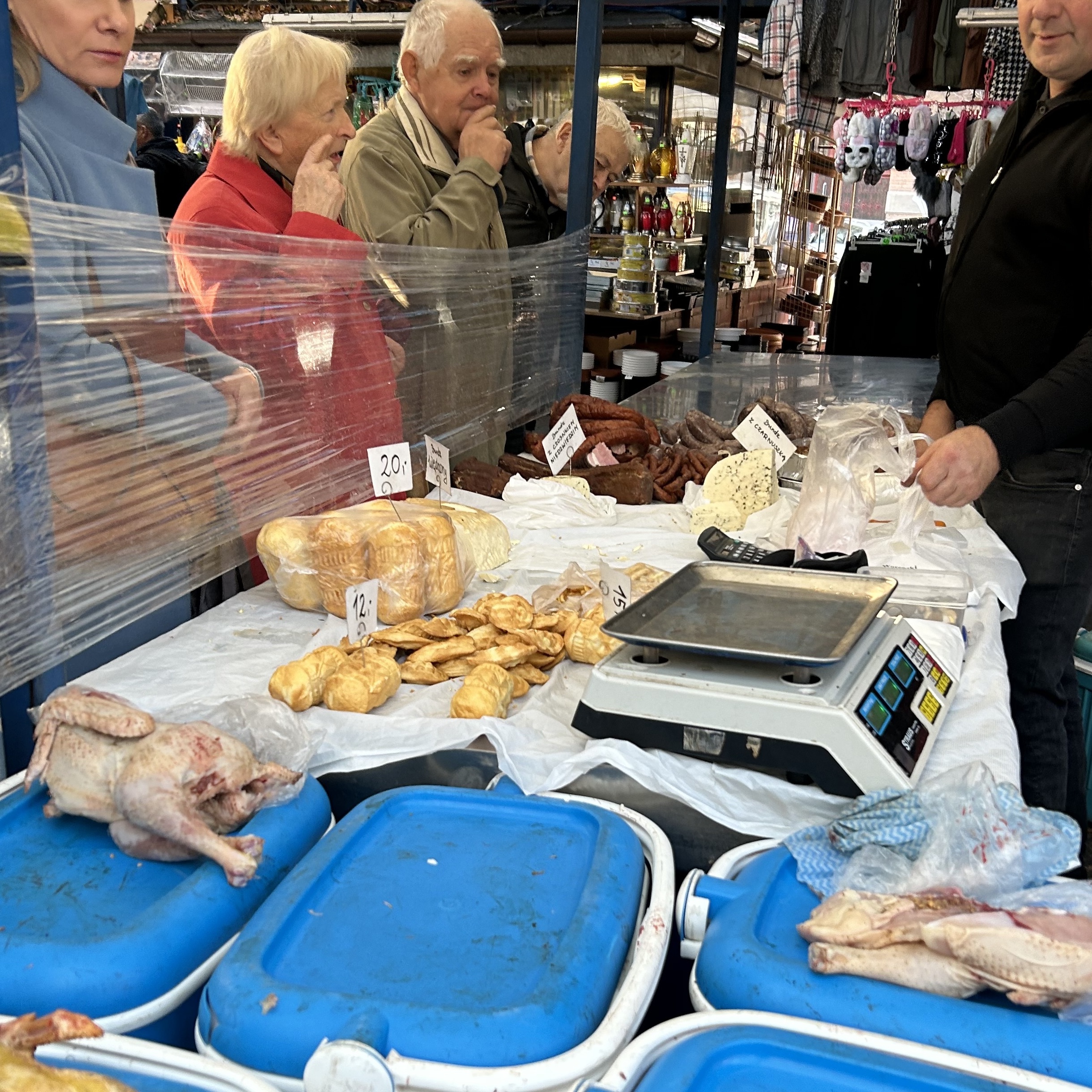
Photo: My favorite vendor at the Stary Kleparz Market, a local farmer who makes the best “Oscypek”—smoked goat cheese. People line up for his fresh chickens and kielbasa, too.
Thanks for reading. I invite you to follow my blog, Present Time, at https://presenttime.blog